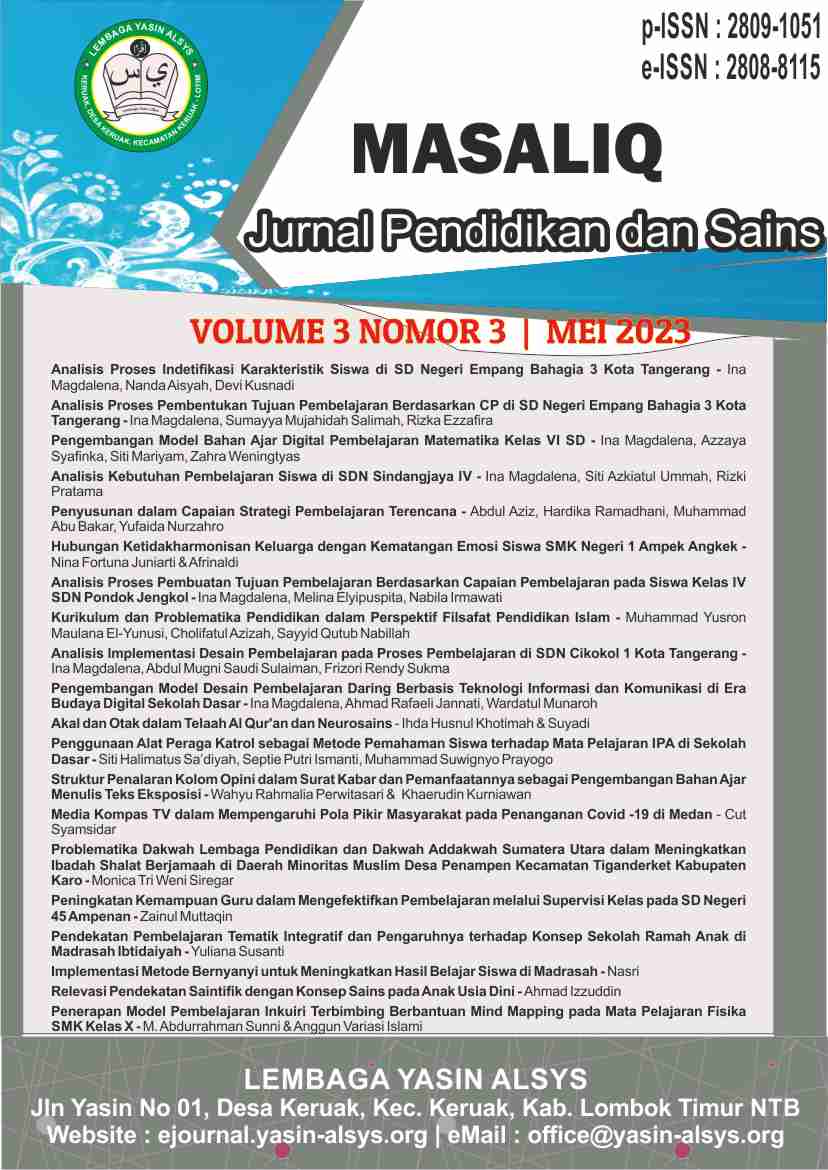
Kurikulum dan Problematika Pendidikan dalam Perspektif Filsafat Pendidikan Islam
Main Article Content
Abstract
In the view of Islamic Education Philosophy, the curriculum is created on the basis of what is contained in the Al-Qur'an and Hadith which mutually reinforce and strengthen. It is with these guidelines that we as humans obtain enlightenment and instructions to become leaders on earth and live a good life in this world and the hereafter, through a process, namely education primarily in Islamic education. Then, in Islamic education, this cannot be separated from the name of the curriculum, the existence of a curriculum is nothing but the birth of education that is knowledgeable, has character, and has skills. In addition to having an educational curriculum, besides that, there are also certain problems that must be faced, but this can also be used as evaluation material and further developed with good, Apart from support, education always goes smoothly but surely there are obstacles or problems that must be faced. Therefore education must really carried out as well as possible for the sake of creating a generation that is intellectual and behaves politely. So must be conveyed in a mature and relevant scientific substance.




Citation Metrics:




Downloads
Citation Metrics & Similar Scopus Articles
-
Ding S. (2027)Digital Renewal of University Education: Barriers, Opportunities, and Contributions to Sustainable Development Goals (SDGs)Asean Journal of Educational Research and Technology, 6(2), 229-240
-
Trisnowati E. (2027)Science, Technology, Engineering, and Mathematics (STEM) and Research Skill Development (RSD) in Science Education in Higher Education: A Delphi-Based ModelAsean Journal of Educational Research and Technology, 6(2), 253-268
-
Unyaphatariyakool S. (2027)Science Teachers’ Learning Management Competency through Professional Learning Communities to Promote Scientific Creativity and Sustainable Development Goals (SDGs)Asean Journal of Educational Research and Technology, 6(2), 241-252
Article Details

Authors retain copyright and grant the journal right of first publication with the work simultaneously licensed under a Creative Commons Attribution-NonCommercial-ShareAlike 4.0 International License that allows others to share the work with an acknowledgement of the work's authorship and initial publication in this journal.
Article Sidebar
 Page Numbers:
370-383
 Digital Object ID:













 Viewed: 1.075 times
 Downloaded: 754 times

LYAS Publisher cordially invites qualified professionals to serve as Editors or Reviewers. Your expertise will make an important contribution to maintaining and strengthening the academic quality of our publications. Interested applicants are kindly requested to complete the application form at the following link: Editors & Reviewers


Please feel free to contact us if you need any further information about the submission process or if you have any additional questions.

 Authors:
 Copyright :
Authors retain copyright and grant the journal right of first publication.
Explore Our Journals
Find the journal that best fits your research. If this journal does not match your manuscript’s scope, explore our portfolio below to select a more suitable publication venue.