
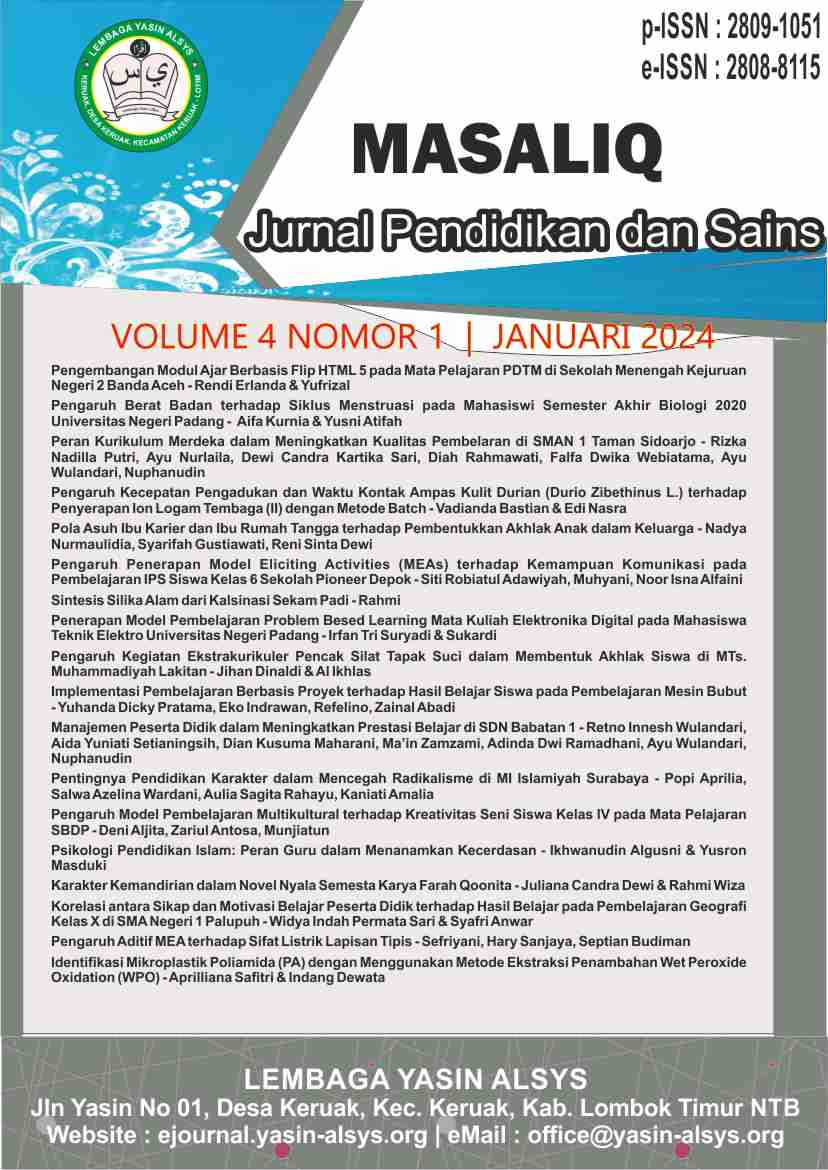
Pola Asuh Ibu Karier dan Ibu Rumah Tangga terhadap Pembentukkan Akhlak Anak dalam Keluarga The Influence of Career and Homemaker Mothers' Parenting Styles on the Formation of Children's Morality in the Family

Article Sidebar
 Page Numbers:
37-49
Page Numbers:
37-49
 Digital Object Identifier:


 Viewed: 537 times
 Downloaded: 468 times












LYAS Publisher cordially invites qualified professionals to serve as Editors or Reviewers. Your expertise will make an important contribution to maintaining and strengthening the academic quality of our publications. Interested applicants are kindly requested to complete the application form at the following link: Editors & Reviewers


Please feel free to contact us if you need any further information about the submission process or if you have any additional questions.

 Authors:
Nadya Nurmaulidia1, Syarifah Gustiawati2, Reni Sinta Dewi3
 Copyright :
Authors retain copyright and grant the journal right of first publication.
Explore Our Journals
Find the journal that best fits your research. If this journal does not match your manuscript’s scope, explore our portfolio below to select a more suitable publication venue.
Main Article Content
Abstract
This research is motivated by a phenomenon occurring in the Ciluar sub-district related to the parenting styles of working mothers and stay-at-home mothers in shaping the morals of their children. This is due to the lack of proper moral guidance and upbringing for children, resulting in children in this environment exhibiting less-than-desirable moral behavior such as drug addiction, using inappropriate language, defying their parents, neglecting religious practices, engaging in premarital sex, and enjoying unrestricted freedom without parental boundaries. These issues stem from parents not paying enough attention to their children's well-being and failing to provide them with affection and care. The role of mothers is crucial in instilling and developing their children's moral values, as children easily observe and mimic their mothers' actions. This research employs a qualitative methodology, specifically using a phenomenological approach. The aim of this study is to explore the parenting styles of working mothers and stay-at-home mothers in the Ciluar sub-district, along with the challenges they face. Relevant data sources, such as textbooks, journals, scientific magazines, and previous research findings, are utilized for this purpose. The research involves interviews, observations, and documentation. The findings of the research regarding the parenting styles of working mothers and stay-at-home mothers in terms of rule-setting, rewards and punishments, decision-making, teaching discipline, and handling disagreements indicate that they implement both democratic and authoritarian parenting styles. This choice is based on the level of child participation in determining family activities and fostering a stable family life. The authoritarian style involves the mother acting as a dictator towards the child, while the democratic style allows children to participate to some extent in family decisions. The obstacles faced by both groups of mothers in shaping their children's morals include stress management and time management.




Citation Metrics:




Downloads
Citation Metrics & Similar Scopus Articles
-
Sasaki Y. (2026)Comparison between Pola-R-CHP and R-CHOP regimens in patients newly diagnosed with diffuse large B-cell lymphoma: a propensity score-matched studyScientific Reports, 16(1)
-
Fujita K. (2026)Real-world outcome and dose intensity of Pola-R-CHP versus R-CHOP/R-THP-COP in newly diagnosed diffuse large B-cell lymphoma: a single-center, retrospective cohort studyBMC Cancer, 26(1)
-
Perrone S. (2026)Pola-R-CHP as frontline therapy for diffuse large B-cell lymphoma: a systematic review and meta-analysis of randomized trials and real-world evidenceBlood Cancer Journal, 16(1)
Article Details

Authors retain copyright and grant the journal right of first publication with the work simultaneously licensed under a Creative Commons Attribution-NonCommercial-ShareAlike 4.0 International License that allows others to share the work with an acknowledgement of the work's authorship and initial publication in this journal.