
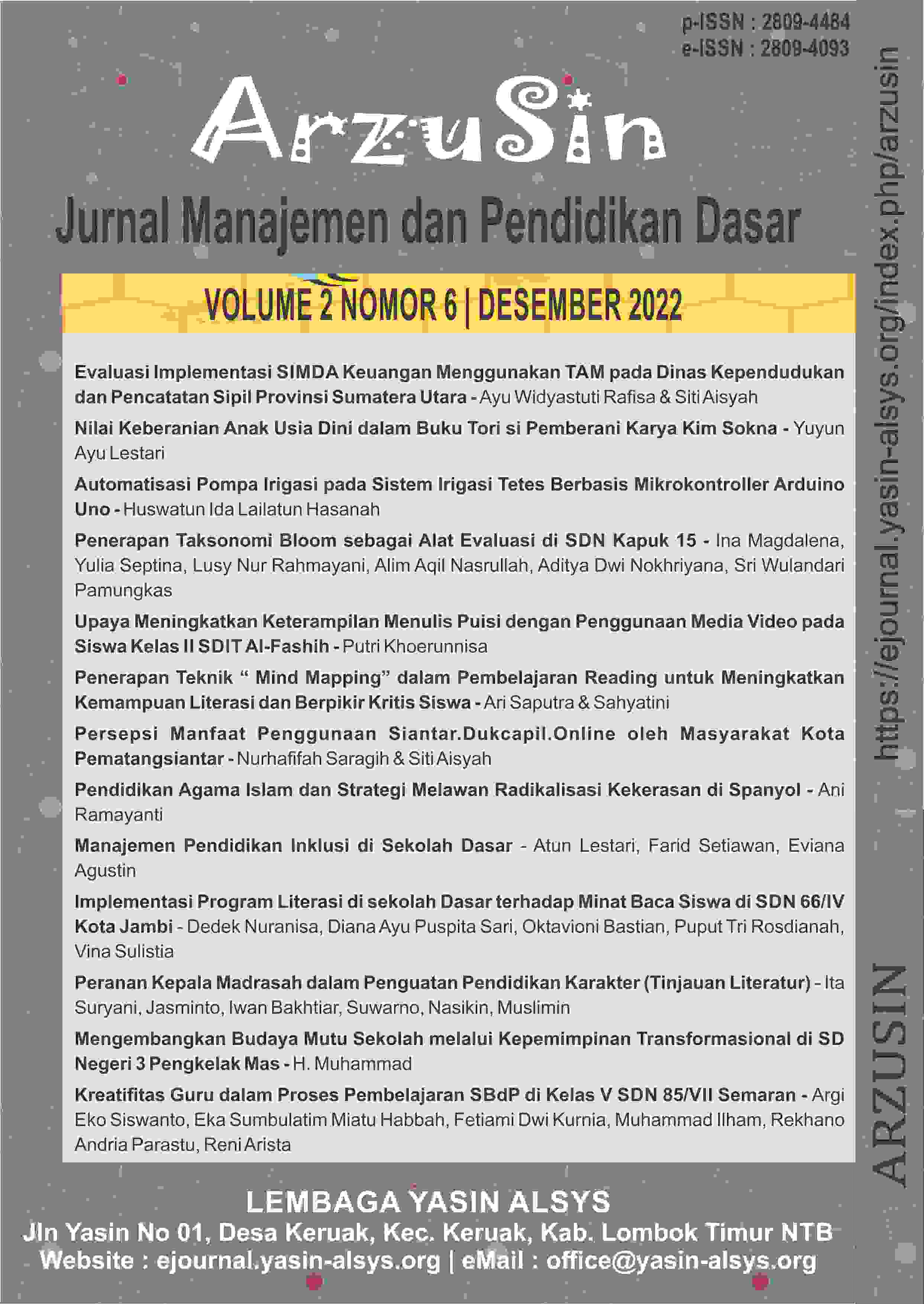
Penerapan Taksonomi Bloom sebagai Alat Evaluasi di SDN Kapuk 15

Article Sidebar
 Page Numbers:
532-539
Page Numbers:
532-539
 Digital Object Identifier:













 Viewed: 1.041 times
 Downloaded: 491 times

LYAS Publisher cordially invites qualified professionals to serve as Editors or Reviewers. Your expertise will make an important contribution to maintaining and strengthening the academic quality of our publications. Interested applicants are kindly requested to complete the application form at the following link: Editors & Reviewers


Please feel free to contact us if you need any further information about the submission process or if you have any additional questions.

 Authors:
Ina Magdalena1, Yulia Septina2, Lusy Nur Rahmayani3, Alim Aqil Nasrullah4, Aditya Dwi Nokhriyana5, Sri Wulandari Pamungkas6
 Copyright :
Authors retain copyright and grant the journal right of first publication.
Explore Our Journals
Find the journal that best fits your research. If this journal does not match your manuscript’s scope, explore our portfolio below to select a more suitable publication venue.
Main Article Content
Abstract
By conducting this research, it is hoped that we can apply Bloom's taxonomy as an evaluation tool and analyze it. Finding out more in-depth information about bloom's taxonomy and learning evaluation. In this research, the type used is a type of qualitative research. in research, for data collection the authors collect through observations to schools, teacher interviews, and documentation. Data analysis techniques were carried out according to the analytical method of Milles and Huberman. In this method there are 3 stages, namely data reduction, data presentation, data verification. in the results of the interviews the teacher actually understood and understood these three domains and the teacher used evaluation very well, but it's just that the teacher was still unfamiliar with "Bloom's Taxonomy". Studying Bloom's taxonomy is a provision or reference evaluation tool for a teacher or prospective teacher. If the basis of the evaluation tool is not studied, it will be difficult for the teacher to carry out an assessment. The use of bloom taxonomy is also highly recommended as an evaluation tool. Because of these three domains can cover all aspects in the world of education or learning.




Citation Metrics:




Downloads
Citation Metrics & Similar Scopus Articles
-
Lukpanov R.E. (2027)Evaluation of the Effect of Additives on the Workability of Concrete Mix as Part of a Study of a Modified Wall BlockKompleksnoe Ispolzovanie Mineralnogo Syra, 342(3), 100-110
-
Abbani Y. (2027)Wastewater heat recovery systems for sustainable building energy efficiency and decarbonization: A comprehensive review with practical insightsUnconventional Resources, 18
-
Sheng T. (2027)Photothermal Superhydrophobic Textiles: An Emerging Paradigm from Passive Water Repellency to Active Thermal ManagementNano Micro Letters, 19(1)
Article Details

Authors retain copyright and grant the journal right of first publication with the work simultaneously licensed under a Creative Commons Attribution-NonCommercial-ShareAlike 4.0 International License that allows others to share the work with an acknowledgement of the work's authorship and initial publication in this journal.