
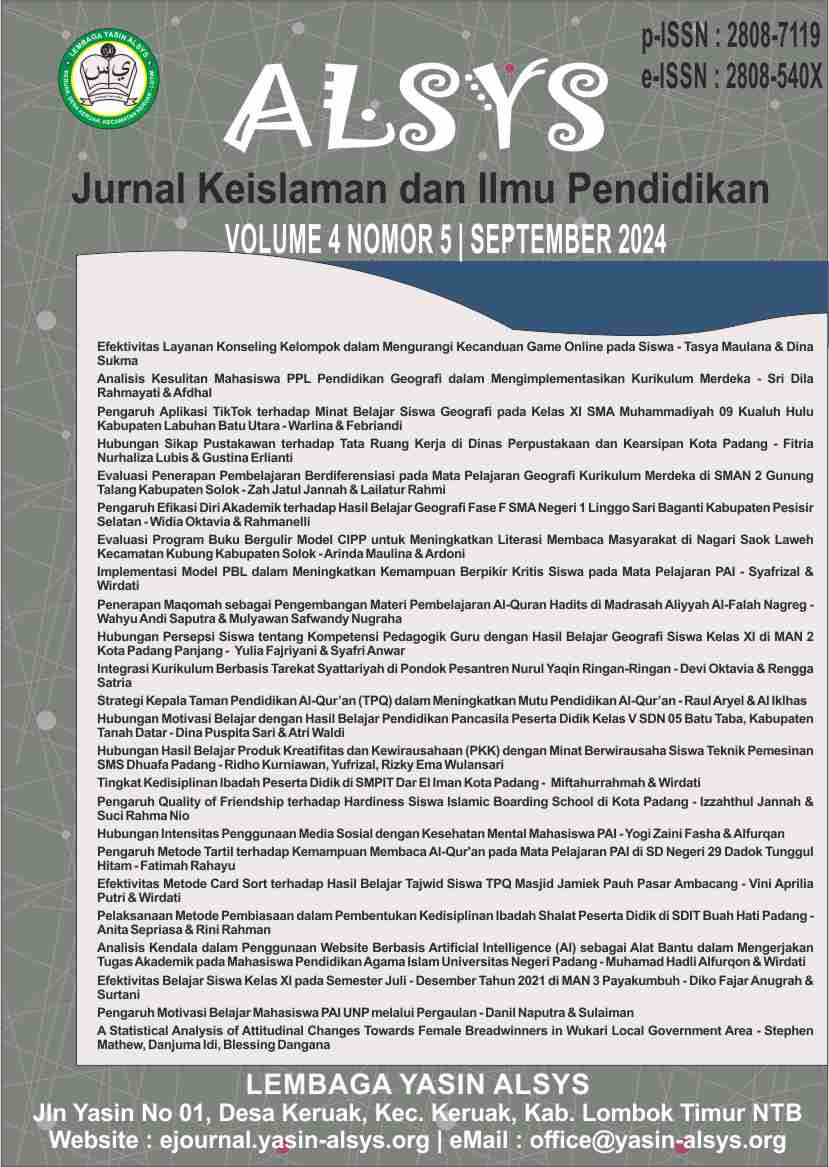
Hubungan Motivasi Belajar dengan Hasil Belajar Pendidikan Pancasila Peserta Didik Kelas V SDN 05 Batu Taba, Kabupaten Tanah Datar The Relationship Between Learning Motivation and Learning Outcomes in Pancasila Education Among Fifth-Grade Students at SDN 05 Batu Taba, Tanah Datar Regency
Main Article Content
Abstract
This research was motivated by the low learning motivation of class V students at SDN 05 Batu Taba. This type of research is correlational research with a quantitative approach. The population in this study was all 20 class V students at SDN 05 Batu Taba. The sampling technique used is a saturated sampling technique, where all members of the population are sampled. Data collection techniques include questionnaires, tests, documentation. The results of the research show that there is no positive relationship between learning motivation and Pancasila education learning outcomes for class V students at SDN 05 Batu Taba, Tanah Datar Regency. This is proven by the calculated t value being smaller than the t table, namely 1.54 < 1.734 so that H0 is accepted and H1 is rejected.




Citation Metrics:




Downloads
Citation Metrics & Similar Scopus Articles
-
Ratnaningsih E. (2027)Designing a Data-Driven E-Learning Module for Teaching English to Young Learners: Integrating Needs Analysis and the ISAV Learning ModelAsean Journal of Educational Research and Technology, 6(2), 269-286
-
Unyaphatariyakool S. (2027)Science Teachers’ Learning Management Competency through Professional Learning Communities to Promote Scientific Creativity and Sustainable Development Goals (SDGs)Asean Journal of Educational Research and Technology, 6(2), 241-252
-
Trisnowati E. (2027)Science, Technology, Engineering, and Mathematics (STEM) and Research Skill Development (RSD) in Science Education in Higher Education: A Delphi-Based ModelAsean Journal of Educational Research and Technology, 6(2), 253-268
Article Details

Authors retain copyright and grant the journal right of first publication with the work simultaneously licensed under a Creative Commons Attribution-NonCommercial-ShareAlike 4.0 International License that allows others to share the work with an acknowledgement of the work's authorship and initial publication in this journal.
References
Dewi, N. P. C. P. (2022). Analisis Buku Panduan Guru Fase A Kelas I Kurikulum Merdeka Mata Pelajaran Pendidikan Pancasila pada Jenjang Sekolah Dasar. Edukasi: Jurnal Pendidikan Dasar, 3(2), 131. https://doi.org/10.55115/edukasi.v3i2.2475
Disriani, R., & Habibi, M. (2023). Hubungan Motivasi Belajar Siswa terhadap Hasil Belajar Siswa. Edukatif : Jurnal Ilmu Pendidikan, 5(1), 125–131. https://doi.org/10.31004/edukatif.v5i1.4242
Fimala, Y., & Miaz, Y. (2020). Hubungan Motivasi Belajar dengan Hasil Belajar Siswa di Sekolah Dasar. E-Journal Inovasi Pembelajaran SD, 8(3), 1–10.
Indriyani, T., & Gumala, Y. (2020). Hubungan Motivasi Belajar dengan Hasil Belajar Siswa Sekolah Dasar. Jurnal Basicedu, 5(5), 3(2), 524–532. https://journal.uii.ac.id/ajie/article/view/971
Iswati dan Muslich Anshori, S. (2017). Metode Penelitian Kuantitatif.
Mudanta, K. A., Astawan, I. G., & Jayanta, I. N. L. (2020). Instrumen Penilaian Motivasi Belajar dan Hasil Belajar IPA Siswa Kelas V Sekolah Dasar. Mimbar Ilmu, 25(2), 101. https://doi.org/10.23887/mi.v25i2.26611
Prasetya, A., Kuryanto, M. S., & Hilyana, F. S. (2023). Hubungan Motivasi Belajar Terhadap Hasil Belajar Siswa Kelas Iv Sd 1 Mijen Kaliwungu Kota Kudus. Pendas : Jurnal Ilmiah Pendidikan Dasar, 8(1), 5052–5061. https://doi.org/10.23969/jp.v8i1.8714
Rahmi, A., & Waldi, A. (2023). Hubungan Motivasi Terhadap Hasil Belajar Pendidikan Pancasila Bagi Siswa Kelas V Sekolah Dasar Islam Terpadu Kota Padang. 11, 633–644.
Sugiyono, D. (2013). Metode Penelitian Kuantitatif, Kualitatif, dan Tindakan.
Article Sidebar
 Page Numbers:
596-603
Page Numbers:
596-603
 Digital Object ID:













 Viewed: 363 times
 Downloaded: 315 times

LYAS Publisher cordially invites qualified professionals to serve as Editors or Reviewers. Your expertise will make an important contribution to maintaining and strengthening the academic quality of our publications. Interested applicants are kindly requested to complete the application form at the following link: Editors & Reviewers


Please feel free to contact us if you need any further information about the submission process or if you have any additional questions.

 Authors:
 Copyright :
Authors retain copyright and grant the journal right of first publication.
Explore Our Journals
Find the journal that best fits your research. If this journal does not match your manuscript’s scope, explore our portfolio below to select a more suitable publication venue.