
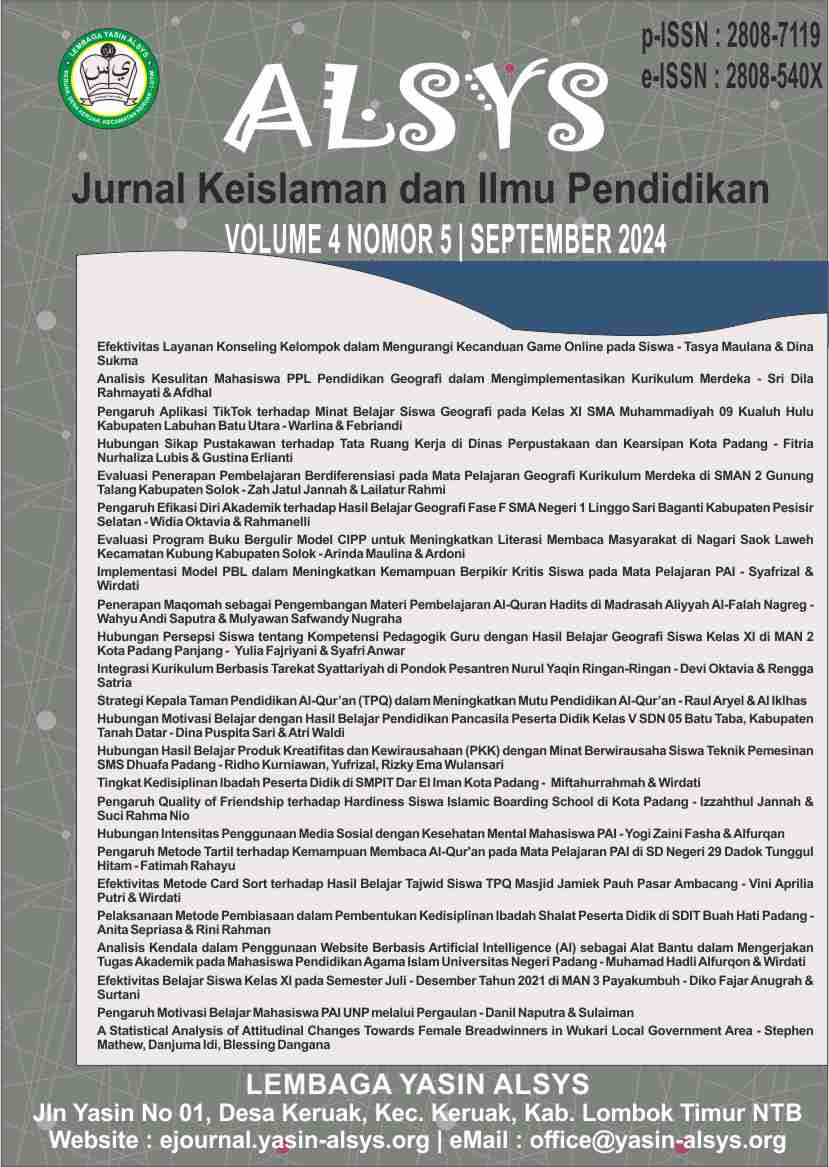
Pengaruh Efikasi Diri Akademik terhadap Hasil Belajar Geografi Fase F SMA Negeri 1 Linggo Sari Baganti Kabupaten Pesisir Selatan The Influence of Academic Self-Efficacy on Geography Learning Outcomes in Grade 11 at SMA Negeri 1 Linggo Sari Baganti, Pesisir Selatan Regency

Article Sidebar
 Page Numbers:
515-525
Page Numbers:
515-525
 Digital Object Identifier:
10.58578/alsys.v4i5.3584
Digital Object Identifier:
10.58578/alsys.v4i5.3584


 Viewed: 341 times
 Downloaded: 229 times












LYAS Publisher cordially invites qualified professionals to serve as Editors or Reviewers. Your expertise will make an important contribution to maintaining and strengthening the academic quality of our publications. Interested applicants are kindly requested to complete the application form at the following link: Editors & Reviewers


Please feel free to contact us if you need any further information about the submission process or if you have any additional questions.

 Authors:
Widia Oktavia1, Rahmanelli Rahmanelli2
 Copyright :
Authors retain copyright and grant the journal right of first publication.
Main Article Content
Abstract
The purpose of this study was to analyze whether there is a positive and significant influence of academic self-efficacy on the learning outcomes of geography phase F of SMA Negeri 1 Linggo Sari Baganti, Pesisir Selatan Regency. The type of research used is quantitative research with a correlational approach. The location of the study was at SMA Negeri 1 Linggo Sari Baganti, Pesisir Selatan Regency. The research period was April 22 to May 22. The population in this study were students of phase F who taught geography subjects at SMA Negeri 1 Linggo Sari Baganti, Pesisir Selatan Regency. The number of samples was 97 people using the total sampling technique. Data collection techniques used in this study were observation, surveys, and documentation records. The data analysis procedure technique in this study used validity tests, reliability tests, descriptive statistical analysis, normality tests, linearity tests and hypothesis tests. The results of this study concluded that 1) There is a significant relationship between academic self-efficacy and student learning outcomses at phase F of SMA Negeri 1 Linggo Sari Baganti, Pesisir Selatan Regency as indicated by a significant correlation level value of 0.000 which is smaller than 0.05. This means that the academic self-efficacy variable has an effect on the learning outcome variable. 2) The academic self-efficacy of students in phase F of SMA Negeri 1 Linggo Sari Baganti Pesisir Selatan as a whole is in the low classification, which can be seen from the pie chart and the academic self- efficacy percentage table. 3) The learning outcomes of students in phase F of SMA Negeri 1 Linggo Sari Baganti as a whole are in the context of the less group, based on the calculation of the pie chart and the Learning Outcome Criteria (KKTP) table set by the school.








Downloads
Citation Metrics & Similar Scopus Articles
-
Azhand A. (2027)Teaching Persian derivational affixes to non-Persian speakers from a Cognitive Morphology Approach: A case study of nominal suffixes (kar, gar, ban, baz, -ande)Language Related Research, 17(4), 469-497
-
Vural G. (2027)Determining the robust drivers of CO2 emissions in Africa: Machine learning and panel econometric evidence on the Environmental Kuznets Curve hypothesisUnconventional Resources, 17
-
Kenzhaliyev B.K. (2027)Predicting Copper Production Cycles in Hydrometallurgy with Interpretable Machine LearningKompleksnoe Ispolzovanie Mineralnogo Syra, 341(2), 5-15
Article Details

Authors retain copyright and grant the journal right of first publication with the work simultaneously licensed under a Creative Commons Attribution-NonCommercial-ShareAlike 4.0 International License that allows others to share the work with an acknowledgement of the work's authorship and initial publication in this journal.
References
Desy Iswayuni, Sidharta Adyatma, A. M. R. (2019). Hubungan Motivasi Belajar Siswa Dengan Hasil Belajar Geografi Siswa Sma Negeri 1 Kurau Dan Sma Negeri 1 Bumi Makmur. 6(2), 29–38.s
Marddiyah, A. (2022). Pengaruh Self Efficacy Terhadap Hasil Belajar Ipa Peserta Didik Kelas Vi Min 14 Al-Azhar Asy-Syarif Indonesia Skripsi.
Rosalina, L., Oktarina, R., Rahmiati, & Saputra, I. (2023). Buku Ajar Statistika. Febs Letters, 185(1), 4–8.
Sugiyono. (2020). Metodologi Penelitian Kuantitatif, Kualitatif Dan R & D.
Warman, D. (2020). Hubungan Percaya Diri Siswa Dengan Hasil Belajar Geografi Kelas Xi Ips Di Sma N 1 Bayang Kabupaten Pesisir Selatan.
Wicaksono, L. (N.D.). Keefektivan Pemodelan Terhadap Peningkatan Efikasi-Diri Akademik Siswa Smp ( Kajian Teoritik Aplikasi Teori Bandura ). 1404–1419.