
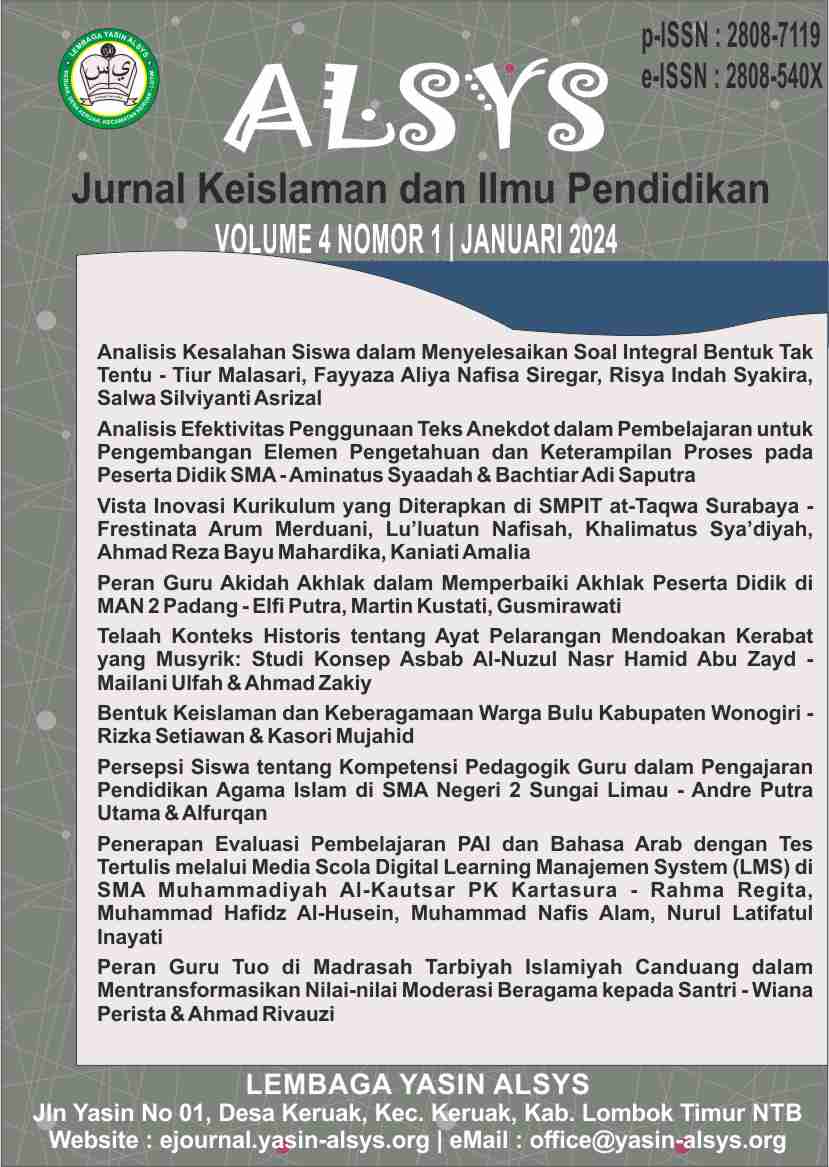
Telaah Konteks Historis tentang Ayat Pelarangan Mendoakan Kerabat yang Musyrik: Studi Konsep Asbab Al-Nuzul Nasr Hamid Abu Zayd Historical Contextual Study on the Prohibition of Praying for Polytheistic Relatives: A Study on the Concept of Asbab al-Nuzul by Nasr Hamid Abu Zayd

Article Sidebar
 Page Numbers:
50-66
Page Numbers:
50-66
 Digital Object Identifier:


 Viewed: 504 times
 Downloaded: 450 times












LYAS Publisher cordially invites qualified professionals to serve as Editors or Reviewers. Your expertise will make an important contribution to maintaining and strengthening the academic quality of our publications. Interested applicants are kindly requested to complete the application form at the following link: Editors & Reviewers


Please feel free to contact us if you need any further information about the submission process or if you have any additional questions.

 Authors:
Mailani Ulfah1, Ahmad Zakiy2*
 Copyright :
Authors retain copyright and grant the journal right of first publication.
Main Article Content
Abstract
Various restrictions on relationships or interactions with people of different beliefs sourced from the Qur’an lead to various responses, one of which is the attempt to find the reason behind the restrictions. QS. al-Taubah [9]:113 is one of the verses of the Qur’an that plays a role in creating these restrictions. This research aims to find various reasons behind the prohibition of praying for polytheists in QS. al-Taubah [9]:113 by looking at the dynamics of asbab al-nuzul of the verse and the socio-cultural reality of Arab society at that time which played a role in shaping the construction of the Qur’anic text by using Nasr Hamid Abu Zayd’s asbab al-nuzul approach. The type of research that will be used in this paper is library research. The results found from this study, first, the number of asbab al-nuzul narrations of this verse has implications, namely the assumption that QS. al-Taubah [9]:113 was revealed repeatedly, and other opinions that state such conclusions cause confusion so that there is a need for an in-depth study of hadith criticism. Secondly, the sharp conflict between Muslims and polytheists from the period of Makkah to Madinah influenced the construction of the text of QS. al-Taubah [9]:113 and the reason for the prohibition of praying and asking forgiveness for polytheist relatives. The nature of research that examines the historical aspects of a verse, needs to be appreciated and even enlivened in order to reveal the right interpretation of the Qur’an and find reasons from the aspect of tasyri’.




Citation Metrics:




Downloads
Citation Metrics & Similar Scopus Articles
-
Monika W. (2026)Retrieval-Augmented Generation for Curated Thematic Corpora: A Critical Survey, Bibliometric Evidence, and the ThemePath-RAG FrameworkInformation Switzerland, 17(7)
-
Arner A.M. (2026)Development and Assessment of Tailored Illustrations to Enhance Community Understandings of Genetics TopicsAmerican Journal of Biological Anthropology, 190(3)
-
Kamil I.M.M. (2026)THE TRANSFORMATION OF LIBERAL ISLAM IN THE CONTEXT OF POSTMODERNISM: AN ANALYSIS OF SOCIAL MOVEMENTS IN MALAYSIAAfkar, 28(1), 251-286
Article Details

Authors retain copyright and grant the journal right of first publication with the work simultaneously licensed under a Creative Commons Attribution-NonCommercial-ShareAlike 4.0 International License that allows others to share the work with an acknowledgement of the work's authorship and initial publication in this journal.