
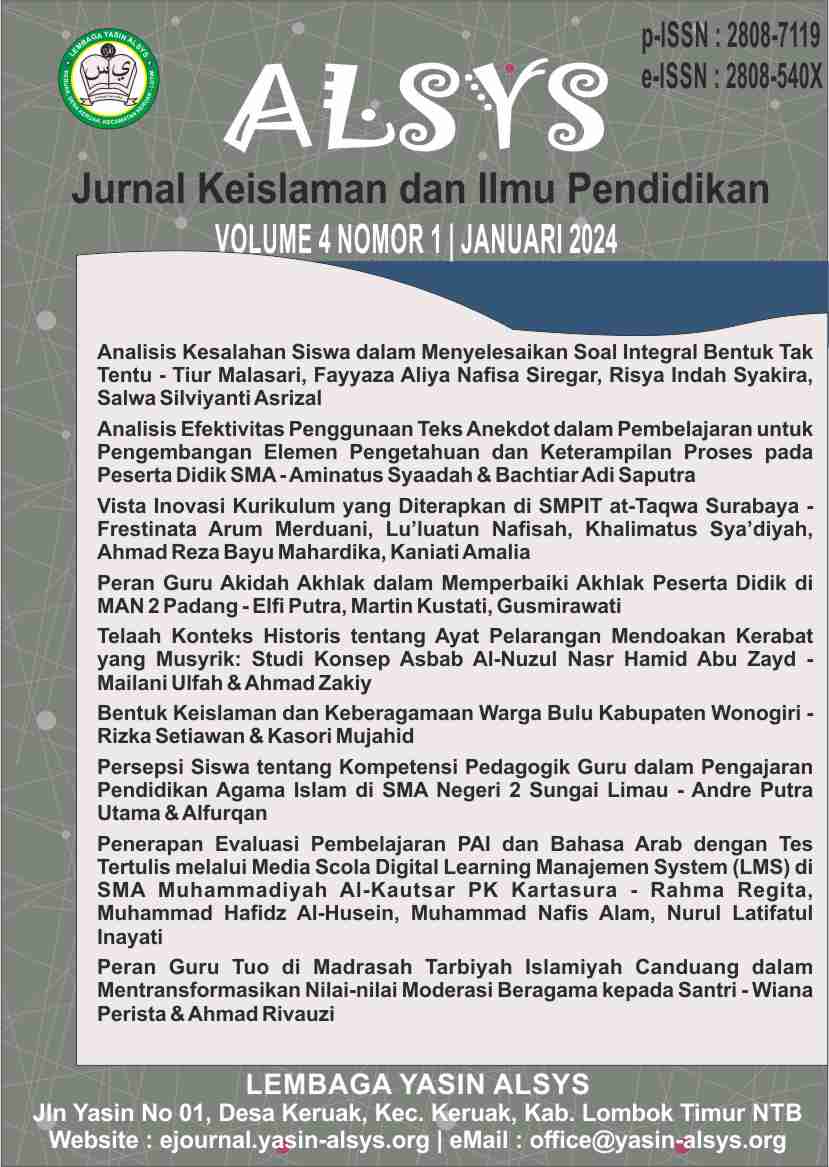
Analisis Kesalahan Siswa dalam Menyelesaikan Soal Integral Bentuk Tak Tentu Analysis of Students' Errors in Solving Indefinite Integral Problems

Article Sidebar
 Page Numbers:
1-16
Page Numbers:
1-16
 Digital Object Identifier:


 Viewed: 423 times
 Downloaded: 443 times












LYAS Publisher cordially invites qualified professionals to serve as Editors or Reviewers. Your expertise will make an important contribution to maintaining and strengthening the academic quality of our publications. Interested applicants are kindly requested to complete the application form at the following link: Editors & Reviewers


Please feel free to contact us if you need any further information about the submission process or if you have any additional questions.

 Authors:
Tiur Malasari1, Fayyaza Aliya Nafisa Siregar2, Risya Indah Syakira3, Salwa Silviyanti Asrizal4
 Copyright :
Authors retain copyright and grant the journal right of first publication.
Main Article Content
Abstract
In this research, researchers analyzed students' errors in solving questions on the topic of indefinite form integrals. The purpose of this research is to determine the patterns of student errors that often occur when working on indefinite form integral questions, as well as the factors that cause them. The subjects in this research were 25 grade 11 high school students. This research was carried out by providing a test sheet in the form of essay questions on the subject matter of indefinite integrals, totaling 5 questions with 1 category of easy questions, 3 categories of medium questions, and 1 category of difficult questions. Based on the results of data analysis, it was obtained that for question number 1 (an easy category question), 100% of respondents answered correctly. Question number 2 (medium category question), 93.3% of respondents answered correctly. Question number 3 (medium category question) 54% of respondents answered correctly. Question number 4 (difficult category question), 46% of respondents answered correctly. Meanwhile, for question number 5 (difficult category question), only 20% of respondents answered correctly.




Citation Metrics:




Downloads
Citation Metrics & Similar Scopus Articles
-
Irawati R. (2027)Enhancing accounting students’ writing performance through problem-based learning: Evidence from a vocational higher education contextMultidisciplinary Science Journal, 9(1)
-
Trisnowati E. (2027)Science, Technology, Engineering, and Mathematics (STEM) and Research Skill Development (RSD) in Science Education in Higher Education: A Delphi-Based ModelAsean Journal of Educational Research and Technology, 6(2), 253-268
-
Herrera V. (2027)Association between exposure to fine particulate matter (PM2.5) and congenital abnormalities in Colombia: An ecological analysis (2016-2020): Particulate matter and congenital abnormalitiesBiomedica, 47(1)
Article Details

Authors retain copyright and grant the journal right of first publication with the work simultaneously licensed under a Creative Commons Attribution-NonCommercial-ShareAlike 4.0 International License that allows others to share the work with an acknowledgement of the work's authorship and initial publication in this journal.