
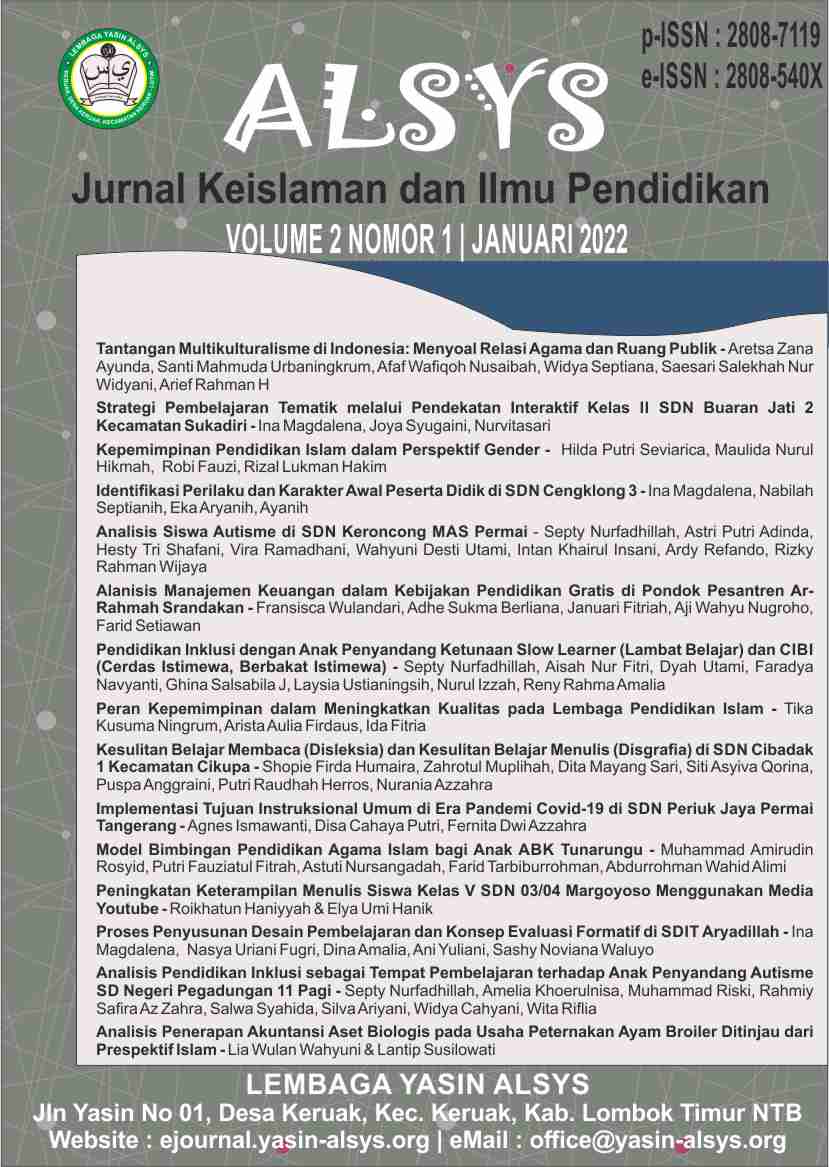
Kepemimpinan Pendidikan Islam dalam Perspektif Gender

Article Sidebar
 Page Numbers:
33-53
Page Numbers:
33-53
 Digital Object Identifier:













 Viewed: 614 times
 Downloaded: 889 times

LYAS Publisher cordially invites qualified professionals to serve as Editors or Reviewers. Your expertise will make an important contribution to maintaining and strengthening the academic quality of our publications. Interested applicants are kindly requested to complete the application form at the following link: Editors & Reviewers


Please feel free to contact us if you need any further information about the submission process or if you have any additional questions.

 Authors:
Hilda Putri Seviarica1, Maulida Nurul Hikmah2, Robi Fauzi3, Rizal Lukman Hakim4
 Copyright :
Authors retain copyright and grant the journal right of first publication.
Explore Our Journals
Find the journal that best fits your research. If this journal does not match your manuscript’s scope, explore our portfolio below to select a more suitable publication venue.
Main Article Content
Abstract
This study aims to analyze the leadership of Islamic education in a gender perspective. This type of research is a literature study that is used to discuss Islamic education leadership in a gender perspective. Data collection techniques use documentation techniques by collecting data through documents, data sources that are inanimate, such as notes, letters, and photos. The results of the study indicate that the leadership of Islamic education in a gender perspective is essentially not looking at gender differences, what is needed as a leader is not to look at gender but from ability. Women and men both have their own specialties or characteristics, but basically they (men and women) are the same, so that all men's rights are also entitled to women's rights. Being a leader is not important to think about men or women, especially in Islamic religious rules there is also no prohibition against a female leader.




Citation Metrics:




Downloads
Citation Metrics & Similar Scopus Articles
-
Ding S. (2027)Digital Renewal of University Education: Barriers, Opportunities, and Contributions to Sustainable Development Goals (SDGs)Asean Journal of Educational Research and Technology, 6(2), 229-240
-
Trisnowati E. (2027)Science, Technology, Engineering, and Mathematics (STEM) and Research Skill Development (RSD) in Science Education in Higher Education: A Delphi-Based ModelAsean Journal of Educational Research and Technology, 6(2), 253-268
-
Unyaphatariyakool S. (2027)Science Teachers’ Learning Management Competency through Professional Learning Communities to Promote Scientific Creativity and Sustainable Development Goals (SDGs)Asean Journal of Educational Research and Technology, 6(2), 241-252
Article Details

Authors retain copyright and grant the journal right of first publication with the work simultaneously licensed under a Creative Commons Attribution-NonCommercial-ShareAlike 4.0 International License that allows others to share the work with an acknowledgement of the work's authorship and initial publication in this journal.