
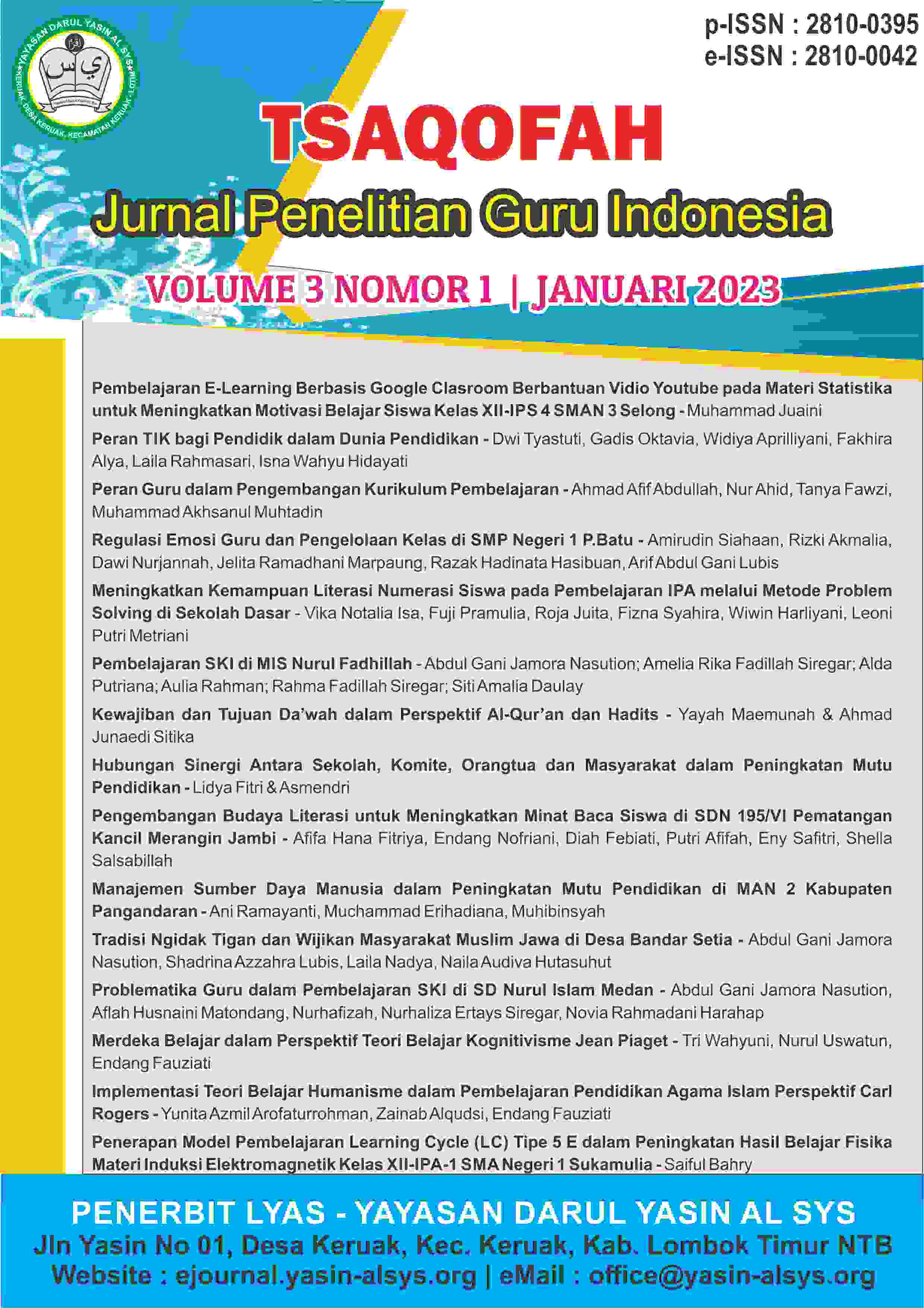
Kewajiban dan Tujuan Da’wah dalam Perspektif Al-Qur’an dan Hadits
Main Article Content
Abstract
Da'wah is duty for all adult muslim . Da'wah can be carried out by all Muslims according to their knowledge, according to their capabilities, according to their capacities wherever they are. Da'wah can be carried out with a variety of strategies, methods and media. Da'wah can involve various groups, both individuals, groups or institutions. Da'wah media can be through print media or electronic (digital) media. Print media such as newspapers, magazines, bulletins, tabloids, and so on. Meanwhile, electronic (digital) media such as YouTube, TikTok, Instagram, websites, and so on. Da'wah can be done anywhere as needed, such as at the mosque, at the prayer room, at the Majlis Ta'lim, at Madrasahs, at institutions government or private, and so on. The purpose of da'wah is to invite others to the straight path, the path that is approved by Allah SWT. If da'wah to non-Muslims means inviting them to convert to Islam, whereas if preaching to Muslims means to increase their faith and piety to Allah SWT.In Alqur’an and Hadits many clauses and argumentations about obligation and purpose of da’wah . Because as we know, the Qur'an and Hadits are a source of guidance for Muslims in doing deeds, both mahdhoh and ghoiromahdhoh. As will be discussed in the following article, regarding the obligations and objectives of da'wah from the perspective of the Qur'an and Hadits.




Citation Metrics:



Downloads
Citation Metrics & Similar Scopus Articles
-
Wiranti B. (2026)GLOBAL POLICIES AND ETHICAL PERSPECTIVES ON EUTHANASIA: A SYSTEMATIC REVIEWIndonesian Journal of Health Administration, 14(1), 152-162
-
Azizah H. (2026)Guarding Property, Recovering Assets: A Constitutional Court Perspective on Non-Conviction-Based Asset Forfeiture in IndonesiaJurnal Konstitusi, 23(2), 337-372
-
Pangestuti D.R. (2026)Public Health Nutrition in a Life-Course Perspective: From Neonatal Stunting to Metabolic Risk in Young AdultsAmerta Nutrition, 10(3), 388-390
Article Details

Authors retain copyright and grant the journal right of first publication with the work simultaneously licensed under a Creative Commons Attribution-NonCommercial-ShareAlike 4.0 International License that allows others to share the work with an acknowledgement of the work's authorship and initial publication in this journal.
Article Sidebar
 Page Numbers:
69-79
Page Numbers:
69-79
 Digital Object ID:













 Viewed: 502 times
 Downloaded: 389 times
LYAS Publisher cordially invites qualified professionals to serve as Editors or Reviewers. Your expertise will make an important contribution to maintaining and strengthening the academic quality of our publications. Interested applicants are kindly requested to complete the application form at the following link: Editors & Reviewers


Please feel free to contact us if you need any further information about the submission process or if you have any additional questions.

 Authors:
 Copyright :
Authors retain copyright and grant the journal right of first publication.
Explore Our Journals
Find the journal that best fits your research. If this journal does not match your manuscript’s scope, explore our portfolio below to select a more suitable publication venue.