
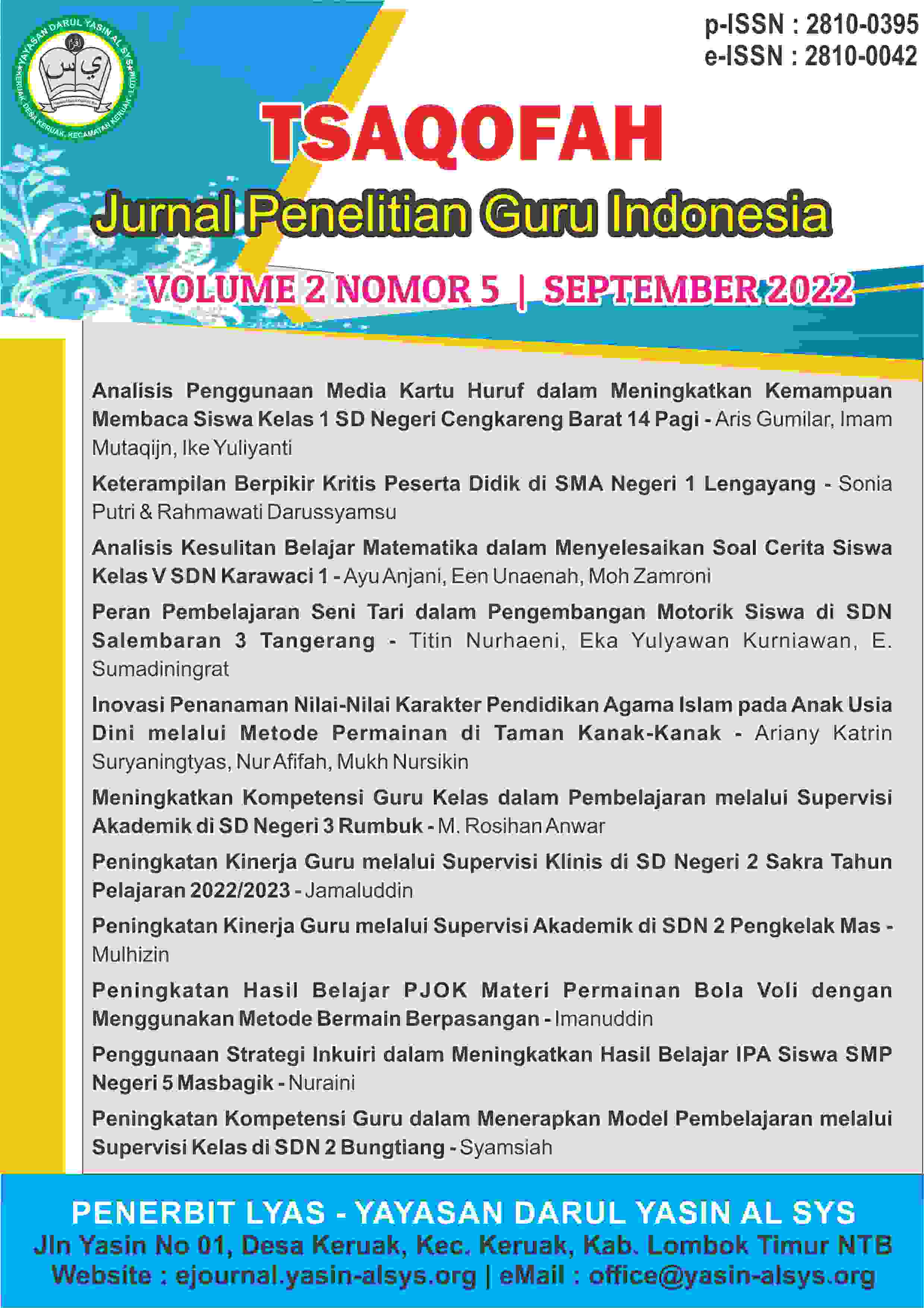
Keterampilan Berpikir Kritis Peserta Didik di SMA Negeri 1 Lengayang

Main Article Content
Abstract
Critical thinking skills are one of the 21st century skills that students must have to face the challenges of the 21st century. Critical thinking skills make students able to think logically, solve problems appropriately and make rational decisions. Measurement of the level of critical thinking skills of students needs to be done as a benchmark for teachers in honing students' critical thinking skills. This study aims to determine the critical thinking skills of students at SMAN 1 Lengayang. This type of research is descriptive research. The sample in this study were 71 students of class XI SMAN 1 Lengayang. The sampling technique is purposive sampling. The instrument used is a validated questionnaire. Data analysis was done by descriptive analysis. The results showed that the critical thinking skills of students in class XI MIPA at SMAN 1 Lengayang were still low. This can be seen from the percentage of critical thinking skills questionnaire scores of the lowest level (T1) as much as 41.5%, level 2 score (T2) 23.6%, level 3 score (T3) 15.8%, level 4 score (T4) 11%, and a score of level 5 (T5) which is the highest level of 8.5%.




Citation Metrics:



Downloads
Citation Metrics & Similar Scopus Articles
-
Wangtaphan W. (2027)From Individual Reasoning to Collaborative Engagement: Continuity of Student Problematic in Grade 1 Mathematical Problem SolvingAsean Journal of Educational Research and Technology, 6(2), 287-300
-
Trisnowati E. (2027)Science, Technology, Engineering, and Mathematics (STEM) and Research Skill Development (RSD) in Science Education in Higher Education: A Delphi-Based ModelAsean Journal of Educational Research and Technology, 6(2), 253-268
-
Ding S. (2027)Digital Renewal of University Education: Barriers, Opportunities, and Contributions to Sustainable Development Goals (SDGs)Asean Journal of Educational Research and Technology, 6(2), 229-240
Article Details

Authors retain copyright and grant the journal right of first publication with the work simultaneously licensed under a Creative Commons Attribution-NonCommercial-ShareAlike 4.0 International License that allows others to share the work with an acknowledgement of the work's authorship and initial publication in this journal.
Article Sidebar
 Page Numbers:
521-528
Page Numbers:
521-528
 Digital Object ID:













 Viewed: 449 times
 Downloaded: 397 times
LYAS Publisher cordially invites qualified professionals to serve as Editors or Reviewers. Your expertise will make an important contribution to maintaining and strengthening the academic quality of our publications. Interested applicants are kindly requested to complete the application form at the following link: Editors & Reviewers


Please feel free to contact us if you need any further information about the submission process or if you have any additional questions.

 Authors:
Sonia Putri1, Rahmawati Darussyamsu2
 Copyright :
Authors retain copyright and grant the journal right of first publication.
Explore Our Journals
Find the journal that best fits your research. If this journal does not match your manuscript’s scope, explore our portfolio below to select a more suitable publication venue.