
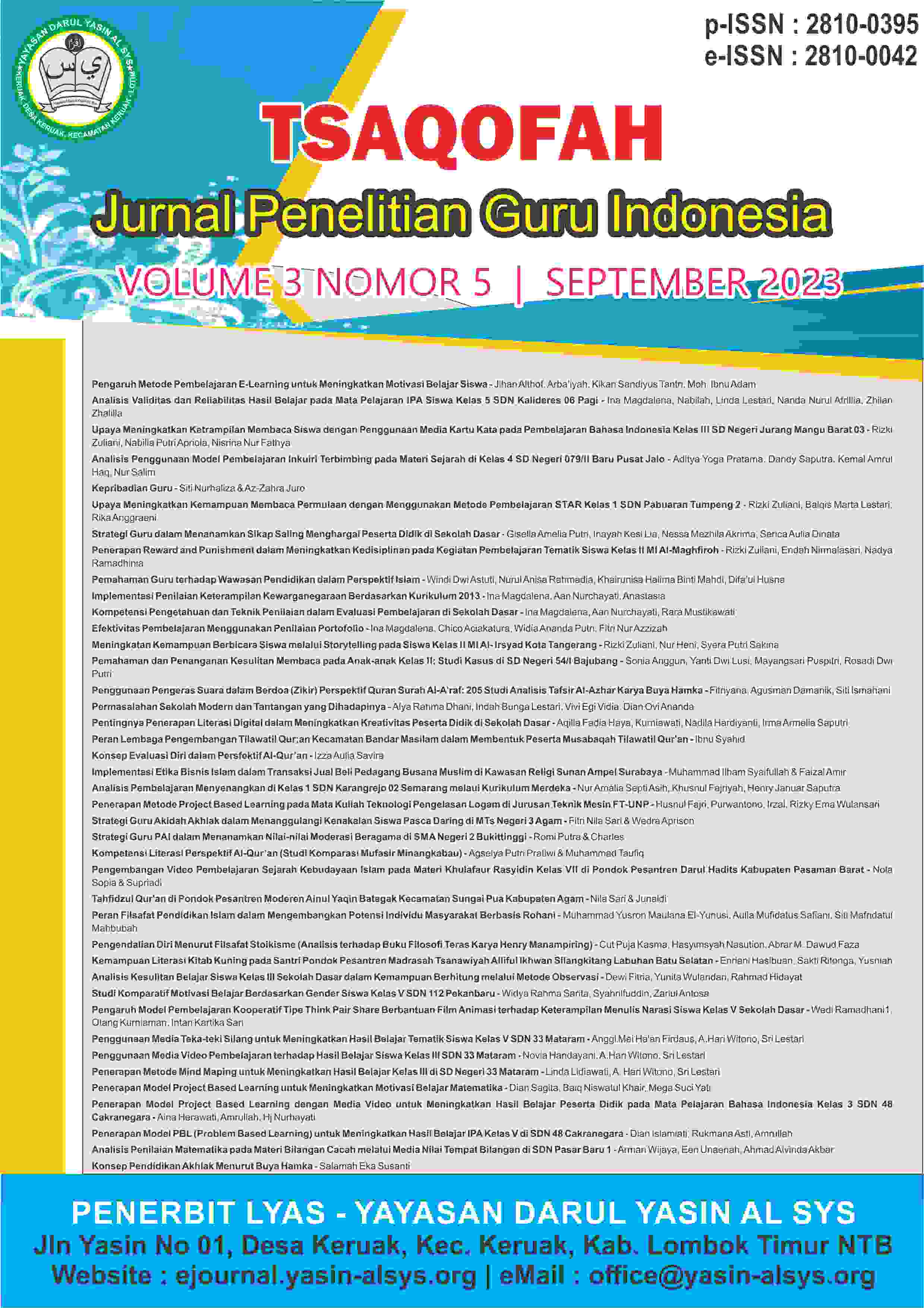
Penerapan Model PBL (Problem Based Learning) untuk Meningkatkan Hasil Belajar IPA Kelas V di SDN 48 Cakranegara
Main Article Content
Abstract
The background of this research is the science learning outcomes of fifth grade students at SDN 48 Cakranegara. After looking at these problems, one solution to overcome this problem is to use the Problem Based Learning (PBL) learning model. The purpose of this study was to determine the application of the Problem Based Learning (PBL) learning model to improve students' natural science learning outcomes at SDN 48 Cakranegara. This research method is Classroom Action Research (PTK) which is carried out in two cycles. Each cycle consists of two meetings and four stages, namely planning, implementing, observing, reflecting, and when the research is carried out. The research subjects in this study were 27 class V students. Data collection techniques in the form of documentation, observation, and learning achievement tests. The results of this study indicate that the results of science learning in class V SDN 48 Cakranegara. The results of this study indicate that the results of learning science in class V SDN 48 Cakranegara in cycle I, based on the calculations that have been done, it is known that students who have fulfilled the KKM, namely ≥ 75, have 18 students (67%). This can be seen from the number of students who get a score of 75 and above. While students who have not reached KKM ≤ 75, namely there are 9 students (33%). Furthermore, in cycle II, the average value of students who have fulfilled the KKM is ≥ 75, there are 23 students (85%). This can be seen from the number of students who get a score of 75 and above. Meanwhile, there were 4 students (15%) who had not reached KKM ≤ 75. Where this percentage can be said that it has reached the criteria for student learning success, where students get a value of ≥ 75. Thus it can be concluded that using the Problem Based Learning learning model can improve student learning outcomes in class V SDN 48 Cakranegara.




Citation Metrics:



Downloads
Citation Metrics & Similar Scopus Articles
-
Ding C. (2027)Development and validation of a machine learning-based predictive model for prognosis in cerebral hemorrhage patients after hyperbaric oxygen therapyMedical Gas Research, 17(1), 15-21
-
Ratnaningsih E. (2027)Designing a Data-Driven E-Learning Module for Teaching English to Young Learners: Integrating Needs Analysis and the ISAV Learning ModelAsean Journal of Educational Research and Technology, 6(2), 269-286
-
Naemi Z. (2027)The Relationship between Second Language Learning Strategies, Learning Engagement, and Writing Skill in the Arabic Writing CurriculumLanguage Related Research, 17(4), 331-360
Article Details

Authors retain copyright and grant the journal right of first publication with the work simultaneously licensed under a Creative Commons Attribution-NonCommercial-ShareAlike 4.0 International License that allows others to share the work with an acknowledgement of the work's authorship and initial publication in this journal.
Article Sidebar
 Page Numbers:
1103-1110
Page Numbers:
1103-1110
 Digital Object ID:













 Viewed: 215 times
 Downloaded: 303 times
LYAS Publisher cordially invites qualified professionals to serve as Editors or Reviewers. Your expertise will make an important contribution to maintaining and strengthening the academic quality of our publications. Interested applicants are kindly requested to complete the application form at the following link: Editors & Reviewers


Please feel free to contact us if you need any further information about the submission process or if you have any additional questions.

 Authors:
 Copyright :
Authors retain copyright and grant the journal right of first publication.
Explore Our Journals
Find the journal that best fits your research. If this journal does not match your manuscript’s scope, explore our portfolio below to select a more suitable publication venue.