
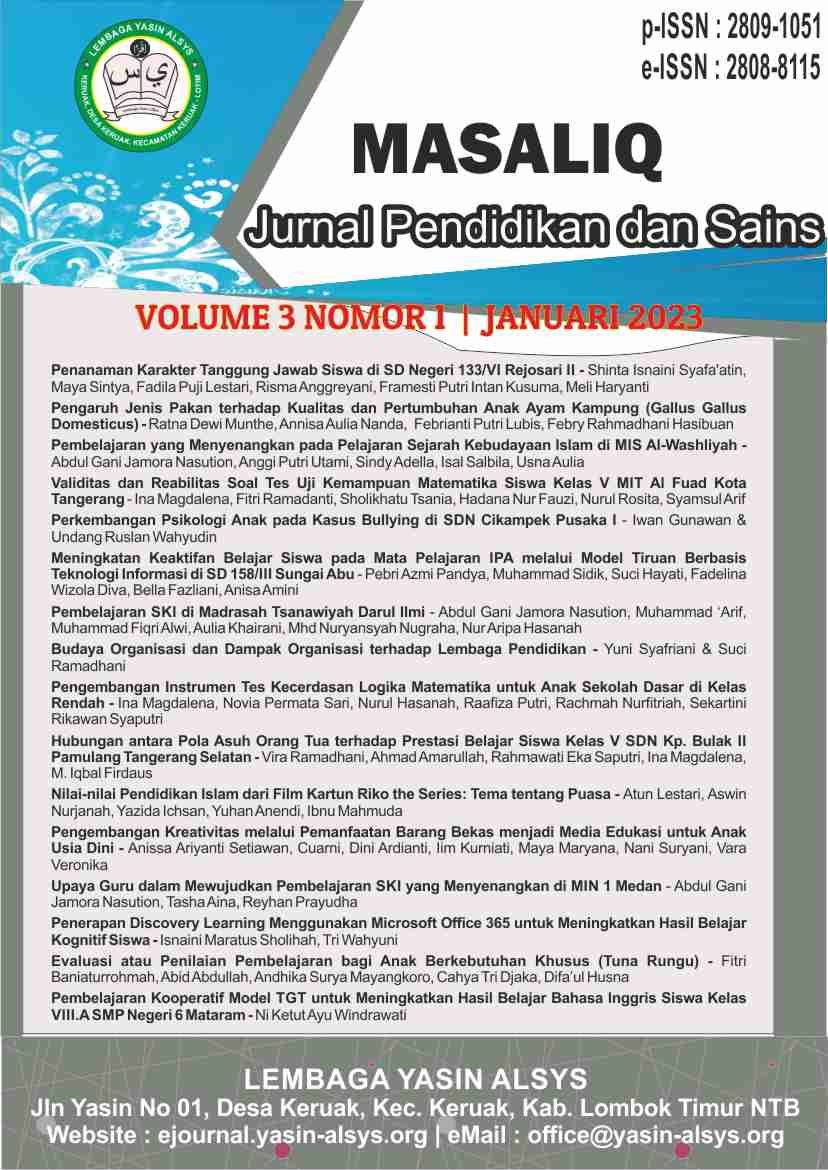
Pengembangan Kreativitas melalui Pemanfaatan Barang Bekas menjadi Media Edukasi untuk Anak Usia Dini

Article Sidebar
 Page Numbers:
115-125
Page Numbers:
115-125
 Digital Object Identifier:
10.58578/masaliq.v3i1.793
Digital Object Identifier:
10.58578/masaliq.v3i1.793


 Viewed: 750 times
 Downloaded: 589 times












LYAS Publisher cordially invites qualified professionals to serve as Editors or Reviewers. Your expertise will make an important contribution to maintaining and strengthening the academic quality of our publications. Interested applicants are kindly requested to complete the application form at the following link: Editors & Reviewers


Please feel free to contact us if you need any further information about the submission process or if you have any additional questions.

 Authors:
Anissa Ariyanti Setiawan1, Cuarni Cuarni2, Dini Ardianti3, Iim Kurniati4, Maya Maryana5, Nani Suryani6, Vara Veronika7
 Copyright :
Authors retain copyright and grant the journal right of first publication.
Main Article Content
Abstract
The problem that occurred in this study was the lack of creativity of children in using used goods during learning. The purpose of this research is to improve and develop children's creativity so that children are stimulated to express their ideas that make used goods useful items to use. The research method used in this research is descriptive analysis method with a qualitative approach. The population used is 15 children with a sample of 3 participants. The research instrument uses observation guidelines, interview guidelines, and documentation guidelines. Data collection techniques using observation techniques, interviews, and documentation. Data analysis uses data triangulation by reducing data, presenting data, and making conclusions. The result of this study is the increase in children's creativity when processing used goods into works or items that can be useful for use. The conclusion is a way to increase creativity by stimulating children using demonstration methods by the teacher by giving examples first. With this stimulus, there is an increase in children when they come up with new ideas by creating works from used goods into useful items.








Downloads
Citation Metrics & Similar Scopus Articles
-
Nordin M.E. (2026)A Systematic Literature Review of Palm Oil Maturity Detection via Deep Learning ApproachesAsia Pacific Journal of Information Technology and Multimedia, 15(1), 251-261
-
Idris H. (2026)FROM POLICY TO PRACTICE: STRENGTHENING HEALTH SYSTEMS THROUGH EVIDENCE, EQUITY, AND INNOVATIONIndonesian Journal of Health Administration, 14(1), 1-4
-
Simanungkalit S.F. (2026)Development of Noodle Product with of Sea-based Crabs (Portunus pelagicus) Shell Flour Substitution as a High-Phosphorus Alternative ProductAmerta Nutrition, 10(2), 360-370
Article Details

Authors retain copyright and grant the journal right of first publication with the work simultaneously licensed under a Creative Commons Attribution-NonCommercial-ShareAlike 4.0 International License that allows others to share the work with an acknowledgement of the work's authorship and initial publication in this journal.