
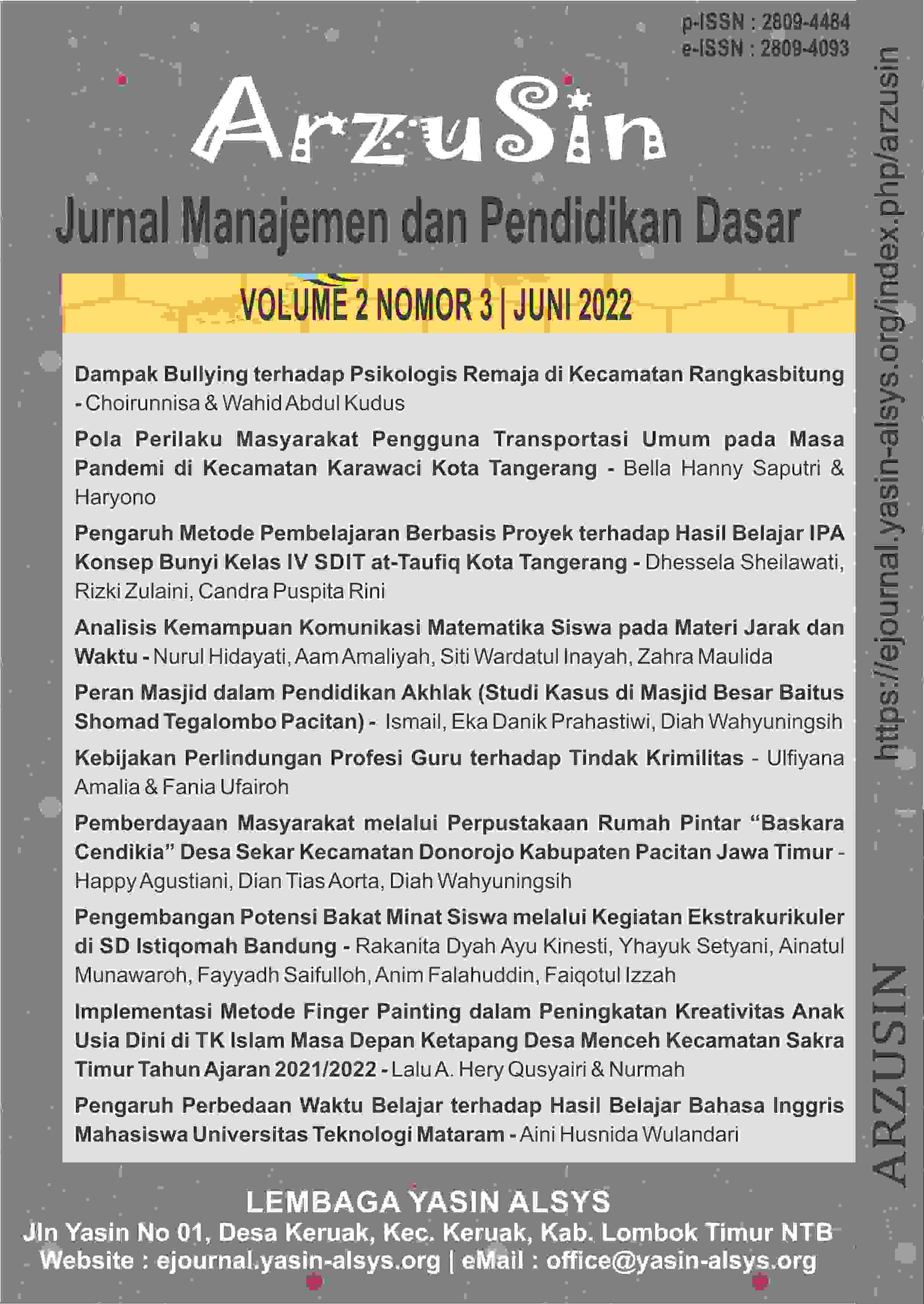
Pengaruh Metode Pembelajaran Berbasis Proyek terhadap Hasil Belajar IPA Konsep Bunyi Kelas IV SDIT at-Taufiq Kota Tangerang
Main Article Content
Abstract
This study aims to determine the effect of project-based learning methods on science learning outcomes for fourth grade students of SDIT At-Taufiq Tangerang City. This study uses a quasi-experimental method with the research design of Neonequivalent Control Group Design. The population subjects in this study were all class IV SDIT At-Taufiq Tangerang City, amounting to 58 students, by taking a sample of two classes of 58 students, namely class IV A, totaling 30 students as the experimental class. Data collection techniques using a test instrument consisting of 22 valid and reliable questions. For testing the pretest hypothesis in this study, the t-test was used, from the results of the t-test obtained calculated = 1.98 and table = 2.00, it can be concluded that there is no significant effect between the average pretest value of the control class and the experimental class. Meanwhile, for testing the posttest hypothesis, the t-test results obtained calculated = 6.167 and table = 2.00, it can be concluded that there is a significant effect between the average posttest value of the control class and the experimental class. This means that the fourth grade students' science learning outcomes using project-based learning methods are higher than using conventional learning methods.




Citation Metrics:




Downloads
Citation Metrics & Similar Scopus Articles
-
Ratnaningsih E. (2027)Designing a Data-Driven E-Learning Module for Teaching English to Young Learners: Integrating Needs Analysis and the ISAV Learning ModelAsean Journal of Educational Research and Technology, 6(2), 269-286
-
Azhand A. (2027)Teaching Persian derivational affixes to non-Persian speakers from a Cognitive Morphology Approach: A case study of nominal suffixes (kar, gar, ban, baz, -ande)Language Related Research, 17(4), 469-497
-
Naemi Z. (2027)The Relationship between Second Language Learning Strategies, Learning Engagement, and Writing Skill in the Arabic Writing CurriculumLanguage Related Research, 17(4), 331-360
Article Details

Authors retain copyright and grant the journal right of first publication with the work simultaneously licensed under a Creative Commons Attribution-NonCommercial-ShareAlike 4.0 International License that allows others to share the work with an acknowledgement of the work's authorship and initial publication in this journal.
Article Sidebar
 Page Numbers:
229-240
Page Numbers:
229-240
 Digital Object ID:













 Viewed: 479 times
 Downloaded: 397 times

LYAS Publisher cordially invites qualified professionals to serve as Editors or Reviewers. Your expertise will make an important contribution to maintaining and strengthening the academic quality of our publications. Interested applicants are kindly requested to complete the application form at the following link: Editors & Reviewers


Please feel free to contact us if you need any further information about the submission process or if you have any additional questions.

 Authors:
 Copyright :
Authors retain copyright and grant the journal right of first publication.
Explore Our Journals
Find the journal that best fits your research. If this journal does not match your manuscript’s scope, explore our portfolio below to select a more suitable publication venue.