
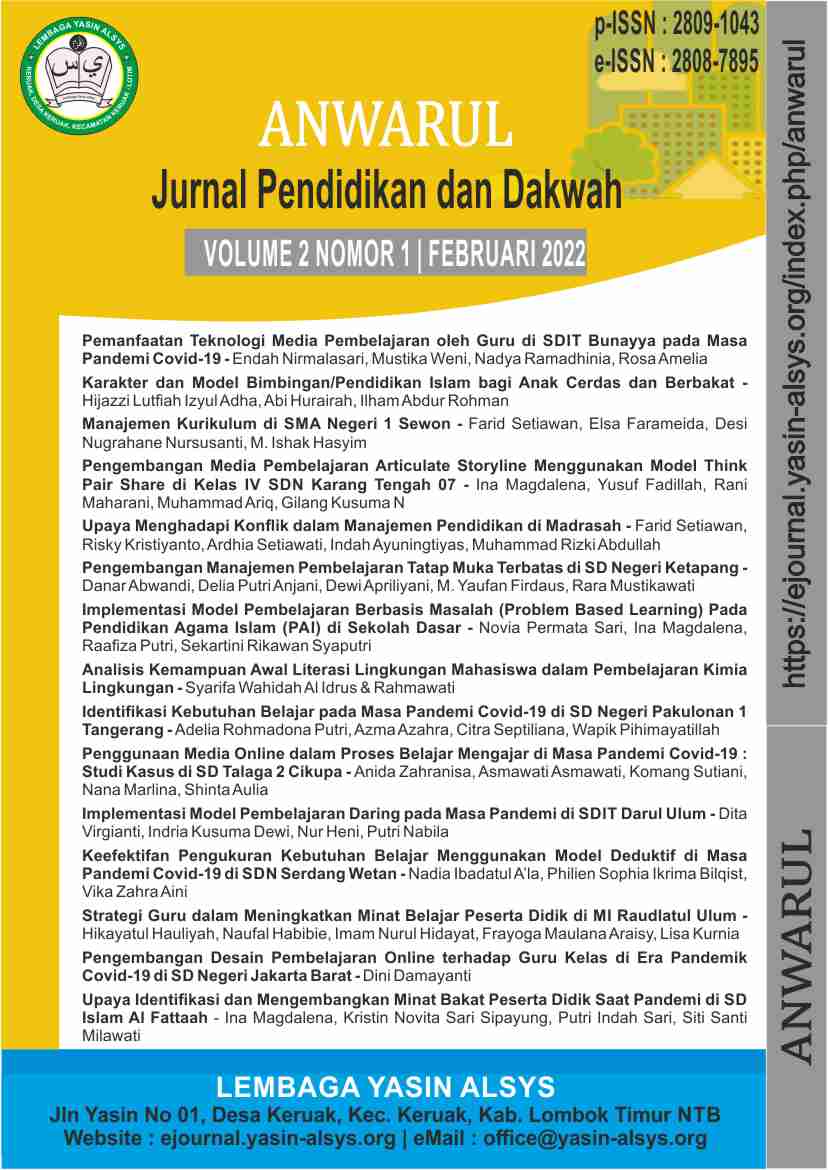
Karakter dan Model Bimbingan/Pendidikan Islam bagi Anak Cerdas dan Berbakat
Main Article Content
Abstract
Islamic education which has or is known by its characteristics, symbolizes something that is inherent in itself. While education in Islam is education that comes directly from Allah SWT. Al-Quran and Sunnah in the development of Islamic education have a character where humans are directly related to their creation through the teachings that have been taught in Islam, such as prayer, reciting and others. On this occasion, the discussion about the characteristics and models of Islamic education guidance for intelligent and gifted children. Hearing the word Islamic education, of course, we are immediately directed to special Islamic educational institutions, namely madrasas, Islamic education is widely taught in Islamic madrasas, ranging from MI, MtS, and MA. Islam really appreciates science, Islam also elevates the degree of people who are knowledgeable and do good deeds. In Islam, if there are students who are talented and intelligent in the religious and social sciences and have good morals, then they are noble in the sight of Allah SWT.




Citation Metrics:




Downloads
Citation Metrics & Similar Scopus Articles
-
Ding S. (2027)Digital Renewal of University Education: Barriers, Opportunities, and Contributions to Sustainable Development Goals (SDGs)Asean Journal of Educational Research and Technology, 6(2), 229-240
-
Trisnowati E. (2027)Science, Technology, Engineering, and Mathematics (STEM) and Research Skill Development (RSD) in Science Education in Higher Education: A Delphi-Based ModelAsean Journal of Educational Research and Technology, 6(2), 253-268
-
Unyaphatariyakool S. (2027)Science Teachers’ Learning Management Competency through Professional Learning Communities to Promote Scientific Creativity and Sustainable Development Goals (SDGs)Asean Journal of Educational Research and Technology, 6(2), 241-252
Article Details

Authors retain copyright and grant the journal right of first publication with the work simultaneously licensed under a Creative Commons Attribution-NonCommercial-ShareAlike 4.0 International License that allows others to share the work with an acknowledgement of the work's authorship and initial publication in this journal.
Article Sidebar
 Page Numbers:
14-23
Page Numbers:
14-23
 Digital Object ID:













 Viewed: 565 times
 Downloaded: 547 times

LYAS Publisher cordially invites qualified professionals to serve as Editors or Reviewers. Your expertise will make an important contribution to maintaining and strengthening the academic quality of our publications. Interested applicants are kindly requested to complete the application form at the following link: Editors & Reviewers


Please feel free to contact us if you need any further information about the submission process or if you have any additional questions.

 Authors:
 Copyright :
Authors retain copyright and grant the journal right of first publication.
Explore Our Journals
Find the journal that best fits your research. If this journal does not match your manuscript’s scope, explore our portfolio below to select a more suitable publication venue.