
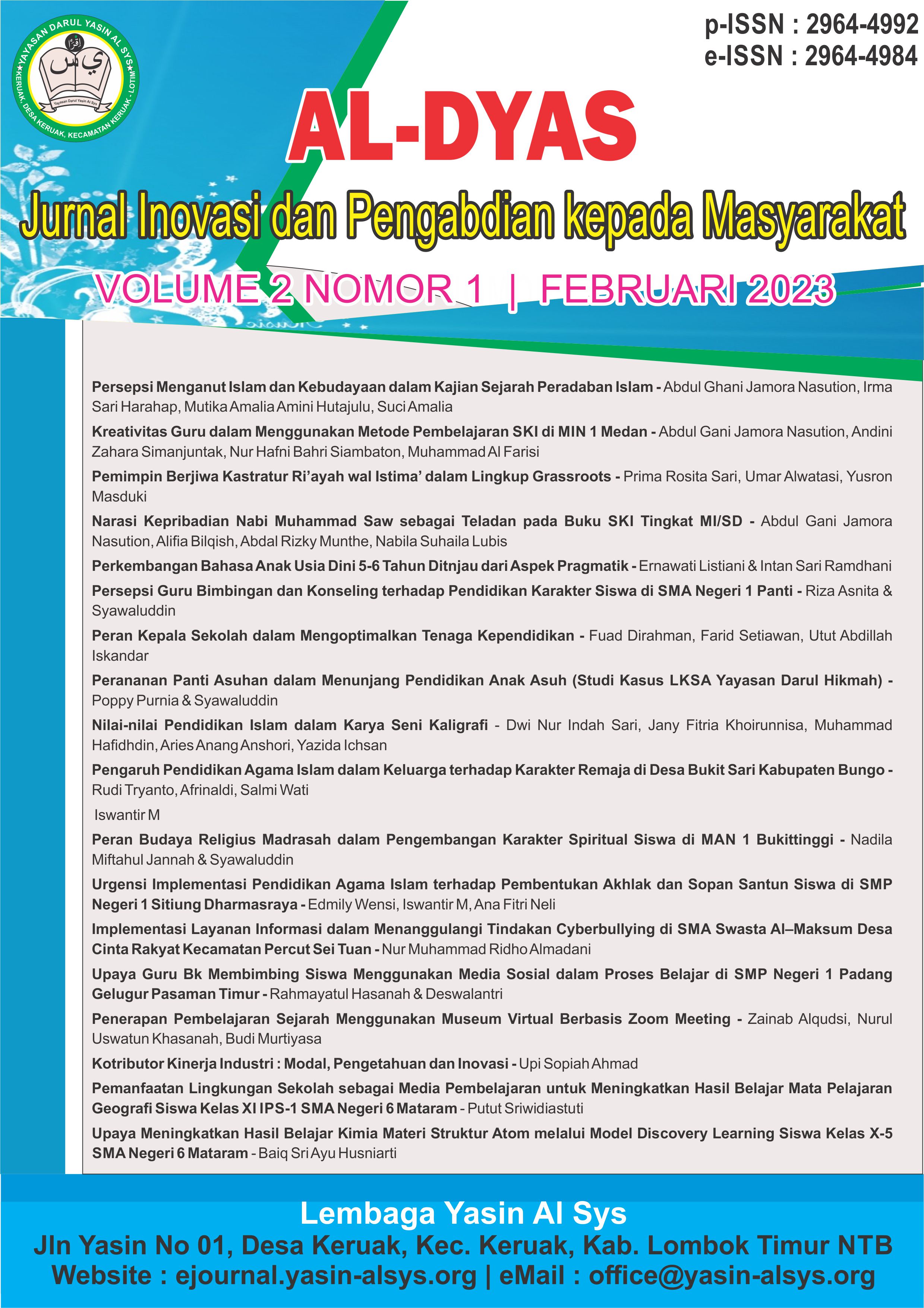
Upaya Meningkatkan Hasil Belajar Kimia Materi Struktur Atom melalui Model Discovery Learning Siswa Kelas X-5 SMA Negeri 6 Mataram

Article Sidebar
 Page Numbers:
181-192
Page Numbers:
181-192
 Digital Object Identifier:


 Viewed: 472 times
 Downloaded: 427 times












LYAS Publisher cordially invites qualified professionals to serve as Editors or Reviewers. Your expertise will make an important contribution to maintaining and strengthening the academic quality of our publications. Interested applicants are kindly requested to complete the application form at the following link: Editors & Reviewers


Please feel free to contact us if you need any further information about the submission process or if you have any additional questions.

 Authors:
Baiq Sri Ayu Husniarti1
 Copyright :
Authors retain copyright and grant the journal right of first publication.
Main Article Content
Abstract
The purpose of this study was to determine the increase in learning outcomes in Chemistry on the subject of atomic structure through the Discovery Learning model for Class X-5 students of SMA Negeri 6 Mataram in the odd semester of the 2022/2023 academic year. This research method uses Classroom Action Research (CAR). The subjects of this study were all 32 students in class X-5 at SMA Negeri 6 Mataram in the odd semester of the 2022/2023 academic year. The instruments used were: observation sheets of teacher and student activities and the rubric of student creativity using percentage analysis. Based on the results of data analysis, it was obtained that: the Discovery Learning model can improve student learning outcomes in class X-5 Mataram 6 Public High School in the odd semester of the 2022/2023 school year. In the initial conditions, students who have completeness in learning Chemistry are 15 students or if the percentage is 46.88%. In the first cycle stage, there were 25 students or if the percentage was 78.13%, this proved an increase of 13.25% from the initial conditions. Then in the second cycle of students who are in complete learning Chemistry, there are 32 students or 87.50%. This proves an increase of 9.37% from cycle II.




Citation Metrics:




Downloads
Citation Metrics & Similar Scopus Articles
-
Irawati R. (2027)Enhancing accounting students’ writing performance through problem-based learning: Evidence from a vocational higher education contextMultidisciplinary Science Journal, 9(1)
-
Azhand A. (2027)Teaching Persian derivational affixes to non-Persian speakers from a Cognitive Morphology Approach: A case study of nominal suffixes (kar, gar, ban, baz, -ande)Language Related Research, 17(4), 469-497
-
Kenzhaliyev B.K. (2027)Predicting Copper Production Cycles in Hydrometallurgy with Interpretable Machine LearningKompleksnoe Ispolzovanie Mineralnogo Syra, 341(2), 5-15
Article Details

Authors retain copyright and grant the journal right of first publication with the work simultaneously licensed under a Creative Commons Attribution-NonCommercial-ShareAlike 4.0 International License that allows others to share the work with an acknowledgement of the work's authorship and initial publication in this journal.