
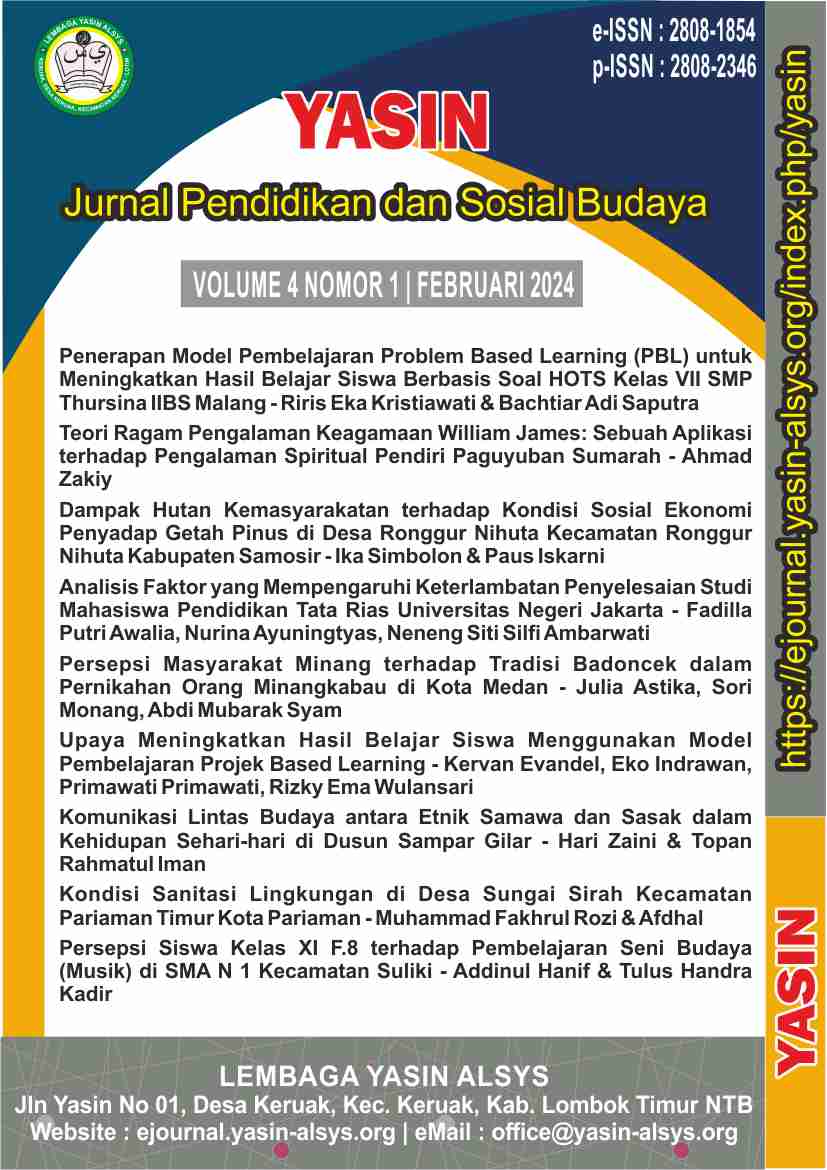
Penerapan Model Pembelajaran Problem Based Learning (PBL) untuk Meningkatkan Hasil Belajar Siswa Berbasis Soal HOTS Kelas VII SMP Thursina IIBS Malang Implementation of Problem-Based Learning (PBL) Model to Enhance the Learning Outcomes of Grade VII Junior High School Students Based on Higher Order Thinking Skills (HOTS) at Thursina IIBS Malang
Main Article Content
Abstract
This learning practice is motivated by the need for critical thinking skills in students, an aspect that is increasingly crucial in the 21st century era. The factors that cause this are students' lack of habit in solving analysis questions, especially those in the HOTS category and the low learning outcomes are the learning process itself. Through PBL, it is hoped that this learning practice can make a positive contribution in improving the quality of students' science learning outcomes, especially in facing the challenges of HOTS questions. The method used in this research is a Problem-based learning (PBL) model which requires a series of steps that focus on active and collaborative learning experiences. First of all, the step of orienting students to the problem becomes the starting point in the PBL model, next, the step of organizing students to learn to bring collaborative concepts into PBL, the third step involves guiding investigations, both individually and in groups, the fourth and fifth steps, namely developing and presenting the results of work, as well as analyzing and evaluating the problem solving process, confirms that PBL. The research results prove that there is an increase in posttest results compared to the pretest. This increase can be seen from the increase in the average score of students from 53.25 at pretest to 84.75 and the percentage of student learning completion which was initially 32% to 92%. Apart from that, students felt that they were given space to work in groups and develop an attitude of mutual cooperation which, based on the questionnaire, was 96%. Overall, the implementation of the Problem-Based Learning (PBL) learning model with the support of modules and electronic Student Worksheets (LKPD) has had a positive impact on science learning at the junior high school level. This research succeeded in improving students' analytical skills regarding ecosystem interactions, significantly improving student learning outcomes, and developing critical thinking skills and collaborative attitudes.




Citation Metrics:




Downloads
Citation Metrics & Similar Scopus Articles
-
Ratnaningsih E. (2027)Designing a Data-Driven E-Learning Module for Teaching English to Young Learners: Integrating Needs Analysis and the ISAV Learning ModelAsean Journal of Educational Research and Technology, 6(2), 269-286
-
Kazhikenova S.S. (2028)Modelling and Solving Problems of Sustainable Efficiency of Technological Processes in MetallurgyKompleksnoe Ispolzovanie Mineralnogo Syra, 344(1), 65-78
-
Naemi Z. (2027)The Relationship between Second Language Learning Strategies, Learning Engagement, and Writing Skill in the Arabic Writing CurriculumLanguage Related Research, 17(4), 331-360
Article Details

Authors retain copyright and grant the journal right of first publication with the work simultaneously licensed under a Creative Commons Attribution-NonCommercial-ShareAlike 4.0 International License that allows others to share the work with an acknowledgement of the work's authorship and initial publication in this journal.
Article Sidebar
 Page Numbers:
1-7
Page Numbers:
1-7
 Digital Object ID:













 Viewed: 505 times
 Downloaded: 502 times

LYAS Publisher cordially invites qualified professionals to serve as Editors or Reviewers. Your expertise will make an important contribution to maintaining and strengthening the academic quality of our publications. Interested applicants are kindly requested to complete the application form at the following link: Editors & Reviewers


Please feel free to contact us if you need any further information about the submission process or if you have any additional questions.

 Authors:
 Copyright :
Authors retain copyright and grant the journal right of first publication.
Explore Our Journals
Find the journal that best fits your research. If this journal does not match your manuscript’s scope, explore our portfolio below to select a more suitable publication venue.