
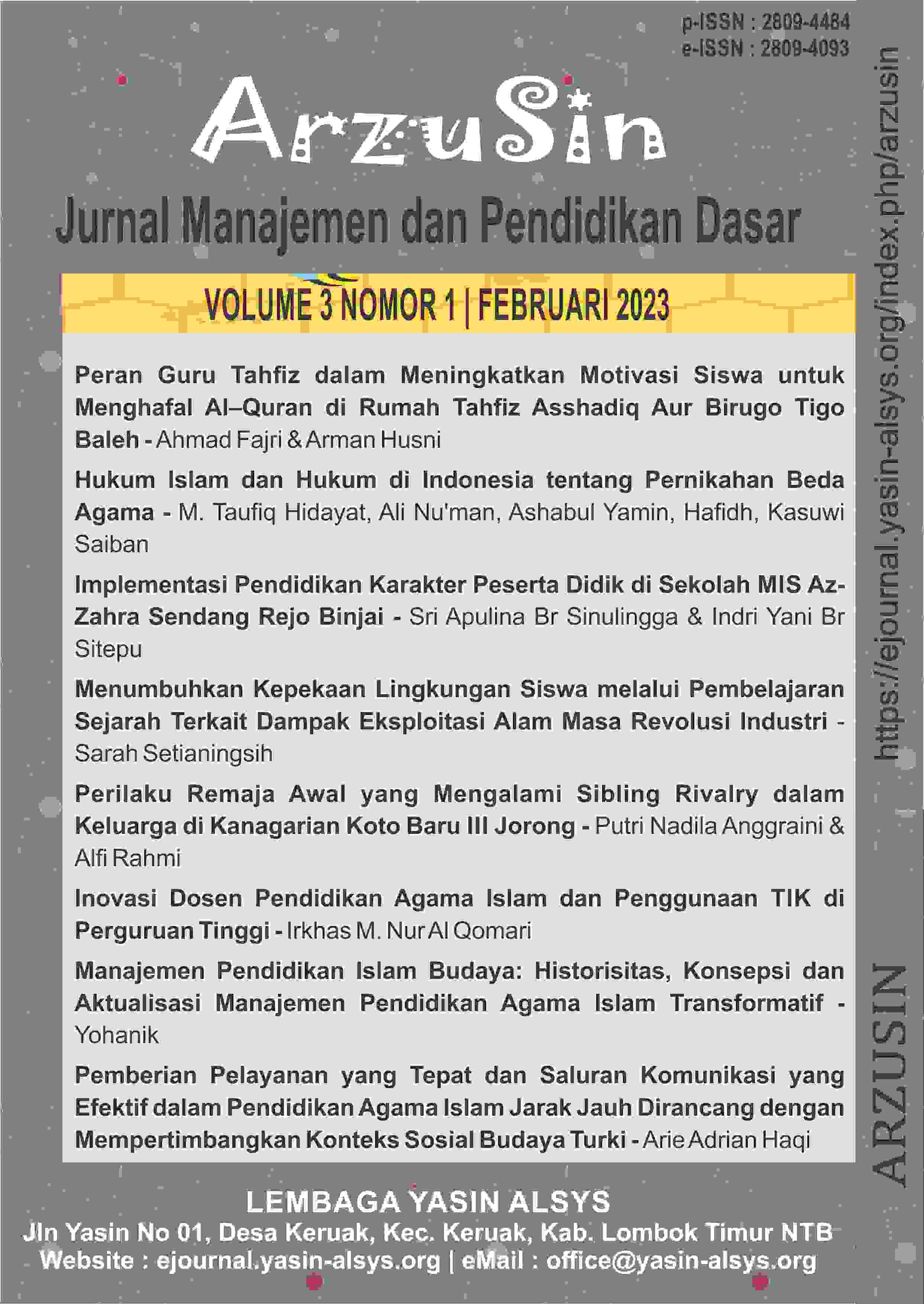
Inovasi Dosen Pendidikan Agama Islam dan Penggunaan TIK di Perguruan Tinggi
Main Article Content
Abstract
This paper uses a theoretical approach to the conceptual study of educational innovation in the field of Higher Education and the use of Information and Communication Technology, as a fundamental support to achieve it. It is intended to present the idea of how the University is a producer of knowledge in a new culture and paradigm in which ICT generates a process of continuous transformation and improvement. Similarly, some educational technologies such as mobile phones and other mobile devices are in the classroom and can be a key element for learning. You should know what to do with them. That's the challenge that seats teachers around innovation. Special interest in technological innovations is manifested as the prerogative of relevance in the digital age. There is a certain consensus within the scientific community that is consulted, when understanding the educational innovations associated with the technologies of the digital age. It is important to value innovation as a procedural category that defines incremental or radical transformations to overcome, complement or enhance an object, process or phenomenon, which can be social, cultural, technical, productive, economic or environmental.




Citation Metrics:




Downloads
Citation Metrics & Similar Scopus Articles
-
Ding S. (2027)Digital Renewal of University Education: Barriers, Opportunities, and Contributions to Sustainable Development Goals (SDGs)Asean Journal of Educational Research and Technology, 6(2), 229-240
-
Trisnowati E. (2027)Science, Technology, Engineering, and Mathematics (STEM) and Research Skill Development (RSD) in Science Education in Higher Education: A Delphi-Based ModelAsean Journal of Educational Research and Technology, 6(2), 253-268
-
Unyaphatariyakool S. (2027)Science Teachers’ Learning Management Competency through Professional Learning Communities to Promote Scientific Creativity and Sustainable Development Goals (SDGs)Asean Journal of Educational Research and Technology, 6(2), 241-252
Article Details

Authors retain copyright and grant the journal right of first publication with the work simultaneously licensed under a Creative Commons Attribution-NonCommercial-ShareAlike 4.0 International License that allows others to share the work with an acknowledgement of the work's authorship and initial publication in this journal.
Article Sidebar
 Page Numbers:
55-70
Page Numbers:
55-70
 Digital Object ID:













 Viewed: 350 times
 Downloaded: 433 times

LYAS Publisher cordially invites qualified professionals to serve as Editors or Reviewers. Your expertise will make an important contribution to maintaining and strengthening the academic quality of our publications. Interested applicants are kindly requested to complete the application form at the following link: Editors & Reviewers


Please feel free to contact us if you need any further information about the submission process or if you have any additional questions.

 Authors:
 Copyright :
Authors retain copyright and grant the journal right of first publication.
Explore Our Journals
Find the journal that best fits your research. If this journal does not match your manuscript’s scope, explore our portfolio below to select a more suitable publication venue.