
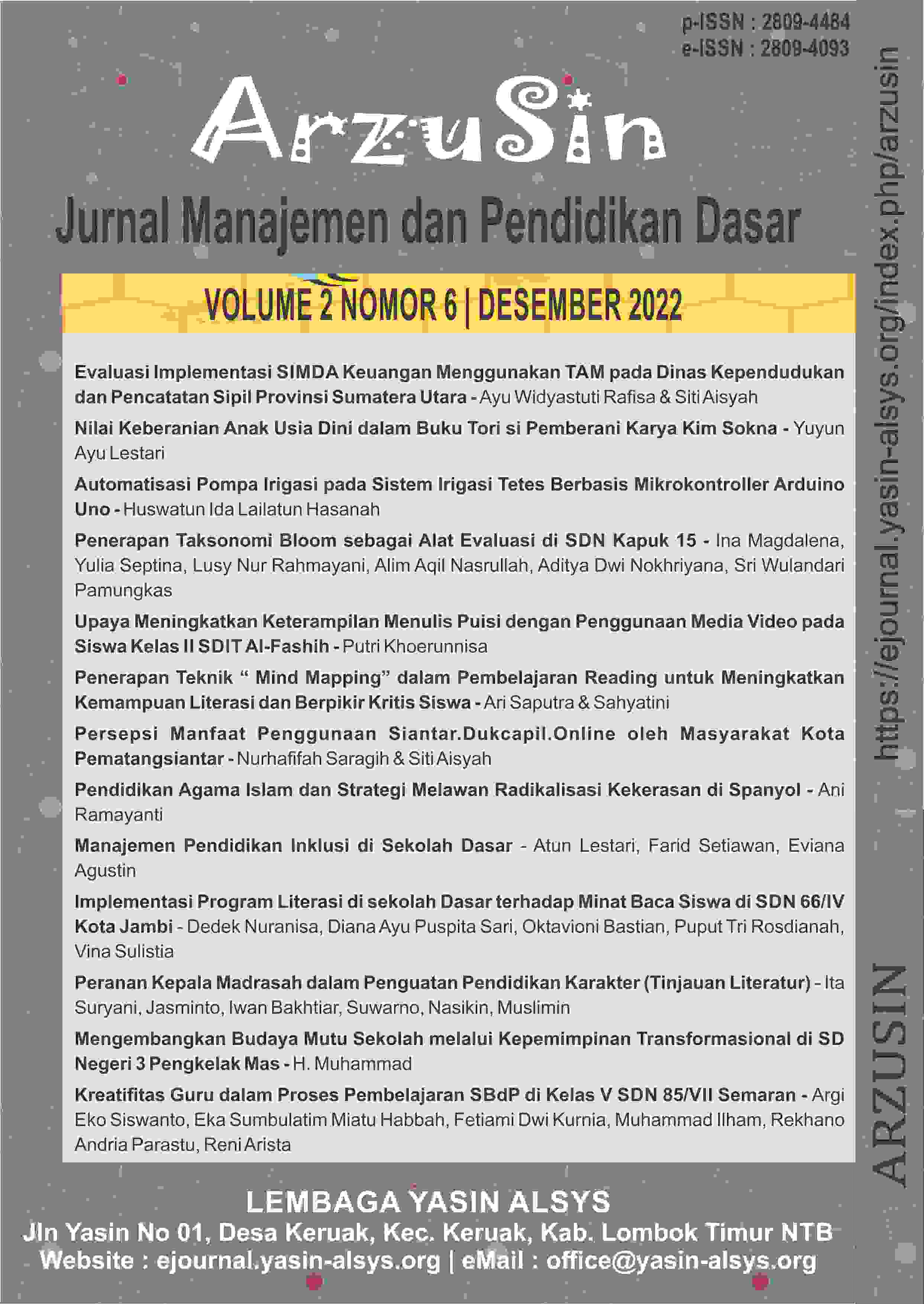
Kreatifitas Guru dalam Proses Pembelajaran SBdP di Kelas V SDN 85/VII Semaran

Article Sidebar
 Page Numbers:
648-662
Page Numbers:
648-662
 Digital Object Identifier:













 Viewed: 394 times
 Downloaded: 402 times

LYAS Publisher cordially invites qualified professionals to serve as Editors or Reviewers. Your expertise will make an important contribution to maintaining and strengthening the academic quality of our publications. Interested applicants are kindly requested to complete the application form at the following link: Editors & Reviewers


Please feel free to contact us if you need any further information about the submission process or if you have any additional questions.

 Authors:
Argi Eko Siswanto1, Eka Sumbulatim Miatu Habbah2, Fetiami Dwi Kurnia3, Muhammad Ilham4, Rekhano Andria Parastu5, Reni Arista6
 Copyright :
Authors retain copyright and grant the journal right of first publication.
Explore Our Journals
Find the journal that best fits your research. If this journal does not match your manuscript’s scope, explore our portfolio below to select a more suitable publication venue.
Main Article Content
Abstract
In the world of education, the teacher is a key success factor in achieving educational goals and improving the quality of learning. When studying SBdP in elementary schools, students still think that learning is difficult to understand, so teachers must have high creativity to teach this. Creativity in this case is a person's ability to create new products, both in the form of ideas and in real works, which are relatively different from those that existed before. The type of research method used is qualitative research, namely research used to describe and analyze phenomena, events, social activities, beliefs, perceptions, and people individually and in groups (Sukmadinata, 2009:53-60). The research objective is teacher creativity in the SBdP learning process in class V at SD Negeri No. 85/VII Semaran. The location used as the research site is SD Negeri No. 85/VII Semaran, Pauh District, Sarolangun Regency, Jambi. Creative educators are expected to be able to help realize the creativity of students. Therefore, an educator must be able to determine the right learning approach and determine the success criteria of a lesson. Each student has a different character, even has unique strengths, weaknesses, interests and talents, and attention that is not the same as that of other students. Based on the description of the explanation that has been explained above, creativity is something that must exist in a person in order to realize something that can produce something both in educational life and for everyday life.




Citation Metrics:




Downloads
Citation Metrics & Similar Scopus Articles
-
Unyaphatariyakool S. (2027)Science Teachers’ Learning Management Competency through Professional Learning Communities to Promote Scientific Creativity and Sustainable Development Goals (SDGs)Asean Journal of Educational Research and Technology, 6(2), 241-252
-
Ratnaningsih E. (2027)Designing a Data-Driven E-Learning Module for Teaching English to Young Learners: Integrating Needs Analysis and the ISAV Learning ModelAsean Journal of Educational Research and Technology, 6(2), 269-286
-
Azhand A. (2027)Teaching Persian derivational affixes to non-Persian speakers from a Cognitive Morphology Approach: A case study of nominal suffixes (kar, gar, ban, baz, -ande)Language Related Research, 17(4), 469-497
Article Details

Authors retain copyright and grant the journal right of first publication with the work simultaneously licensed under a Creative Commons Attribution-NonCommercial-ShareAlike 4.0 International License that allows others to share the work with an acknowledgement of the work's authorship and initial publication in this journal.