
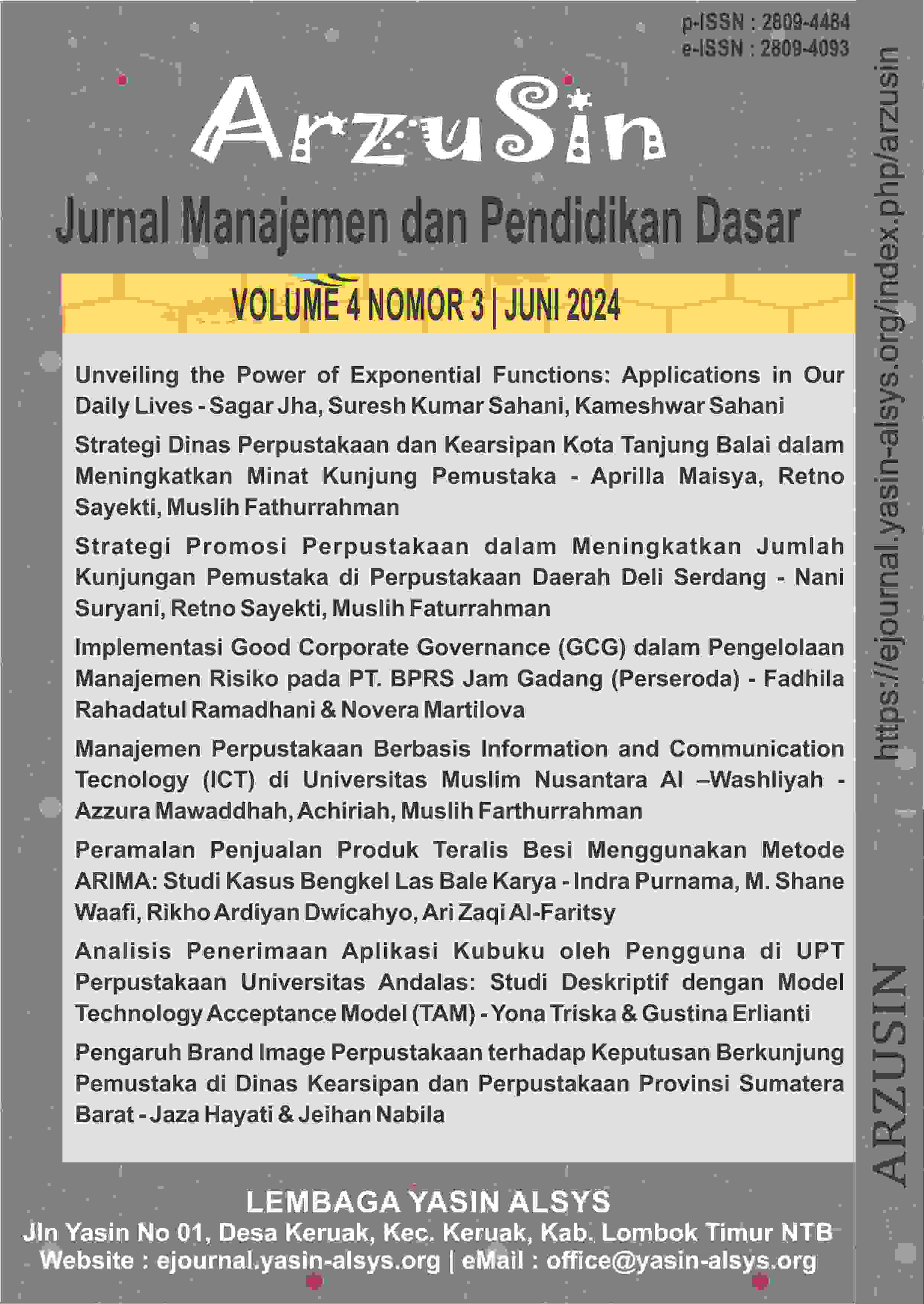
Peramalan Penjualan Produk Teralis Besi Menggunakan Metode ARIMA: Studi Kasus Bengkel Las Bale Karya Sales Forecasting of Iron Grills Using ARIMA Method: A Case Study of Bale Karya Welding Workshop

Article Sidebar
 Page Numbers:
464-471
Page Numbers:
464-471
 Digital Object Identifier:
10.58578/arzusin.v4i3.2965
Digital Object Identifier:
10.58578/arzusin.v4i3.2965


 Viewed: 425 times
 Downloaded: 308 times












LYAS Publisher cordially invites qualified professionals to serve as Editors or Reviewers. Your expertise will make an important contribution to maintaining and strengthening the academic quality of our publications. Interested applicants are kindly requested to complete the application form at the following link: Editors & Reviewers


Please feel free to contact us if you need any further information about the submission process or if you have any additional questions.

 Authors:
Indra Purnama1, M. Shane Waafi2, Rikho Ardiyan Dwicahyo3, Ari Zaqi Al-Faritsy4
 Copyright :
Authors retain copyright and grant the journal right of first publication.
Main Article Content
Abstract
Bengkel Las Bale Karya is one of the small and medium-sized enterprises (SMEs) that produces various types of iron crafts such as seesaws, swings, staircase railings, balcony railings, spiral staircases, iron doors, grilles, fence doors, and others. This research focuses on the production of iron grille products. The research method employed in this study is the ARIMA method for forecasting over the next 12 periods. The results of this study aim to optimize iron grille production to prevent product stockpiling, ensure material availability, and enhance workplace safety.








Downloads
Citation Metrics & Similar Scopus Articles
-
Pu X. (2027)Manufacturer vs. Retailer live-streaming introduction strategy: Product quality perspectiveJournal of Retailing and Consumer Services, 94
-
Sreedhanya L.R. (2027)Smart Cyber-Physical System Implementation Strategy for Real-Time Operational Optimization in Sugar FactoriesSmart Innovation Systems and Technologies, 505 SIST, 63-74
-
Hanyu K. (2027)Effect of the humidifying process conditions on the strength of formulated milk powder tabletsJournal of Food Engineering, 421
Article Details

Authors retain copyright and grant the journal right of first publication with the work simultaneously licensed under a Creative Commons Attribution-NonCommercial-ShareAlike 4.0 International License that allows others to share the work with an acknowledgement of the work's authorship and initial publication in this journal.
References
Anggraeni, K. (2011). Peramalan Volume Penjualan Mipcinta 50 WP di PT. Petrokimia Kayaku Gresik. Surabaya : Institut Teknologi Sepuluh Nopember
Arif. (2010). Penerapan metode ARIMA dalam memprediksi temperatur udara. Retrieved November 12, 2011, from http://arifzenki.wordpress.com/2008 /08/29/penerapan-metode-arima-dalam memprediksi-temperature-udara.
Bowerman, B. L., & O’Connell, R. T. (1993). Forecasting and Time Series. California : Duxbury Press. Cryer, J. D., & Chan, K. (2008). Time Series Analysis With Application in R Second Edition. New York: Springer Science Bussines Media.
Box, G. E. P., Jenkins, G. M., & Reinsel, G. C. (2015). Time Series Analysis: Forecasting and Control. John Wiley & Sons.
Chatfield, C. (2019). The Analysis of Time Series: An Introduction. Chapman and Hall/CRC.
Enders, W. (2014). Applied Econometric Time Series. John Wiley & Sons.
Hanke, J.E. & Wichern D.W. (2009). Business Forcasting (9th edition). New Jersey: Pearson Prentice-Hall, Inc.
Hyndman, R. J., & Athanasopoulos, G. (2018). Forecasting: Principles and Practice. OTexts.
Makridakis, S., & Wheelwright, S. C. (2018). Forecasting: Methods and Applications. John Wiley & Sons.
Reksohadiprodjo, R. (1995). Business Forecasting. Yogyakarta: Edisi Keempat, Penerbit BPFE-Yogyakarta. Sumayang, L. 2003). Dasar-Dasar Manajemen Produksi dan Operasi. Jakarta: Salemba Empat.
Supranto, J. M A . (2000). Metode Peramalan Kuantitatif Untuk Perencanaan Ekonomi dan Bisnis. Jakarta: Cetakan Kedua, Penerbit Rineka Cipta.