
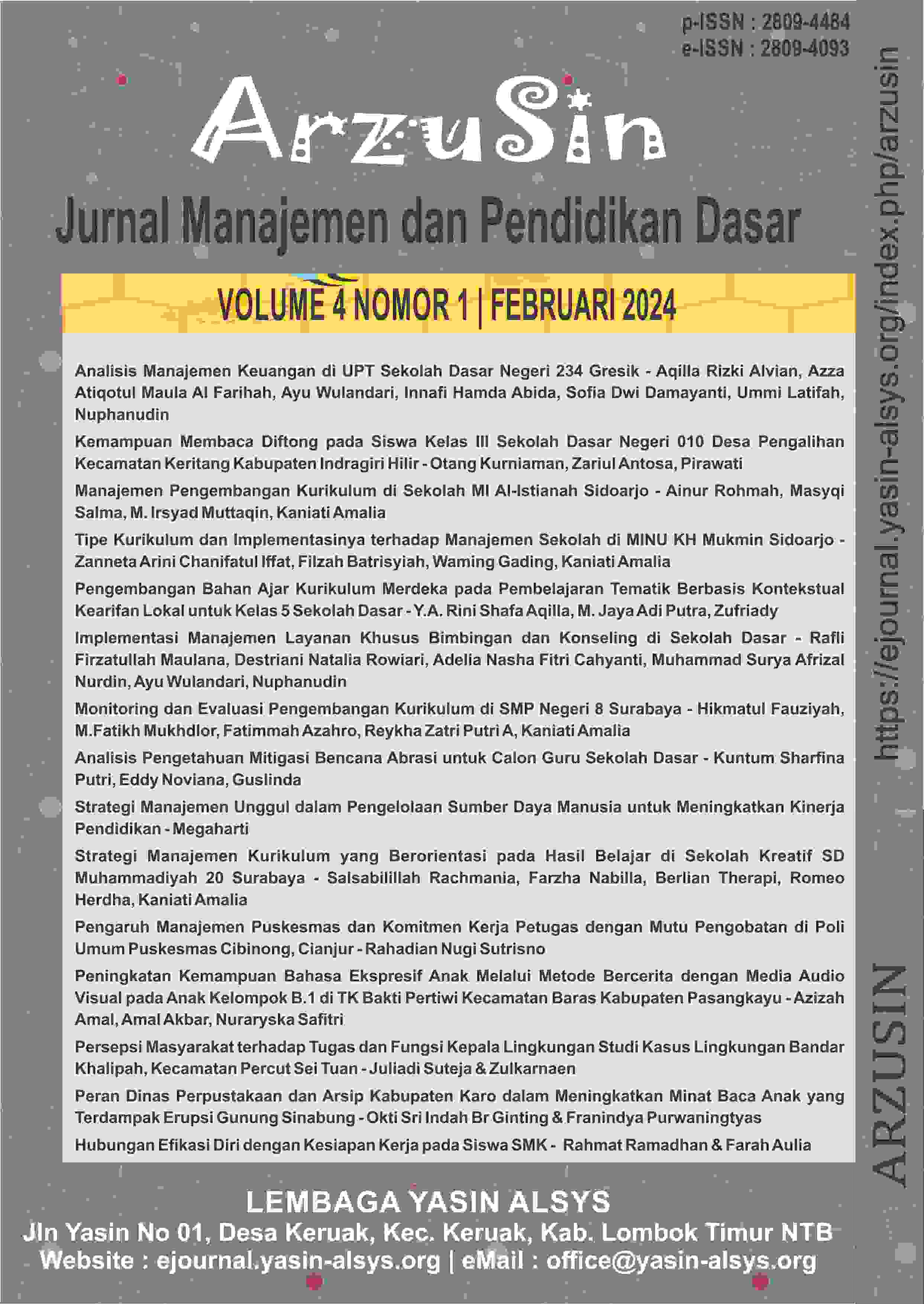
Peningkatan Kemampuan Bahasa Ekspresif Anak Melalui Metode Bercerita dengan Media Audio Visual pada Anak Kelompok B.1 di TK Bakti Pertiwi Kecamatan Baras Kabupaten Pasangkayu Improving Expressive Language Skills in Children through Storytelling with Audio-Visual Media in Group B.1 at Bakti Pertiwi Kindergarten, Baras Subdistrict, Pasangkayu Regency

Article Sidebar
 Page Numbers:
127-135
Page Numbers:
127-135
 Digital Object Identifier:


 Viewed: 433 times
 Downloaded: 417 times












LYAS Publisher cordially invites qualified professionals to serve as Editors or Reviewers. Your expertise will make an important contribution to maintaining and strengthening the academic quality of our publications. Interested applicants are kindly requested to complete the application form at the following link: Editors & Reviewers


Please feel free to contact us if you need any further information about the submission process or if you have any additional questions.

 Authors:
Azizah Amal1, Amal Akbar2, Nuraryska Safitri3
 Copyright :
Authors retain copyright and grant the journal right of first publication.
Explore Our Journals
Find the journal that best fits your research. If this journal does not match your manuscript’s scope, explore our portfolio below to select a more suitable publication venue.
Main Article Content
Abstract
The main problem in this research is whether using the storytelling method through audio-visual media can improve the expressive language skills of group B.1 children at TK Bakti Pertiwi Kab. Pasangkayu. The aim of this research is to improve children's expressive language skills through storytelling using audio-visual media for Group B.1 children at Bakti Pertiwi Kindergarten, Baras District, Kab. Pasangkayu. The benefits of this research can increase knowledge, especially in improving expressive language skills and it is hoped that it will be beneficial for children, teachers and schools. This type of research is class action research (Class Action Research) which consists of two cycles carried out in 3 meetings each cycle, research procedures include planning, implementation, observation and reflection. The subjects in this research were students of group B.1 TK Bakti Pertiwi Kab.Pasangkayu as many as 16 children. The results of this study showed that in the first cycle after being given action at meetings I, II, and III, there was an increase in children in the Starting to Develop (MB) criteria with a percentage of 43.74%, and in the second cycle after being given action at meetings I, II , and III, there is an increase in children with the criteria of Developing According to Expectations (BSH) with a percentage of 70.13%, which means that they have reached the target of children's development achievements with the criteria of Already Developing According to Expectations (BSH). Based on the research results, it can be concluded that applying the storytelling method through audio-visual media can improve expressive language skills in Group B.1 children at Bakti Pertiwi Kindergarten, Baras District, Kab. Pasangkayu with an average gain of 70.13% with the criteria of Developing According to Expectations (BSH).




Citation Metrics:




Downloads
Citation Metrics & Similar Scopus Articles
-
Zhao S. (2027)Research on the Representation Methods of Higher-Order Thinking Skills in Collaborative Inquiry-Based Learning: A Systematic Literature ReviewLecture Notes in Computer Science, 16778 LNCS, 123-137
-
Wei X. (2027)Impacts of GenAI-Enhanced Interdisciplinary Project-Based Learning Model on Students’ Higher-Order Thinking SkillsLecture Notes in Computer Science, 16778 LNCS, 211-224
-
Prahani R.S.B.K. (2027)Problem-Based Learning Assisted by Physics Digital Pocket Book: Experimental Study to Enhance Students’ Critical Thinking Skills Completed with Bibliometric Analysis toward Sustainable Development Goals (SDGs)Asean Journal of Educational Research and Technology, 6(1), 15-34
Article Details

Authors retain copyright and grant the journal right of first publication with the work simultaneously licensed under a Creative Commons Attribution-NonCommercial-ShareAlike 4.0 International License that allows others to share the work with an acknowledgement of the work's authorship and initial publication in this journal.