
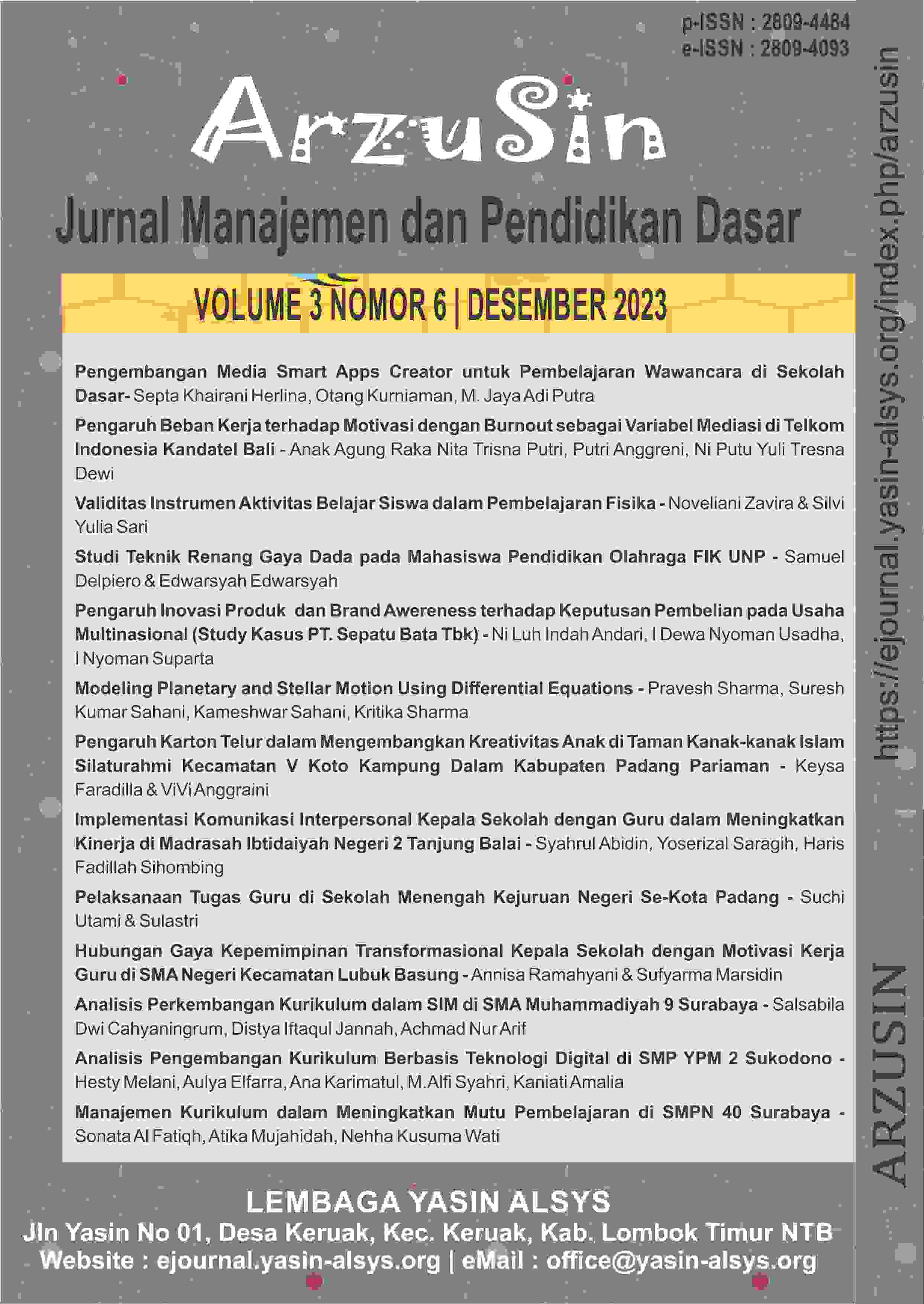
Pengembangan Media Smart Apps Creator untuk Pembelajaran Wawancara di Sekolah Dasar
Main Article Content
Abstract
This research aims to produce interactive multimedia development products on human digestive system material in elementary schools. The method used in this research is the R&D (Research and Development) development method with the 4D model. There are 4 stages carried out, namely definition, planning, development, distribution. In this research, researchers only carried out the development stage. The media developed by researchers was validated by 2 media experts. The practicality can be seen from the small group limited trial questionnaire. The data collection technique used by researchers in this research was a questionnaire. The data obtained from this data collection is then processed using quantitative analysis and description techniques. Based on the validation results of the smart apps creator media which was developed with very valid criteria with an average percentage of 95.93%. Meanwhile, the practicality of this media is based on the average percentage score of teacher response questionnaires of 93.63% and the average percentage of students' practicality score of 86.56%. From the research results, it can be concluded that the smart apps creator media in the interview material criteria is valid and practical to use for learning.




Citation Metrics:




Downloads
Citation Metrics & Similar Scopus Articles
-
Azhand A. (2027)Teaching Persian derivational affixes to non-Persian speakers from a Cognitive Morphology Approach: A case study of nominal suffixes (kar, gar, ban, baz, -ande)Language Related Research, 17(4), 469-497
-
Naemi Z. (2027)The Relationship between Second Language Learning Strategies, Learning Engagement, and Writing Skill in the Arabic Writing CurriculumLanguage Related Research, 17(4), 331-360
-
Kenzhaliyev B.K. (2027)Predicting Copper Production Cycles in Hydrometallurgy with Interpretable Machine LearningKompleksnoe Ispolzovanie Mineralnogo Syra, 341(2), 5-15
Article Details

Authors retain copyright and grant the journal right of first publication with the work simultaneously licensed under a Creative Commons Attribution-NonCommercial-ShareAlike 4.0 International License that allows others to share the work with an acknowledgement of the work's authorship and initial publication in this journal.
Article Sidebar
 Page Numbers:
709-721
 Digital Object ID:













 Viewed: 386 times
 Downloaded: 392 times

LYAS Publisher cordially invites qualified professionals to serve as Editors or Reviewers. Your expertise will make an important contribution to maintaining and strengthening the academic quality of our publications. Interested applicants are kindly requested to complete the application form at the following link: Editors & Reviewers


Please feel free to contact us if you need any further information about the submission process or if you have any additional questions.

 Authors:
 Copyright :
Authors retain copyright and grant the journal right of first publication.
Explore Our Journals
Find the journal that best fits your research. If this journal does not match your manuscript’s scope, explore our portfolio below to select a more suitable publication venue.