
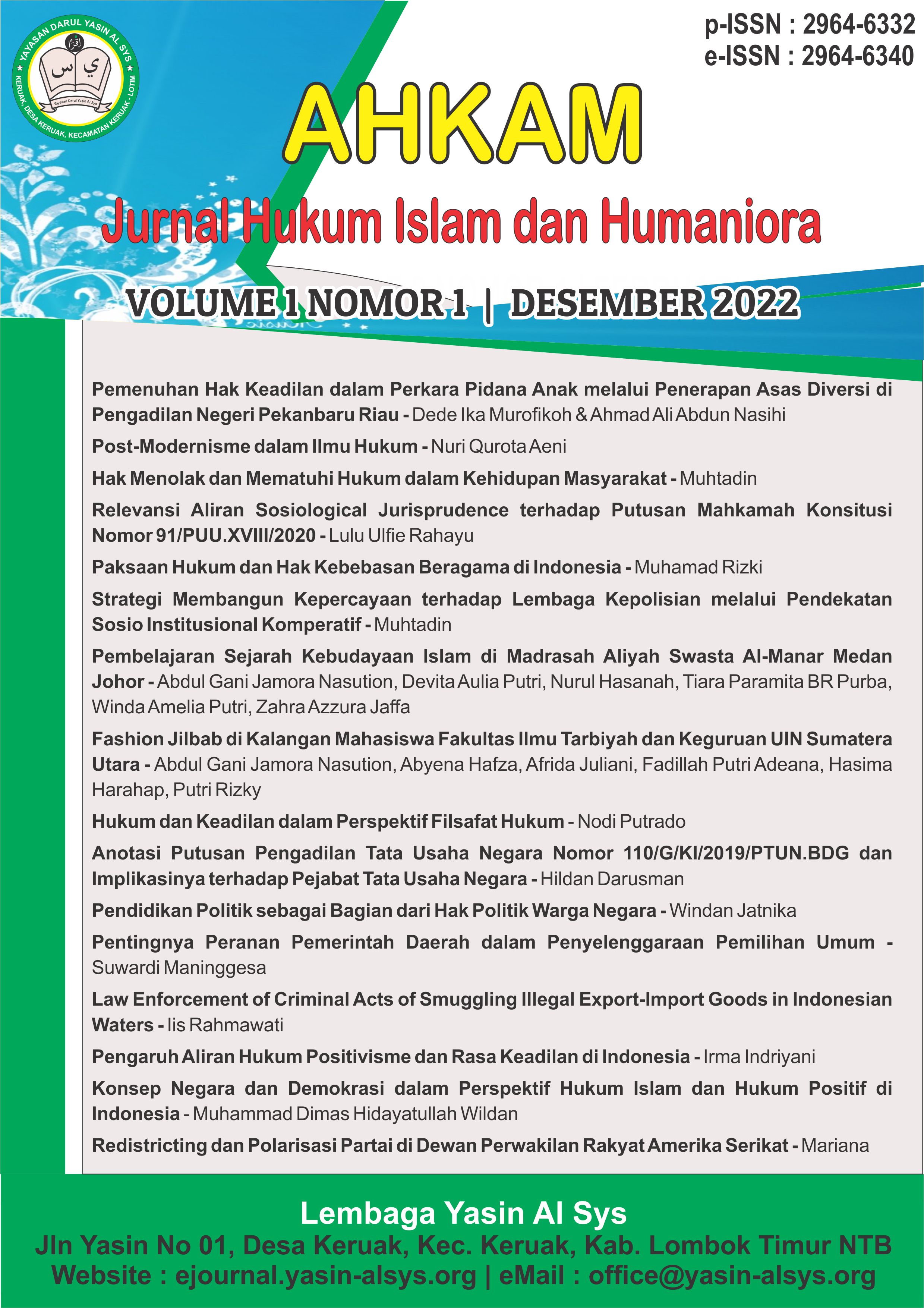
Fashion Jilbab di Kalangan Mahasiswa Fakultas Ilmu Tarbiyah dan Keguruan UIN Sumatera Utara

Main Article Content
Abstract
This article examines “Hijab Fashion Among Students of the Tarbiyah and Teacher Training Faculty of UIN North Sumatra” using a descriptive qualitative approach. focus on answering the first question, about female students' understanding of the headscarf. Second, regarding the reference to the hijab style. Third, regarding the trend of wearing the headscarf and regulations in the Faculty of Tarbiyah Science and Teacher Training at UIN North Sumatra Medan. The results of the study show that first, when critically discussed, a fundamental difference is found regarding the understanding of the headscarf for women. Second, the style or model of wearing the hijab for female students at the State Islamic University of North Sumatra, especially the Faculty of Tarbiyah and Teacher Training, varies greatly. The change of every hijab model trend cannot be separated from the influence of social media, such as Instagram, Tiktok, YouTube. Third, there are several classification models for the trend of wearing the headscarf when compared to FITK regulations, namely that only a few female students cover their genitals, such as covering their chests, clothes that are not too thin, tight, and cover their genitals up to their wrists, which follow the hijab rules according to FITK regulations. However, there are also not a few female students who do not follow the hijab rules according to FITK regulations.




Citation Metrics:




Downloads
Citation Metrics & Similar Scopus Articles
-
Irawati R. (2027)Enhancing accounting students’ writing performance through problem-based learning: Evidence from a vocational higher education contextMultidisciplinary Science Journal, 9(1)
-
Trisnowati E. (2027)Science, Technology, Engineering, and Mathematics (STEM) and Research Skill Development (RSD) in Science Education in Higher Education: A Delphi-Based ModelAsean Journal of Educational Research and Technology, 6(2), 253-268
-
Naemi Z. (2027)The Relationship between Second Language Learning Strategies, Learning Engagement, and Writing Skill in the Arabic Writing CurriculumLanguage Related Research, 17(4), 331-360
Article Details

Authors retain copyright and grant the journal right of first publication with the work simultaneously licensed under a Creative Commons Attribution-NonCommercial-ShareAlike 4.0 International License that allows others to share the work with an acknowledgement of the work's authorship and initial publication in this journal.
References
Afifah, Neng Dara. 2007. Islam, Kepemimpinan Perempuan dan Seksualitas. Jakarta: Yayasan Obor Indonesia.
Asari, Hasan & Dkk. 2015. Etika dan Tata Tertib Mahasiswa UIN SU Medan. Medan: UINSU Press.
Dahlan, Abdul Aziz. 1997. Ensiklopedia Hukum Islam, Jilid II. Jakarta: PT. Icthiar Baru Van Hoeve.
Gainau, Maryam B. 2016. Pengantar Metode Penelitian. Yogyakarta: PT Kanisius.
Novendawati, Ayu Sulistiawati. 2015. Hubungan antara Citra Tubuh dengan Harga Diri Remaja Akhir Putri. Studi pada Mahasiswa Regular: Universitas Esa Unggul. Jurnal Psikologi Vol 13 No. 1.
Santoso, Didik. 2021. Buku Panduan Akademik FITK UIN SU Medan Tahun Akademik 2021/2022. Medan: FITK UIN Sumatera Utara Medan.
Shihab, M. Quraish. 2004. Jilbab, Pakaian Wanita Muslimah Pandangan Ulama Masa Lalu & Cendekiawan Kontemporer. Jakarta: Lentera Hati.
Sofiah, Ahlan. 2020. Hijab Bagi Wanita Muslimah di Era Modern. Jurnal Pengembangan Masyarakat Islam. Vol. 1.
Yavie, K.H. Alie. 1994. Menggagas Fikih Sosial. Bandung: Mizan.
Article Sidebar
 Page Numbers:
106-115
Page Numbers:
106-115
 Digital Object Identifier:













 Viewed: 774 times
 Downloaded: 571 times

LYAS Publisher cordially invites qualified professionals to serve as Editors or Reviewers. Your expertise will make an important contribution to maintaining and strengthening the academic quality of our publications. Interested applicants are kindly requested to complete the application form at the following link: Editors & Reviewers


Please feel free to contact us if you need any further information about the submission process or if you have any additional questions.

 Authors:
Abdul Gani Jamora Nasution1, Abyena Hafza2, Afrida Juliani3, Fadillah Putri Adeana4, Hasima Harahap5, Putri Rizky6
 Copyright :
Authors retain copyright and grant the journal right of first publication.
Explore Our Journals
Find the journal that best fits your research. If this journal does not match your manuscript’s scope, explore our portfolio below to select a more suitable publication venue.