
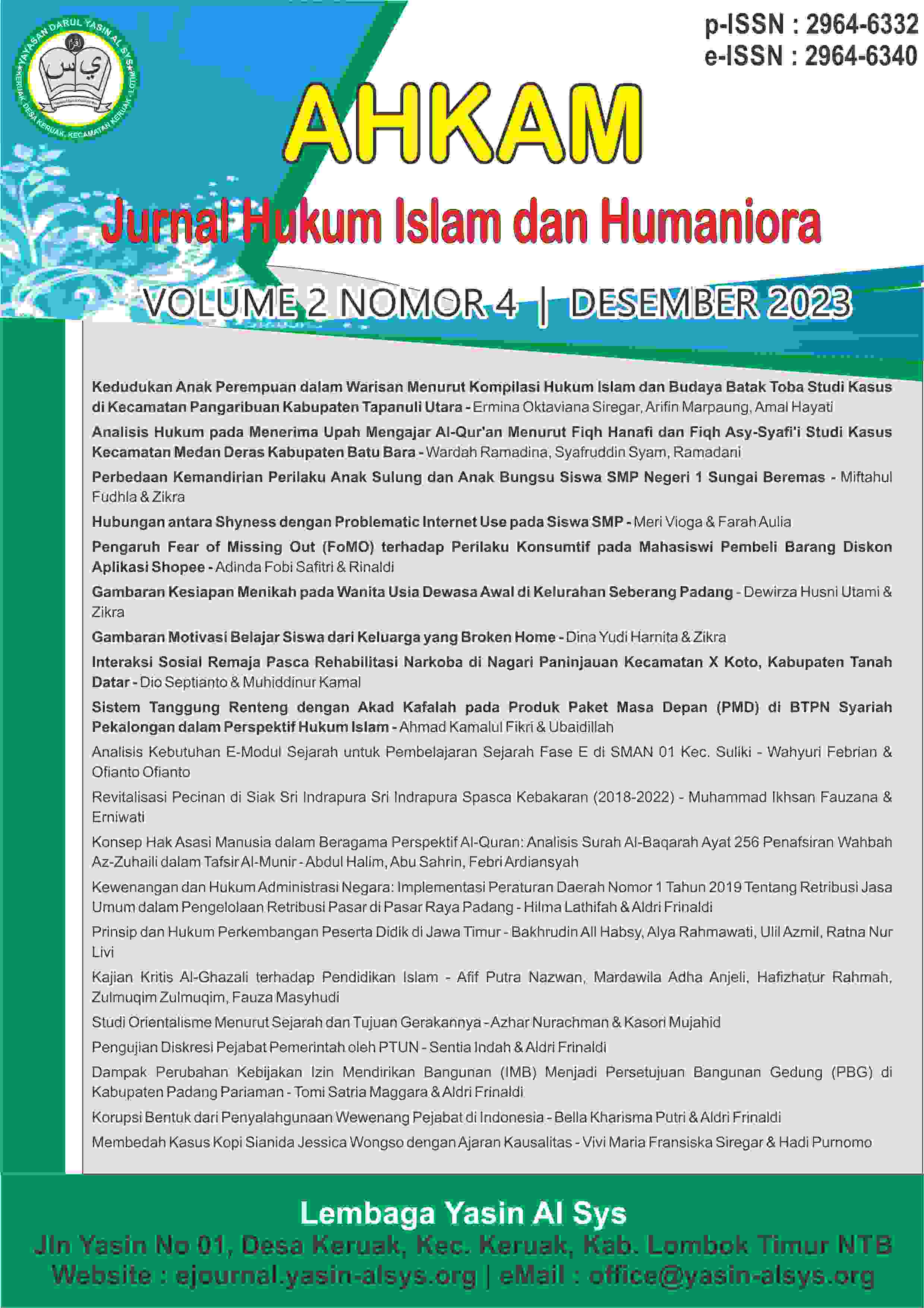
Gambaran Motivasi Belajar Siswa dari Keluarga yang Broken Home
Main Article Content
Abstract
Every teenager wants to live in a complete family. However, not all teenagers are lucky to have it, such as family divorce. broken home Families can affect teenagers' learning at school. This research aims to describe the learning motivation of students from broken home families. This research uses quantitative methods with a descriptive approach. The sample for this research was 56 students using a purposive sampling technique using the criteria of young victims of broken homes and looking at the students' behavior and achievements at school. Data were collected using a learning motivation questionnaire consisting of aspects of learning preparation, aspects of following the teaching and learning process, and aspects of following up on lessons with a Likert model scale. The number of validity items is 30 items and the reliability is 0.884. To find out the description of the research variables, use the percentage formula. The results of this research found that 43.10% of students from broken home families had low learning motivation. Therefore, guidance and counseling services are needed, such as information services, content mastery services, individual counseling services and group guidance services to increase student learning motivation.




Citation Metrics:




Downloads
Citation Metrics & Similar Scopus Articles
-
Ratnaningsih E. (2027)Designing a Data-Driven E-Learning Module for Teaching English to Young Learners: Integrating Needs Analysis and the ISAV Learning ModelAsean Journal of Educational Research and Technology, 6(2), 269-286
-
Unyaphatariyakool S. (2027)Science Teachers’ Learning Management Competency through Professional Learning Communities to Promote Scientific Creativity and Sustainable Development Goals (SDGs)Asean Journal of Educational Research and Technology, 6(2), 241-252
-
Trisnowati E. (2027)Science, Technology, Engineering, and Mathematics (STEM) and Research Skill Development (RSD) in Science Education in Higher Education: A Delphi-Based ModelAsean Journal of Educational Research and Technology, 6(2), 253-268
Article Details

Authors retain copyright and grant the journal right of first publication with the work simultaneously licensed under a Creative Commons Attribution-NonCommercial-ShareAlike 4.0 International License that allows others to share the work with an acknowledgement of the work's authorship and initial publication in this journal.
References
Aini, H & Afdal. (2020). “Analisis Kesiapan Psikologi Pasangan dalam Menghadapi Pernikahan”. JAIPTEKIN, 4 (2).
Ar-Rusyd & Saekan. (2013). Broken Home dari Perspektif Ilmu Sosial. Kudus: Jurusan Dakwah.
Aziz, M. (2015). "Perilaku Sosial Anak Remaja Korban Broken Home dalam Berbagai Perspektif". Jurnal AlIjtimaiyyah, 1(1).
Badan Pusat Statistik. (2022). Kasus Perceraian di Kota Padang. Retrieved from Padangkota.bps.go.id.
Badaruddin, A. (2015). Peningkatan Motivasi Belajar Siswa melalui Konseling Klasikal. Padang: Abe Kreatifindo.
Cahyani, N. F., Samad, S & Anas, M . (2022). "Konseling Individu bagi Siswa Korban Broken Home". Phinisi Journal Of Art, Humanity & Social Studies, 1(1).
Durrotunnisa & Hanita . (2022). "Konseling Kelompok Teknik Reinforcement Positif untuk Meningkatkan Motivasi Belajar Siswa Broken Home". Jurnal BASICEDU, 6(1).
Fajriyati, M., Nurdin, S & Nelissa, Z. (2022). "Diagnosis Kesulitan Belajar Siswa dari Keluarga Broken Home". Teraputik, 6(1).
Fikri., Neviyarni & Syukur. (2021). "Hakekat Keluarga dan Dasar Pembentukan Keluarga". Jambura Guidance and Counseling Journal, 2(1).
Maulida, S. (2021). "Peran Guru BK dalam Meningkatkan Motivasi Belajar Anak Broken Home Melalui Pendekatan Realita Pada Siswa Kelas VIII di SMPN 7 Kota Sukabumi". Prosiding Seminar Nasional Bimbingan dan Konseling Islam.
Mu'jizah, D. S. (2019). "Motivasi Belajar Pada Anak Keluarga Broken Home di SMK Piri 1" Yogyakarta. Jurnal Riset Mahasiswa Bimbingan dan Konseling, 5(7).
Nadila, E. Y. Taufik & Syarif, S. 2021. "Analisis Konseling Rational Emotive Behavior Therapy dalam Pendidikan". Jurnal Bimbingan Konseling dan Psikologi, 1(2).
Neli, U. S & Sukmawati, I. (2019). "Altruistic Behavior of Students in SMA N 1 Kampung Dalam Padang Pariaman Regency and The Implication in Guidance and Counseling". Jurnal Neo Konseling, 1(4).
Oktavia., Zikra dan Nurfarhanah . (2016). " Konsep Diri Penyandang Tunanetra dan Implikasinya terhadap Layanan Bimbingan dan Konseling". Konselor, 5(4).
Prayitno & Amti, E. (2006). Psikologi Perkembangan Remaja. Padang: Angkasa Raya.
Putra, S. A., Daharnis & Syahniar. (2013). "Efektivitas Layanan Bimbingan Kelompok dalam Meningkatkan Self Efficacy Siswa". Konselor, 2(2).
Rusni, I., Karnilawati, Desyandri & Murni, I (2022). "Dampak Keluarga Broken Home terhadap Motivasi Belajar Siswa". Jurnal Pendidikan Tambusai, 6(2).
Subtikasari, A & Neviyarni. (2019). "Contect Mastery Services With Contextual Teaching and Learning Approaches to Improve Student Self Regulated Learning". Jurnal Neo Konseling, 1(1).
Syaifuddin, M., Turatmiyah, S & Yahanan, A. (2013). Hukum Perceraian. Jakarta: Sinar Grafika.
Tania, A. L, dkk. (2021). Usaha Pemberian Layanan yang Optimal Guru BK pada Masa Pandemi Covid-19. Yogyakarta: UAD Press.
Taufik. (2015). “Bimbingan Kelompok Pra-Nikah bagi Mencegah Perceraian di Kalangan Pasangan Muda” Jurnal Ilmiah Ilmu Pendidikan, 15(2).
Taufik & Komar, N. (2021). "Hubungan Self Efficacy terhadap Peningkatan Motivasi Belajar dan Hasil Belajar Matematika Siswa di Sekolah". Jurnal Andragogi, 3(2).
Yendi, F. M., Ardi, Z., & Ifdil, I. (2014). “Counseling Services for Women in Marriage Age”. Jurnal Konseling dan Pendidikan, 2(3).
Yendi, F. M., Syukur, Y & Rafsyam, Y. (2015). "Self Esteem dan Pelayanan Bimbingan dan Konseling yang Dibutuhkan Siswa Kelas Akselerasi". Konselor, 4(4).
Zarniati., Alizamar & Zikra. (2014). "Upaya Guru Bimbingan dan Konseling dalam Meningkatkan Kegiatan Belajar Peserta Didik". Konselor, 3(1).
Article Sidebar
 Page Numbers:
751-761
Page Numbers:
751-761
 Digital Object ID:













 Viewed: 553 times
 Downloaded: 481 times

LYAS Publisher cordially invites qualified professionals to serve as Editors or Reviewers. Your expertise will make an important contribution to maintaining and strengthening the academic quality of our publications. Interested applicants are kindly requested to complete the application form at the following link: Editors & Reviewers


Please feel free to contact us if you need any further information about the submission process or if you have any additional questions.

 Authors:
 Copyright :
Authors retain copyright and grant the journal right of first publication.
Explore Our Journals
Find the journal that best fits your research. If this journal does not match your manuscript’s scope, explore our portfolio below to select a more suitable publication venue.