
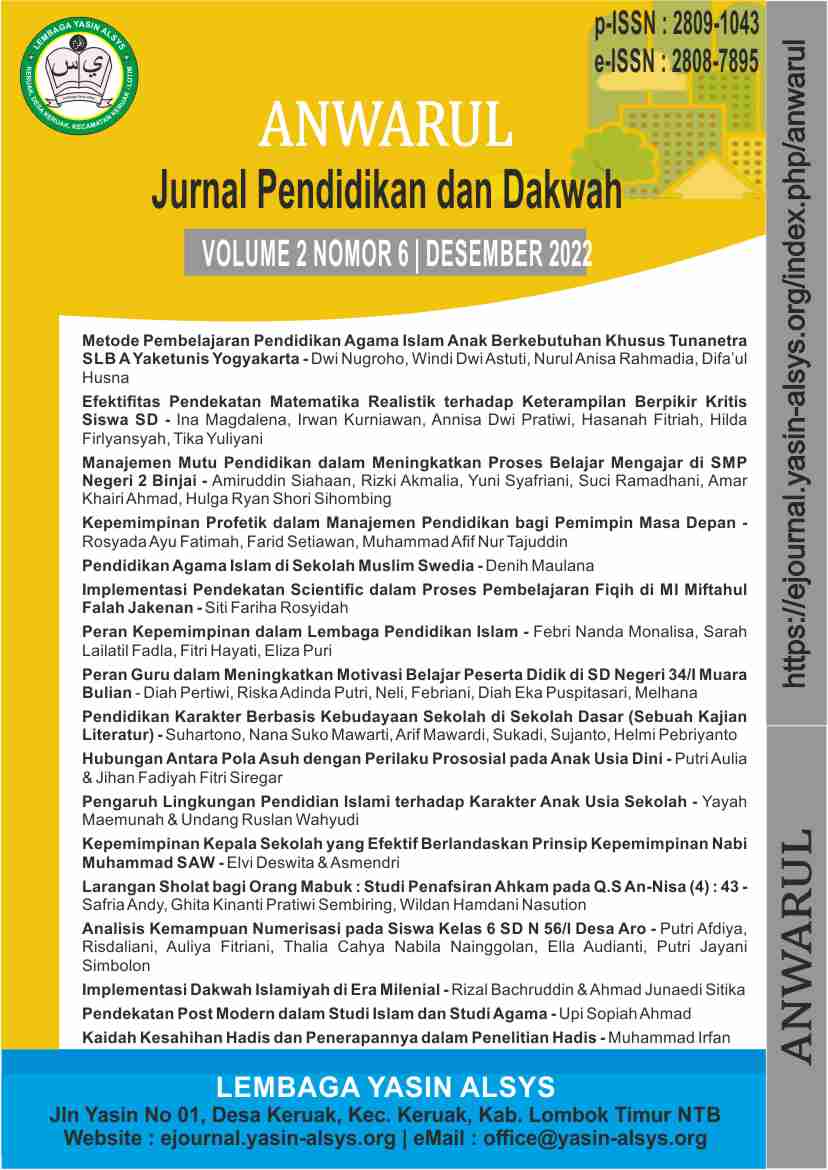
Pendidikan Agama Islam di Sekolah Muslim Swedia

Article Sidebar
 Page Numbers:
455-468
Page Numbers:
455-468
 Digital Object Identifier:


 Viewed: 403 times
 Downloaded: 389 times












LYAS Publisher cordially invites qualified professionals to serve as Editors or Reviewers. Your expertise will make an important contribution to maintaining and strengthening the academic quality of our publications. Interested applicants are kindly requested to complete the application form at the following link: Editors & Reviewers


Please feel free to contact us if you need any further information about the submission process or if you have any additional questions.

 Authors:
Denih Maulana1
 Copyright :
Authors retain copyright and grant the journal right of first publication.
Explore Our Journals
Find the journal that best fits your research. If this journal does not match your manuscript’s scope, explore our portfolio below to select a more suitable publication venue.
Main Article Content
Abstract
In the literature on Islamic religious education (IRE), the process of teaching Islam to the younger generation is often referred to as "transmitting Islam". Obviously, there are certain "facts" that are often transmitted from one generation to another, such as the names of prophets, the five pillars of Islam and the words of the Quran. But what meaning and meaning people have and these concepts are not necessarily "transmitted". In this paper, I argue that using the concept of "transmit- ting" raises some problems, such as providing a static view of the Islamic educational process, thus ignoring the contextualization that is an important part of all teaching. Referring to Homi Bhabha, I instead suggest that the concept of translation is more accurate to what Islamic religious education teachers do, because translation includes the idea of interpretation and thus shows the power that teachers have when they make educational choices. The empirical material used comes from fr om fieldwork in Swedish Muslim schools.




Citation Metrics:




Downloads
Citation Metrics & Similar Scopus Articles
-
Bursan I.Z. (2027)The Integration of Islamic Religious Values in the Ritual Mantras of Pinisi Boat-Making as Instructional Material for Literature Learning in Islamic SchoolsAsean Journal of Educational Research and Technology, 6(1), 1-14
-
Kumar A. (2027)Direct Technology Diffusion in Higher Education: Evidence from Doctoral StudentsAsean Journal of Educational Research and Technology, 6(1), 79-92
-
Ding S. (2027)Digital Renewal of University Education: Barriers, Opportunities, and Contributions to Sustainable Development Goals (SDGs)Asean Journal of Educational Research and Technology, 6(2), 229-240
Article Details

Authors retain copyright and grant the journal right of first publication with the work simultaneously licensed under a Creative Commons Attribution-NonCommercial-ShareAlike 4.0 International License that allows others to share the work with an acknowledgement of the work's authorship and initial publication in this journal.