
Urgensi Asbabun Nuzul bagi Seorang Mufassir dalam Menafsirkan Ayat Al-Qur'an The Significance of Asbab al-Nuzul for a Mufassir (Quranic Interpreter) in Interpreting Quranic Verses

Article Sidebar
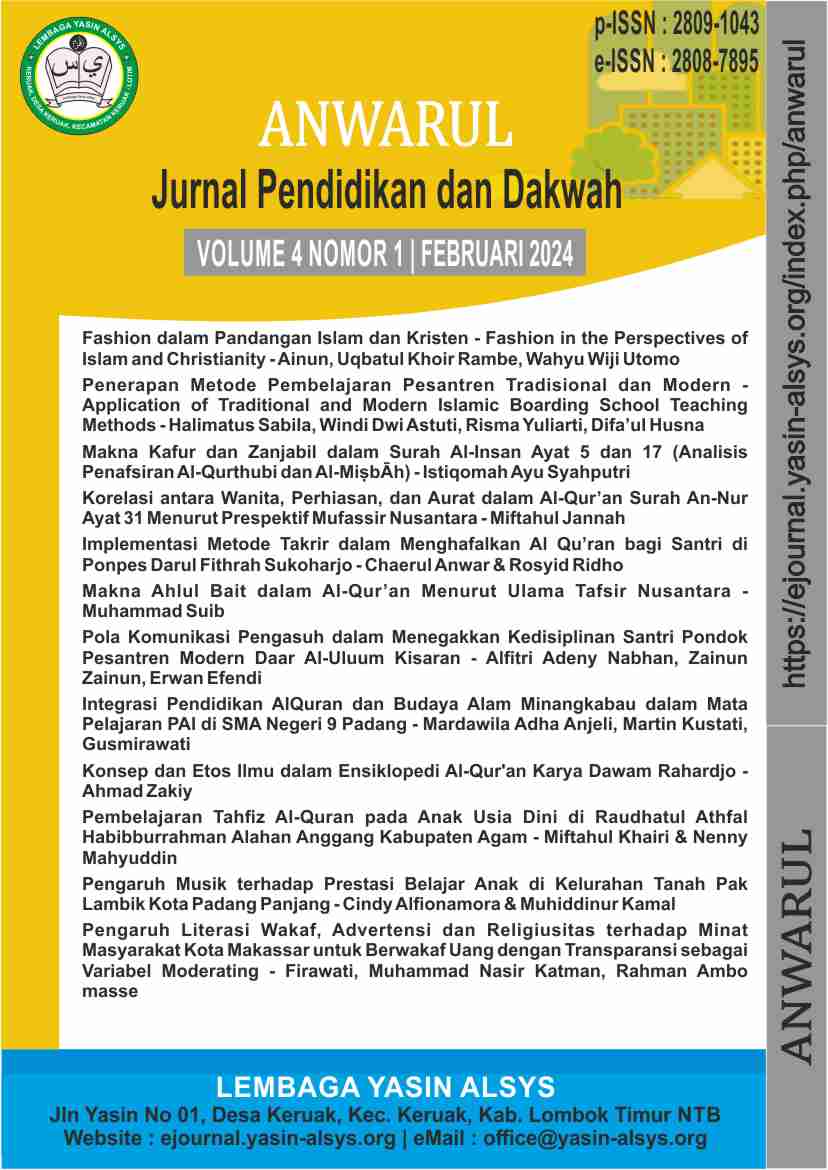
 Page Numbers:
196-206
Page Numbers:
196-206
 Digital Object Identifier:


 Viewed: 611 times
 Downloaded: 447 times












LYAS Publisher cordially invites qualified professionals to serve as Editors or Reviewers. Your expertise will make an important contribution to maintaining and strengthening the academic quality of our publications. Interested applicants are kindly requested to complete the application form at the following link: Editors & Reviewers


Please feel free to contact us if you need any further information about the submission process or if you have any additional questions.

 Authors:
Ahmad Yasir Al Amin1*, Nashruddin Baidan2
 Copyright :
Authors retain copyright and grant the journal right of first publication.
Main Article Content
Abstract
The Qur'an is the Word of Allah, revealed to Prophet Muhammad (peace be upon him) through the intermediary of the angel Gabriel in a continuous and well-documented manner. It serves as a miracle and a guide for humanity. The Qur'an was revealed to Prophet Muhammad (peace be upon him) at specific times and during particular events. Therefore, understanding the reasons for the revelation of the Qur'an is a fundamental basis for a commentator (mufassir) to interpret its verses and implications in the establishment of Sharia law. By comprehending the interpretation correctly and understanding the establishment of Sharia law, we can extract wisdom from it and find motivation to fulfill what is contained within the Qur'an.




Citation Metrics:




Downloads
Citation Metrics & Similar Scopus Articles
-
Benuzzi L. (2026)Impact of blunt adrenal gland injury (BAGI) in major trauma: a systematic review and meta-analysisWorld Journal of Emergency Surgery, 21(1)
-
Sulthana H. (2026)Green analytical evaluation of anticancer drug analysis: A multi-tool assessment of HPLC and LC–MS methodsScientific Reports, 16(1)
-
Alam P. (2026)Greenness and whiteness profiles of a validated HPTLC method for the simultaneous analysis of clopidogrel and rosuvastatin in fixed-dose combination capsulesBMC Chemistry, 20(1)
Article Details

Authors retain copyright and grant the journal right of first publication with the work simultaneously licensed under a Creative Commons Attribution-NonCommercial-ShareAlike 4.0 International License that allows others to share the work with an acknowledgement of the work's authorship and initial publication in this journal.