
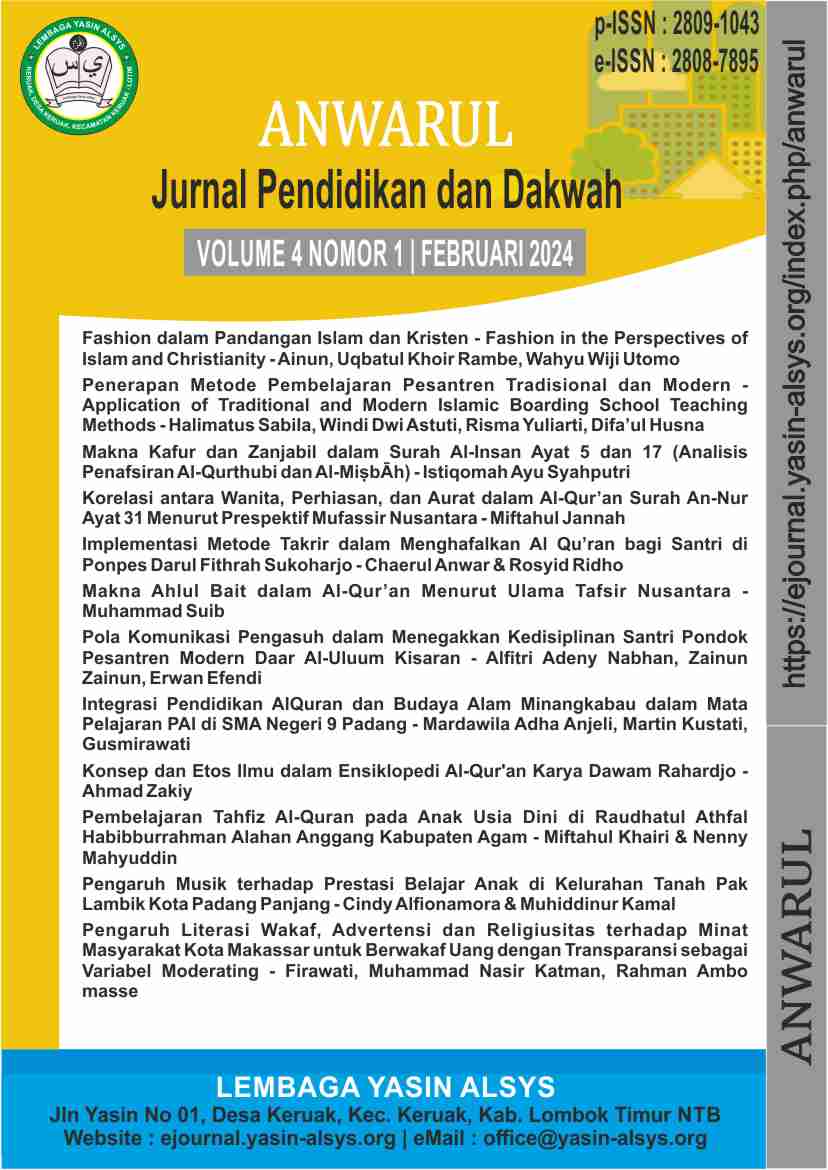
Fashion dalam Pandangan Islam dan Kristen Fashion in the Perspectives of Islam and Christianity

Article Sidebar
 Page Numbers:
1-12
Page Numbers:
1-12
 Digital Object Identifier:













 Viewed: 269 times
 Downloaded: 318 times

LYAS Publisher cordially invites qualified professionals to serve as Editors or Reviewers. Your expertise will make an important contribution to maintaining and strengthening the academic quality of our publications. Interested applicants are kindly requested to complete the application form at the following link: Editors & Reviewers


Please feel free to contact us if you need any further information about the submission process or if you have any additional questions.

 Authors:
Ainun Ainun1, Uqbatul Khoir Rambe2, Wahyu Wiji Utomo3
 Copyright :
Authors retain copyright and grant the journal right of first publication.
Explore Our Journals
Find the journal that best fits your research. If this journal does not match your manuscript’s scope, explore our portfolio below to select a more suitable publication venue.
Main Article Content
Abstract
This research examines fashion from Islamic and Christian views. The methodology used in this research is qualitative with a library research research design. And the data sources obtained from this research are primary and secondary data sources that are in accordance with the discussion. Then this research uses a phenomenological approach method, where the phenomenological approach method is an approach that attempts to capture various problems that exist in society. Meanwhile, the theoretical approach is a comparative-descriptive theory. This research aims to explore how religion regulates its people in fashion, especially clothing, and also to find out whether there are similarities and differences in clothing in Islam and Christianity. Based on this research, the results showed that dressing in Islam and Christianity requires women to dress to cover their bodies and requires women to wear clothing appropriate for women. In Islam, there is more emphasis on dressing to cover the private parts, the clothes worn are thick and loose, not tasyabbuh, not required to wear fragrance/perfume, not glamorous clothes and not as jewelry. And the essence of clothing for Muslim women is to cover their private parts, not for the purpose of showing off and arrogance which will have a bad impact on themselves. Christianity emphasizes on its followers to dress appropriately and fulfill the requirements stated in the Bible.




Citation Metrics:




Downloads
Citation Metrics & Similar Scopus Articles
-
Tiwari V. (2027)Reframing artificial intelligence as an observable market signal: Extending Signaling Theory in luxury fashion retailJournal of Retailing and Consumer Services, 95
-
Ullah O. (2027)When do sustainability-related fashion reviews become helpful? The credibility role of verified purchase in online retailingJournal of Retailing and Consumer Services, 95
-
Angraini L.M. (2027)Integrating Computational Thinking and Islamic Values in Geometry Learning: Effects on Pre-Service Primary Teachers’ Conceptual UnderstandingAsean Journal of Educational Research and Technology, 6(1), 67-78
Article Details

Authors retain copyright and grant the journal right of first publication with the work simultaneously licensed under a Creative Commons Attribution-NonCommercial-ShareAlike 4.0 International License that allows others to share the work with an acknowledgement of the work's authorship and initial publication in this journal.