
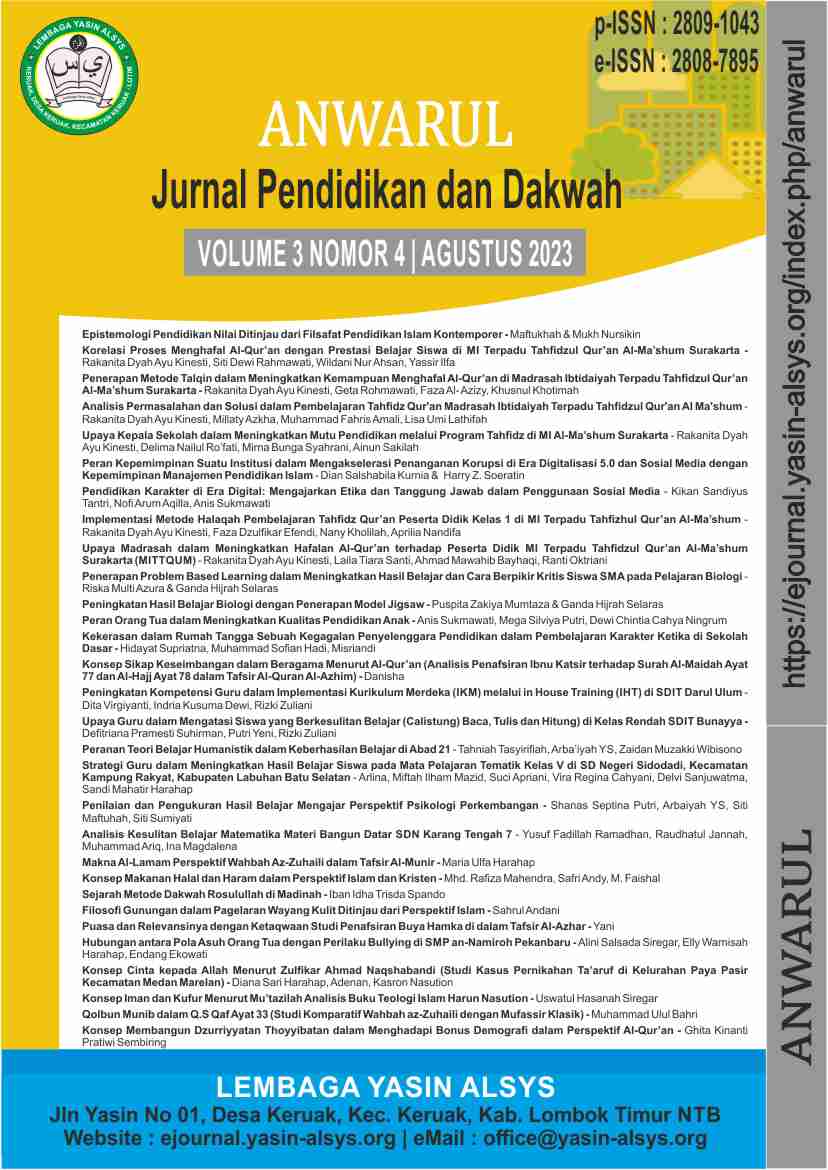
Penilaian dan Pengukuran Hasil Belajar Mengajar Perspektif Psikologi Perkembangan

Article Sidebar
 Page Numbers:
799-819
Page Numbers:
799-819
 Digital Object Identifier:


 Viewed: 696 times
 Downloaded: 592 times












LYAS Publisher cordially invites qualified professionals to serve as Editors or Reviewers. Your expertise will make an important contribution to maintaining and strengthening the academic quality of our publications. Interested applicants are kindly requested to complete the application form at the following link: Editors & Reviewers


Please feel free to contact us if you need any further information about the submission process or if you have any additional questions.

 Authors:
Shanas Septina Putri1, Arbaiyah YS2, Siti Maftuhah3, Siti Sumiyati4
 Copyright :
Authors retain copyright and grant the journal right of first publication.
Main Article Content
Abstract
This article discusses the importance of evaluating and measuring teaching and learning outcomes from a developmental psychology perspective. Developmental psychology plays an important role in understanding how people learn and develop over time and in identifying the factors that influence learning outcomes. This article discusses several developmental psychology theories that are important for the evaluation and measurement of learning outcomes, the methods used in the evaluation and measurement, as well as challenges and solutions for the evaluation and measurement of learning outcomes. Hopefully, this article can provide new knowledge for teachers and researchers about how to optimize the teaching and learning process and improve student learning outcomes. Evaluation is a process or activity that provides information about the quality, quantity, and meaning of an observed phenomenon or event. Thorndike defines measurement as the process of generating quantitative information about the nature or characteristics of an object, event, or individual through measurement. According to Thorndike, measurement is the process of producing objective quantitative information about the trait or characteristic being measured. According to Gronlund (2006), teaching and learning outcomes are students' abilities to apply knowledge, skills, and attitudes learned in real-life situations. According to Mulyasa (2013), teaching and learning outcomes are the attainment of learning objectives as measured by students' knowledge, skills, and attitudes. According to Papalia and Feldman (2011), developmental psychology studies the changes that occur in humans during their life span, from childhood to old age.




Citation Metrics:




Downloads
Citation Metrics & Similar Scopus Articles
-
Irawati R. (2027)Enhancing accounting students’ writing performance through problem-based learning: Evidence from a vocational higher education contextMultidisciplinary Science Journal, 9(1)
-
Azhand A. (2027)Teaching Persian derivational affixes to non-Persian speakers from a Cognitive Morphology Approach: A case study of nominal suffixes (kar, gar, ban, baz, -ande)Language Related Research, 17(4), 469-497
-
Kenzhaliyev B.K. (2027)Predicting Copper Production Cycles in Hydrometallurgy with Interpretable Machine LearningKompleksnoe Ispolzovanie Mineralnogo Syra, 341(2), 5-15
Article Details

Authors retain copyright and grant the journal right of first publication with the work simultaneously licensed under a Creative Commons Attribution-NonCommercial-ShareAlike 4.0 International License that allows others to share the work with an acknowledgement of the work's authorship and initial publication in this journal.