
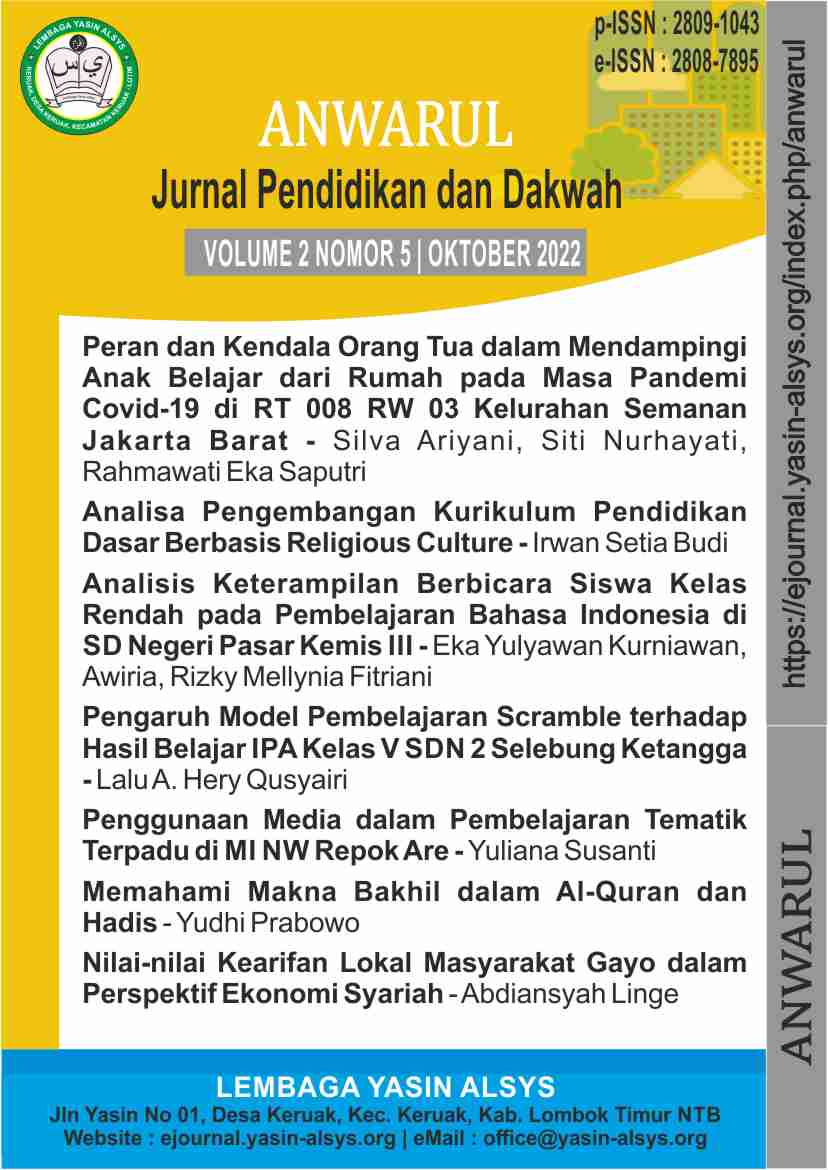
Memahami Makna Bakhil dalam Al-Quran dan Hadis
Main Article Content
Abstract
Islam is a religion that places great emphasis on people giving away their wealth in a good way, so that generosity arises which is one of the main characteristics that every Muslim individual who hopes for success in life and his life needs to always have, grow and develop. However, there is a trait and characteristic that can destroy generosity and the root of compassion, that can hide itself in the human subconscious to abandon good morals, that is known as miserliness. Miserliness paved the way for human nature to abandon its good morals. This research study is entirely based on literature review or literature studies. Therefore, the nature of the research is library (Library Research). The data collected and analyzed all come from literature and other document materials, such as books, writings in journals, as well as in other media, which are relevant to the problem under study. so you get the right answer. First, the word expression derived from the word (بخل) in the Qur'an is mentioned 12 times in 6 letters. Second, there are many things explained in the Qur'an in response to miserly acts, including encouraging sacrifices with one's soul, sacrificing property in jihad, Allah says about various kinds of harsh threats against miserly people, and stinginess is an illustration of shirk. who have loved excessive wealth than loving God. arrogance and turning away from the truth. The emergence of miserliness which is human nature due to driving factors such as the environment and education, love of the world and fear of poverty, being arrogant, money is the goal of life, and neglecting the effects of stinginess.




Citation Metrics:




Downloads
Citation Metrics & Similar Scopus Articles
-
Sulaeman M. (2026)Qur’an Reading Methods in Post-Soeharto Indonesia: The Conservative Turn, Commodified Piety, and the Reconfiguration of Qur’anic AuthorityJurnal Studi Ilmu Ilmu Al Qur an Dan Hadis, 27(2), 396-429
-
Dimyathi M.A. (2026)Qur’anic Exegesis in a Pedagogical Milieu: A Gadamerian Reading of the Tarbawī Spectrum in Thaifur ʿAli Wafa’s Firdaws al-NaʿīmJurnal Studi Ilmu Ilmu Al Qur an Dan Hadis, 27(2), 650-677
-
Shohib M. (2026)What the Qur’an Rules Out: Mā Kāna Constructions and the Rhetoric of Restriction in the Qur’anJurnal Studi Ilmu Ilmu Al Qur an Dan Hadis, 27(2), 542-561
Article Details

Authors retain copyright and grant the journal right of first publication with the work simultaneously licensed under a Creative Commons Attribution-NonCommercial-ShareAlike 4.0 International License that allows others to share the work with an acknowledgement of the work's authorship and initial publication in this journal.
Article Sidebar
 Page Numbers:
438-456
Page Numbers:
438-456
 Digital Object ID:













 Viewed: 936 times
 Downloaded: 860 times

LYAS Publisher cordially invites qualified professionals to serve as Editors or Reviewers. Your expertise will make an important contribution to maintaining and strengthening the academic quality of our publications. Interested applicants are kindly requested to complete the application form at the following link: Editors & Reviewers


Please feel free to contact us if you need any further information about the submission process or if you have any additional questions.

 Authors:
 Copyright :
Authors retain copyright and grant the journal right of first publication.
Explore Our Journals
Find the journal that best fits your research. If this journal does not match your manuscript’s scope, explore our portfolio below to select a more suitable publication venue.