
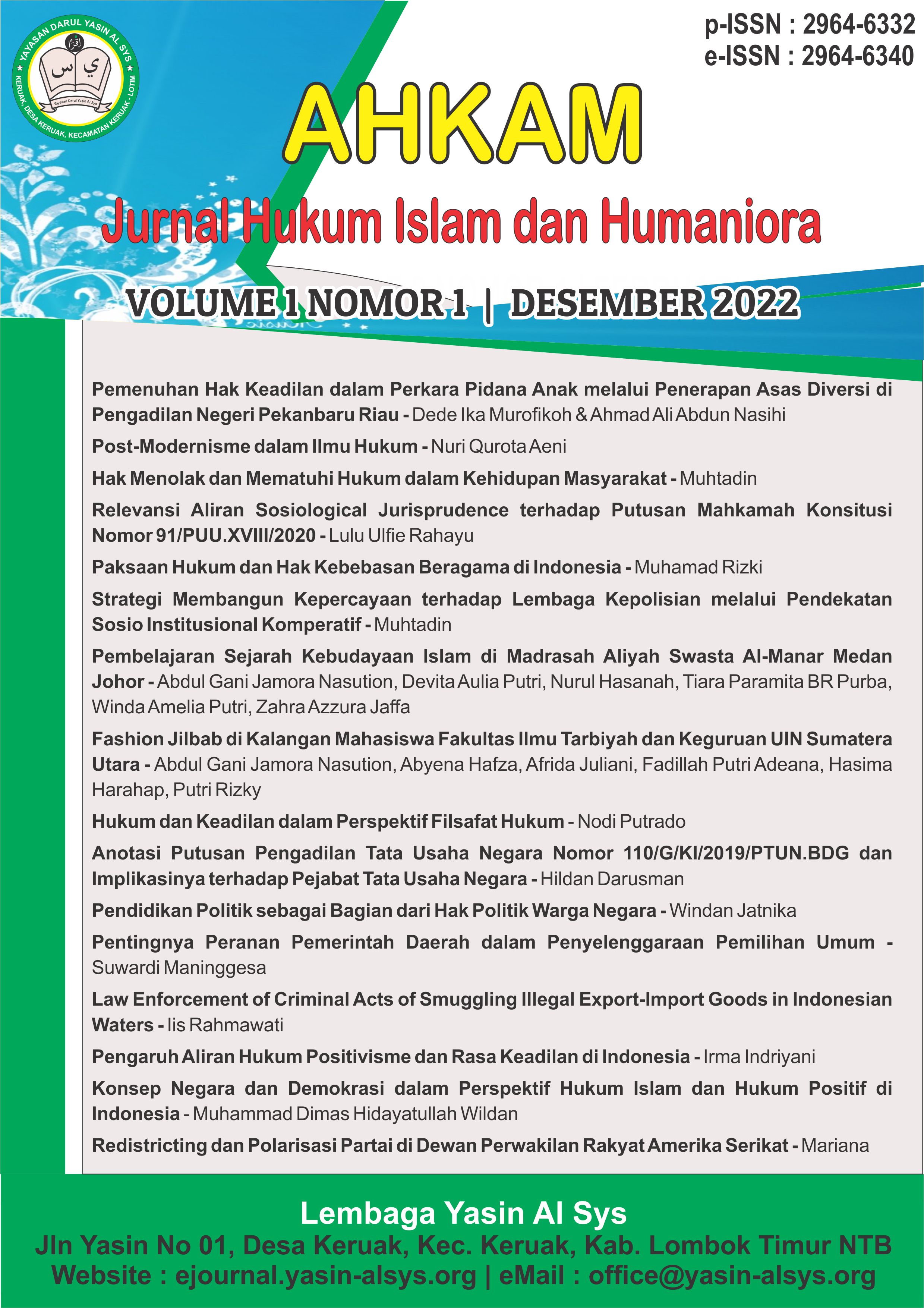
Hak Menolak dan Mematuhi Hukum dalam Kehidupan Masyarakat

Main Article Content
Abstract
Law is a set of regulations and rules of norms which is made by the state and judicially enforceable. The rule of law ideally provides both justice and order to individual as well as social stability. This article is aimed to highlight some particular circumstances on how people tend to justify obedience or disobedience in society and of the nation. This article is written and analyzed by using normative legal research methods. A strong legal system should consist of legal rights and obligations as two inseparable parts. It also discusses about two aspects of legal relationships, namely: (a) power or authority of rights, (b) legal obligations. Practically, law has given legal consequences in people's lives in terms of right and obligation so that people will act obediently and appropriately by following the legal norms. The right to obey and disobey a law is inherent in people as legal subjects. This circumstances will give both benefits and consequences as defined on the purpose of the law itself.




Citation Metrics:




Downloads
Citation Metrics & Similar Scopus Articles
-
Michou V. (2027)Breathing in harm: current insights into the effects of air pollution on cardiorespiratory healthMedical Gas Research, 17(1)
-
Fazeli F. (2027)The representation of the properties of the social actors in the two poetries of“Aghadar”and “Fokhos”written by Sheevan Foumani in accordance with the socio-semantic model and semio-semantic analysisLanguage Related Research, 17(4), 397-431
-
Arianpour M. (2027)Assessment of Pragmatic Disorders in PersianSpeaking Adults with Acquired Brain InjuryLanguage Related Research, 17(4), 35-70
Article Details

Authors retain copyright and grant the journal right of first publication with the work simultaneously licensed under a Creative Commons Attribution-NonCommercial-ShareAlike 4.0 International License that allows others to share the work with an acknowledgement of the work's authorship and initial publication in this journal.
References
Atmadja, I Dewa Gede, I. N. P. B. (2018). Teori-Teori Hukum. Setara Press, 233. http://repository.warmadewa.ac.id/id/eprint/441/
Celikates, R. (2016). Democratizing civil disobedience. Philosophy and Social Criticism, 42(10), 982–994. https://doi.org/10.1177/0191453716638562
Danardono, D. (2006). Teori Hukum Feminis: Menolak Netralitas Hukum, merayakan Difference dan Anti Esensialisme. Perempuan & Hukum: Menuju Hukum Yang Berperspektif Kesetaraan Dan Keadilan, 1.
Humulhaer, S. (2020). Kepatuhan Hukum Kawasan Dilarang Merokok Menurut Teori Lawrence M. Friedman. Supremasi Hukum, 15(2), 10–17. https://doi.org/10.33592/jsh.v15i2.438
Lathif, N. (2017). Teori Hukum Sebagai Sarana Alat Untuk Memperbaharui Atau Merekayasa Masyarakat. Palar | Pakuan Law Review, 3(1), 73–94. https://doi.org/10.33751/palar.v3i1.402
Lefkowitz, D. (2007). On a moral right to civil disobedience. Ethics, 117(2), 202–233. https://doi.org/10.1086/510694
Rosana, E. (2013). Hukum dan Perkembangan Masyarakat. TAPIs, 1, 99–118. http://ejournal.radenintan.ac.id/index.php/TAPIs/article/view/1578/0
Yohanes Suahrdin. (2007). Peranan Hukum dalam Mewujudkan Kesejahteraan Masyarakat. In Jurnal Hukum Pro Jutistia (Vol. 25, Issue 3, pp. 270–282).
Article Sidebar
 Page Numbers:
26-44
Page Numbers:
26-44
 Digital Object Identifier:













 Viewed: 587 times
 Downloaded: 798 times

LYAS Publisher cordially invites qualified professionals to serve as Editors or Reviewers. Your expertise will make an important contribution to maintaining and strengthening the academic quality of our publications. Interested applicants are kindly requested to complete the application form at the following link: Editors & Reviewers


Please feel free to contact us if you need any further information about the submission process or if you have any additional questions.

 Authors:
Muhtadin Muhtadin1
 Copyright :
Authors retain copyright and grant the journal right of first publication.
Explore Our Journals
Find the journal that best fits your research. If this journal does not match your manuscript’s scope, explore our portfolio below to select a more suitable publication venue.