
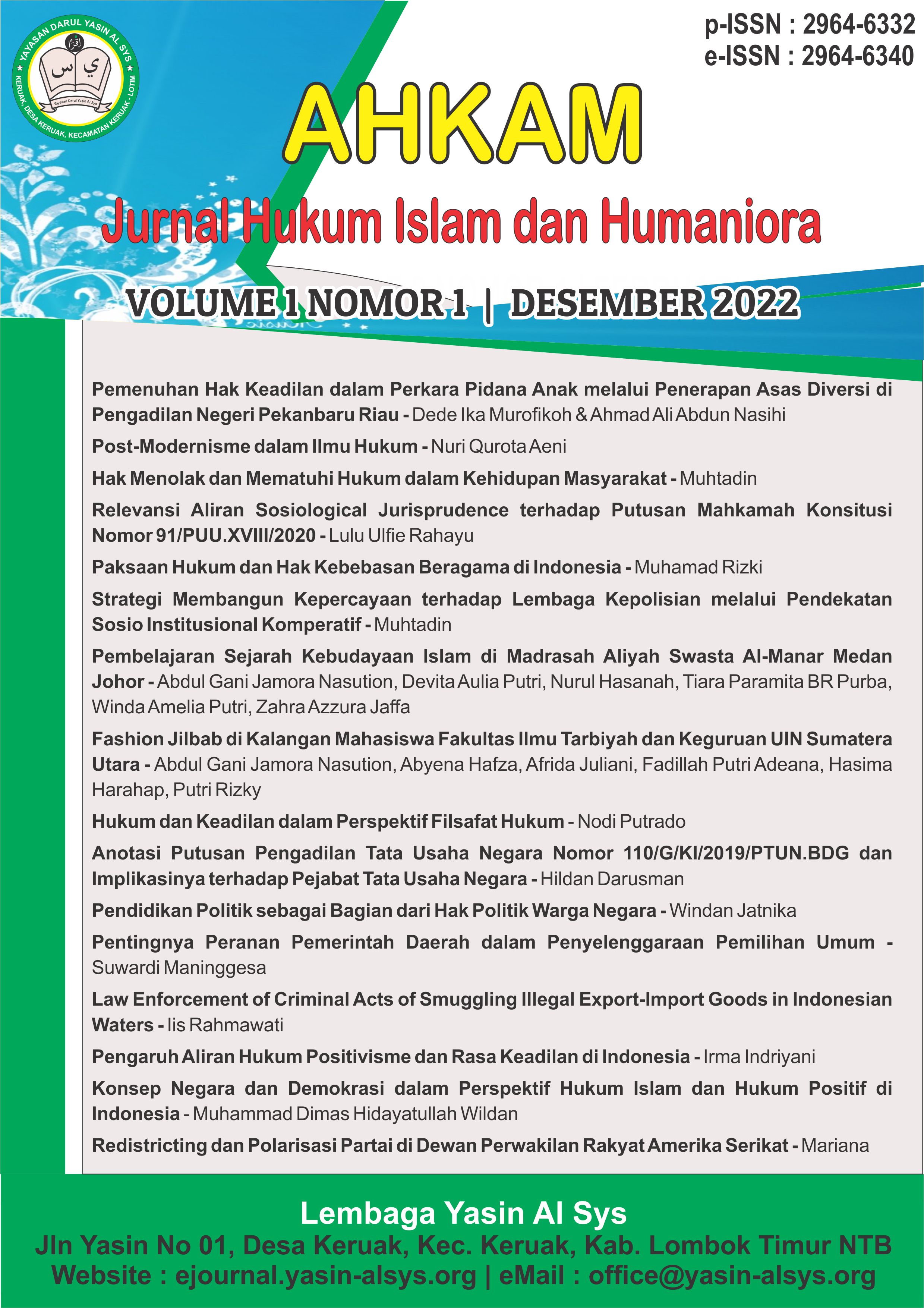
Redistricting dan Polarisasi Partai di Dewan Perwakilan Rakyat Amerika Serikat

Main Article Content
Abstract
The increasing level of party polarization observed in contemporary Congress has been attributed to a variety of factors. One of the more commonly recurring themes among congressional political observers is that the changes in district boundaries resulting from the redistricting process are the root cause. Using a new data set connecting congressional districts from 1962 to 2002, we offer hands-on testing of these claims. Our results show that despite an overall trend of increased polarization, districts that have undergone significant changes as a result of redistricting are becoming more polarized. Although the effect is relatively simple, it suggests that redistricting is one among other factors that generates party polarization in the House and may help explain the increasing level of polarization in the House relative to the Senate.




Citation Metrics:




Downloads
Citation Metrics & Similar Scopus Articles
-
Shibatani D. (2027)Envy-Free School Redistricting Between Two GroupsLecture Notes in Computer Science, 16835 LNCS, 342-354
-
Hackett U. (2026)District protectionism: Public opinion on race, partisanship, and redistricting changeElectoral Studies, 102
-
32nd International Computing and Combinatorics Conference, COCOON 2026Lecture Notes in Computer Science, 16835 LNCS
Article Details

Authors retain copyright and grant the journal right of first publication with the work simultaneously licensed under a Creative Commons Attribution-NonCommercial-ShareAlike 4.0 International License that allows others to share the work with an acknowledgement of the work's authorship and initial publication in this journal.
References
Boatright, R. G. (n.d.). Preparations for , and Responses to , Redistricting. 4(4), 436–454.
Brady, D. W., Han, H., & Pope, J. C. (2007). Primary elections and candidate ideology: Out of step with the primary electorate? Legislative Studies Quarterly, 32(1), 79–105. https://doi.org/10.3162/036298007X201994
Erikson, R. S., & Wright, G. C. (1980). Policy representation of constituency interests. Political Behavior, 2(1), 91–106. https://doi.org/10.1007/BF00989757
Glazer, A., Grofman, B., & Robbins, M. (1987). Partisan and Incumbency Effects of 1970s Congressional Redistricting. American Journal of Political Science, 31(3), 680. https://doi.org/10.2307/2111288
Jacobson, G. C. (2005). Polarized politics and the 2004 congressional and presidential elections. Political Science Quarterly, 120(2), 199–218. https://doi.org/10.1002/j.1538-165X.2005.tb00544.x
Jacobson, G. C. (2016). Party Polarization in National Politics: The Electoral Connection. Https://Medium.Com/, 1–22. https://medium.com/@arifwicaksanaa/pengertian-use-case-a7e576e1b6bf
Roberts, J. M., & Smith, S. S. (2003). Procedural contexts, party strategy, and conditional party voting in the U.S. House of representatives, 1971-2000. American Journal of Political Science, 47(2), 305–317. https://doi.org/10.1111/1540-5907.00021
SALAMANDER, E. G. (n.d.). the electoral consequences of the reapportionment revolution.
Stonecash, J. M. (n.d.). Diverging Parties: Social Change, Realignment and Party Polarization.
Stratmann, T. (2000). Congressional Voting over Legislative Careers: Shifting Positions and Changing Constraints. American Political Science Review, 94(3), 665–676. https://doi.org/10.2307/2585838
Theriault, S. M. (2006). Party polarization in the US Congress. Party Politics, 12(4), 483–503. https://doi.org/10.1177/1354068806064730
Article Sidebar
 Page Numbers:
215-231
Page Numbers:
215-231
 Digital Object Identifier:













 Viewed: 305 times
 Downloaded: 412 times

LYAS Publisher cordially invites qualified professionals to serve as Editors or Reviewers. Your expertise will make an important contribution to maintaining and strengthening the academic quality of our publications. Interested applicants are kindly requested to complete the application form at the following link: Editors & Reviewers


Please feel free to contact us if you need any further information about the submission process or if you have any additional questions.

 Authors:
Mariana Mariana1
 Copyright :
Authors retain copyright and grant the journal right of first publication.
Explore Our Journals
Find the journal that best fits your research. If this journal does not match your manuscript’s scope, explore our portfolio below to select a more suitable publication venue.