
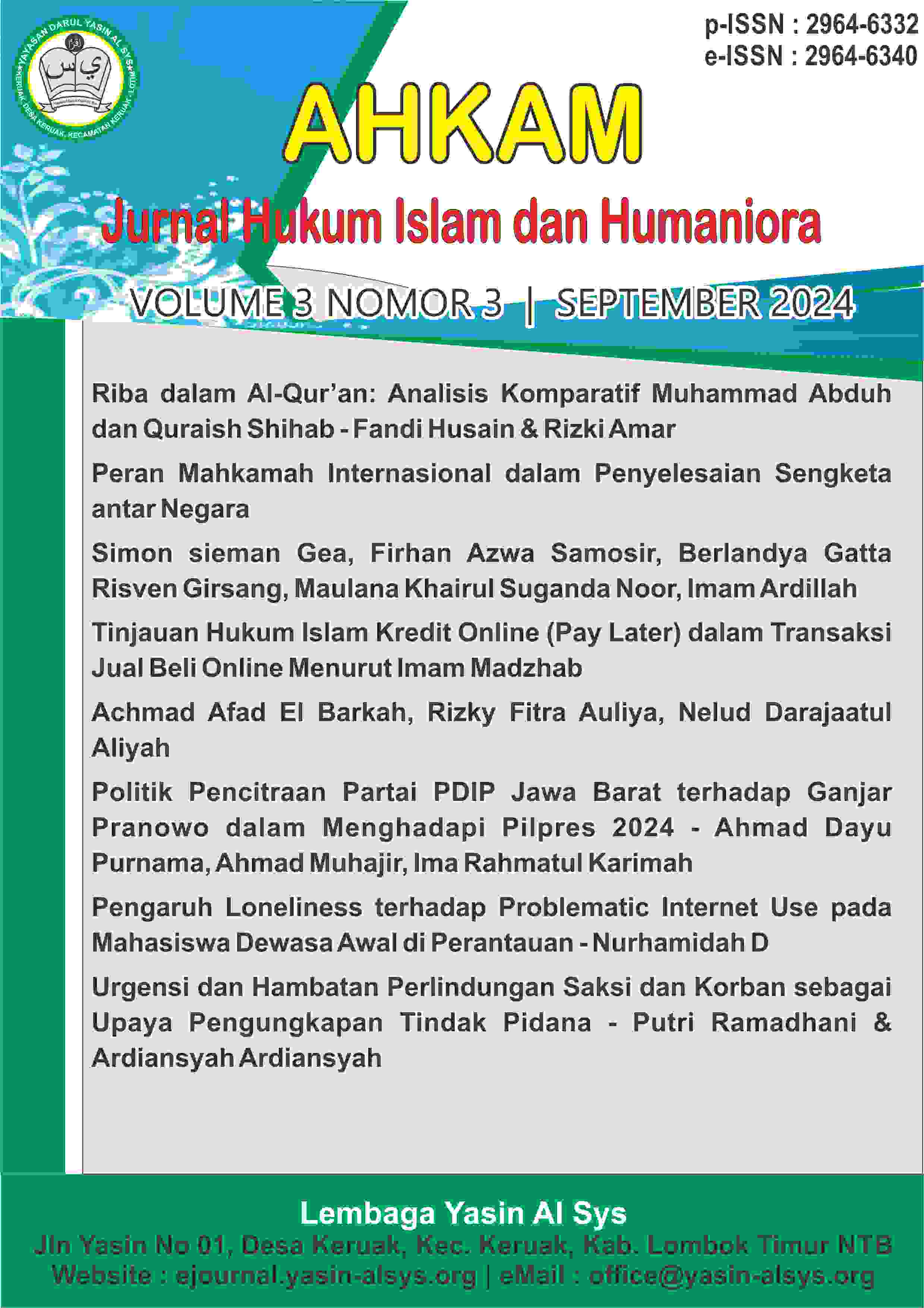
Pengaruh Loneliness terhadap Problematic Internet Use pada Mahasiswa Dewasa Awal di Perantauan The Influence of Loneliness on Problematic Internet Use Among Young Adult Students Living Away from Home
Main Article Content
Abstract
The purpose of this study is to determine the effect of loneliness on problematic internet use in overseas early adult students. Data were collected with the Problematic Internet Use Scale and the Loneliness Scale from 100 samples. Sample selection was used using purposive sampling technique. The data analysis used is simple linear regression analysis. With the results of p value = 0.060 (>0.01), t count = 1.903 (> t table). This shows that there is a negative relationship or there is no influence of loneliness on problematic internet use in early adult students overseas. The coefficient of determination (R2) = 0.036, this shows that loneliness only has a contribution of 3.6% to problematic internet use.




Citation Metrics:




Downloads
Citation Metrics & Similar Scopus Articles
-
Wangtaphan W. (2027)From Individual Reasoning to Collaborative Engagement: Continuity of Student Problematic in Grade 1 Mathematical Problem SolvingAsean Journal of Educational Research and Technology, 6(2), 287-300
-
Irawati R. (2027)Enhancing accounting students’ writing performance through problem-based learning: Evidence from a vocational higher education contextMultidisciplinary Science Journal, 9(1)
-
Trisnowati E. (2027)Science, Technology, Engineering, and Mathematics (STEM) and Research Skill Development (RSD) in Science Education in Higher Education: A Delphi-Based ModelAsean Journal of Educational Research and Technology, 6(2), 253-268
Article Details

Authors retain copyright and grant the journal right of first publication with the work simultaneously licensed under a Creative Commons Attribution-NonCommercial-ShareAlike 4.0 International License that allows others to share the work with an acknowledgement of the work's authorship and initial publication in this journal.
References
Chung D. (2018). The eight stages of psychosocial protective development: Developmental psychology. DOI:10.4236/jbbs.2018.86024.
Kim, J., Larose, R., & Peng, W. (2009). Loneliness As The Cause And The Effect Of Problematic Internet Use: The Relationship Between Internet Use And Psychological Well-Being. Cyberpsychology and Behavior, 12(4), 451–455. https://doi.org/10.1089/cpb.2008.0327
Marisa, D., & Afriyeni, N. (2019). Kesepian dan self compassion mahasiswa perantau. Psibernetika, 12(1), 1-11.
Naim, Mochtar. 2013. Merantau Pola Migrasi Suku Minangkabau. Jakarta: Raja Grafindo Persada.
Odaci, H. & Celik, C. B. (2013). Who are problematic internet users? An investigation of the correlations between problematic internet use and shyness, loneliness, narcissism, aggression and selfperception. Computers in Human Behavior, 29, 2382–2387
Perlman, Daniel & Peplau, Letitia. (1982). Theoretical approaches to loneliness. Loneliness: A Sourcebook of Current Theory, Research and Therapy. 123- 134.
Santrock. J. W. (2012). Lifespan development (Terjemahan oleh Widyasinta). Jakarta: Erlangga.
Sum, S., Mathews, R. M., Hughes, I., & Campbell, A. (2008). Internet Use and Loneliness in Older Adults. Cyberpsychology & Behavior , 11 (2), 208-211.
Ulfah, D. M., & Nisa, Y. F. (2015). Pengaruh Kepribadian, Kontrol Diri, Kesepian, dan Jenis Kelamin, Terhadap Penggunaan Internet Kompulsif Pada Remaja. Tazkiya Journal of Psychology , 20 (1), 113-131.
Article Sidebar
 Page Numbers:
616-622
Page Numbers:
616-622
 Digital Object ID:













 Viewed: 476 times
 Downloaded: 376 times

LYAS Publisher cordially invites qualified professionals to serve as Editors or Reviewers. Your expertise will make an important contribution to maintaining and strengthening the academic quality of our publications. Interested applicants are kindly requested to complete the application form at the following link: Editors & Reviewers


Please feel free to contact us if you need any further information about the submission process or if you have any additional questions.

 Authors:
 Copyright :
Authors retain copyright and grant the journal right of first publication.
Explore Our Journals
Find the journal that best fits your research. If this journal does not match your manuscript’s scope, explore our portfolio below to select a more suitable publication venue.