
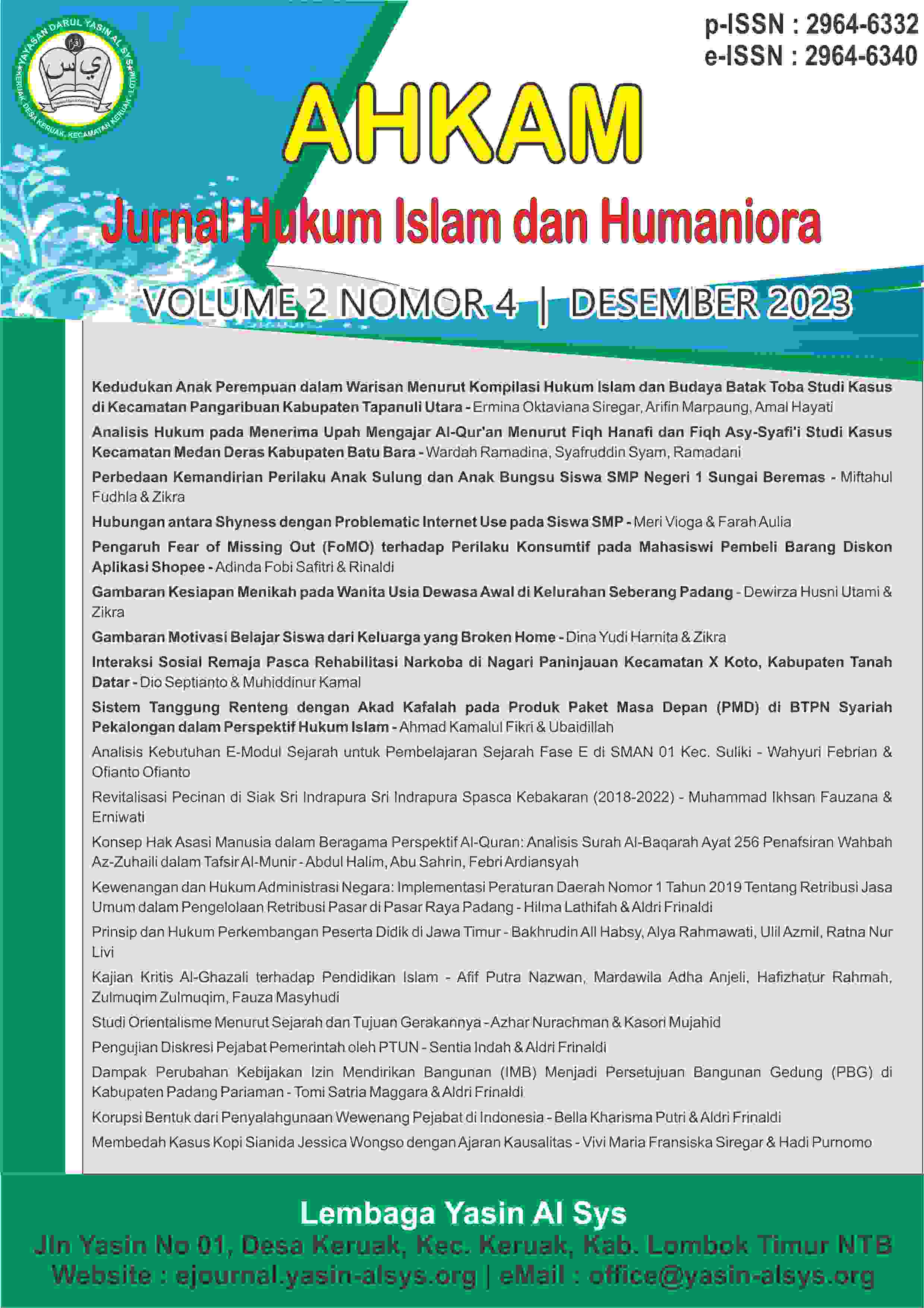
Analisis Kebutuhan E-Modul Sejarah untuk Pembelajaran Sejarah Fase E di SMAN 01 Kec. Suliki
Main Article Content
Abstract
This research aims to collect information on the needs for the development of E-Modules as a history learning medium at SMA 01 Kec. Suliki and analysis of the need for E-Modules as a medium for learning history in high school for Phase E (X E 3) class students. The research method used by researchers in this study is a qualitative descriptive method where the researcher is the key instrument and data processing is descriptive. Data collection techniques in this research used observation and interviews. The results of the discussion in this research are that students have low enthusiasm for learning history which is caused by the monotonous use of history learning media so that students need interesting and interactive learning media, for this reason the researcher offers to develop media that is interactive and can attract interest and motivation. and can help students in learning. The media that is the solution in this research is E-Module media which contains learning material content that is packaged digitally and is interactive. It is hoped that the e-Module can be a solution to problems related to students' low learning enthusiasm, so that effective history learning will be created and learning objectives can be achieved.




Citation Metrics:




Downloads
Citation Metrics & Similar Scopus Articles
-
Ratnaningsih E. (2027)Designing a Data-Driven E-Learning Module for Teaching English to Young Learners: Integrating Needs Analysis and the ISAV Learning ModelAsean Journal of Educational Research and Technology, 6(2), 269-286
-
Azhand A. (2027)Teaching Persian derivational affixes to non-Persian speakers from a Cognitive Morphology Approach: A case study of nominal suffixes (kar, gar, ban, baz, -ande)Language Related Research, 17(4), 469-497
-
Naemi Z. (2027)The Relationship between Second Language Learning Strategies, Learning Engagement, and Writing Skill in the Arabic Writing CurriculumLanguage Related Research, 17(4), 331-360
Article Details

Authors retain copyright and grant the journal right of first publication with the work simultaneously licensed under a Creative Commons Attribution-NonCommercial-ShareAlike 4.0 International License that allows others to share the work with an acknowledgement of the work's authorship and initial publication in this journal.
References
Abdullah, R. (2017). Pembelajaran Dalam Perspektif Kreativitas Guru Dalam Pemanfaatan Media Pembelajaran. Lantanida Journal, 4(1), 35–49.
Gazali, R. Y. (2016). Pengembangan bahan ajar matematika untuk siswa SMP berdasarkan teori belajar ausubel. . PYTHAGORAS: Jurnal Pendidikan Matematika, 11(2), 182–192.
Hamdu, G. , & Agustina, L. (2017). Pengaruh Motivasi Belajar Siswa Terhadap Prestasi Belajar Ipa Di Sekolah Dasar. Jurnal Penelitian Pendidikan, 12(1), 90–96.
Imansari, N., & Suryati Ningsih, I. (2017). Pengaruh Penggunaan E-Modul Interaktif Terhadap Hasil Belajar Peserta didik Pada Materi Kesehatan dan Keselamatan Kerja. Jurnal Ilmiah Pendidikan Teknik Elektro, 11-16 , 2(1), 11–16.
Nugraha, A., Subarkah, C., & Sari. (2015). Penggunaan E-Module Pembelajaran Pada Konsep Sifat Koligatif Larutan Untuk Mengembangkan Literasi Kimia SIswa. Prosiding Simposium Nasional Inovasi dan Pembelajaran Sains. 201–204.
Sukmawati F. (2021). Media Pembelajaran. CV Tahta Media Group.
Winatha, K. R., Suharsono, N., & Agustin, K. (2018). Pengembangan E-Modul Interaktif Berbasis Proyek Mata Pelajaran Simulasi Digital. Jurnal Pendidikan Teknologi Dan Kejuruan, 15(2), 188–199.
Yusuf, M. (2018). Pengantar Ilmu Pendidikan. Lembaga Penerbit Kampus IAIN Palopo.
Article Sidebar
 Page Numbers:
786-794
Page Numbers:
786-794
 Digital Object ID:













 Viewed: 443 times
 Downloaded: 369 times

LYAS Publisher cordially invites qualified professionals to serve as Editors or Reviewers. Your expertise will make an important contribution to maintaining and strengthening the academic quality of our publications. Interested applicants are kindly requested to complete the application form at the following link: Editors & Reviewers


Please feel free to contact us if you need any further information about the submission process or if you have any additional questions.

 Authors:
 Copyright :
Authors retain copyright and grant the journal right of first publication.
Explore Our Journals
Find the journal that best fits your research. If this journal does not match your manuscript’s scope, explore our portfolio below to select a more suitable publication venue.