
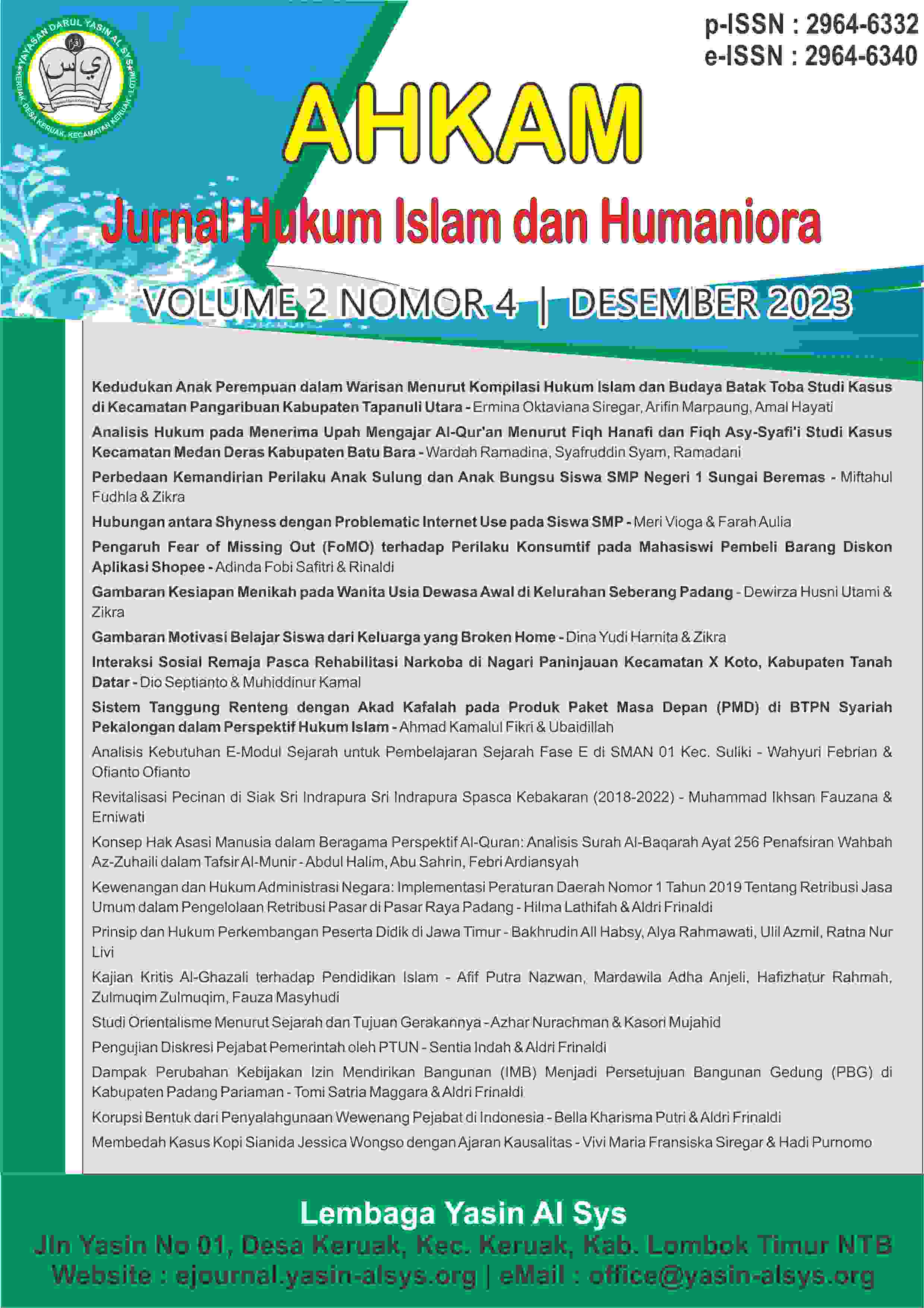
Sistem Tanggung Renteng dengan Akad Kafalah pada Produk Paket Masa Depan (PMD) di BTPN Syariah Pekalongan dalam Perspektif Hukum Islam

Article Sidebar
 Page Numbers:
773-785
Page Numbers:
773-785
 Digital Object Identifier:


 Viewed: 461 times
 Downloaded: 817 times












LYAS Publisher cordially invites qualified professionals to serve as Editors or Reviewers. Your expertise will make an important contribution to maintaining and strengthening the academic quality of our publications. Interested applicants are kindly requested to complete the application form at the following link: Editors & Reviewers


Please feel free to contact us if you need any further information about the submission process or if you have any additional questions.

 Authors:
Ahmad Kamalul Fikri1, Ubaidillah Ubaidillah2
 Copyright :
Authors retain copyright and grant the journal right of first publication.
Main Article Content
Abstract
The Future Package (PMD) is an integrated program of the Sharia National Pension Savings Bank provided to a group of women in rural areas who wish to start businesses and have dreams of transforming their lives but do not have access to banking services. Currently, there is a trend among financial institutions, both banks and cooperatives, in mitigating financing risks through the Joint Liability System. From this background, questions arise: (1) How is the joint liability system practiced in the Future Package (PMD) product at BTPN Sharia Pekalongan? (2) What is the Islamic legal perspective on the joint liability system with kafalah contract in the Future Package (PMD) product at BTPN Sharia Pekalongan? This study uses a qualitative descriptive analysis approach aimed at systematically describing the research focus, which includes the joint liability system, where the researcher describes the joint liability system and evaluates it from an Islamic legal perspective. Data collection techniques involve observation, interviews, documentation, and triangulation. The researcher analyzes the data using theories and legal foundations related to joint liability with a kafalah contract, resulting in findings on the mechanism and Islamic legal review of the joint liability system with a kafalah contract in the Future Package (PMD) product at BTPN Sharia Pekalongan. The research findings indicate that the implementation of joint liability in the Future Package (PMD) product at BTPN Sharia Pekalongan is temporary but can become permanent if group members under joint liability run away. The joint liability contract in financing the Future Package (PMD) does not fully comply with Islamic principles, particularly concerning the insurance object, as it is often used for consumable goods instead of business purposes.




Citation Metrics:




Downloads
Citation Metrics & Similar Scopus Articles
-
Zhao Y. (2027)Graphene-assisted infrared freeze-drying of blue honeysuckle (Lonicera caerulea L.): Effects of tray material on drying characteristics and product qualityJournal of Food Engineering, 423
-
Ahamad S. (2027)Exogenous melatonin application retains bioactive compounds, enhances antioxidant activity, reduces softening, and prolongs shelf life of cherry tomato (Solanum lycopersicum var. cerasiforme) during cold storageJournal of Future Foods, 7(2), 730-744
-
Abushal S.A. (2027)Nanoencapsulation of thyme oleoresin: a novel strategy to enhance bioactive ingredients' bioaccessibility in functional ultrafiltration-labneh and prolong shelf lifeJournal of Future Foods, 7(2), 566-579
Article Details

Authors retain copyright and grant the journal right of first publication with the work simultaneously licensed under a Creative Commons Attribution-NonCommercial-ShareAlike 4.0 International License that allows others to share the work with an acknowledgement of the work's authorship and initial publication in this journal.
References
Ahmed, Habib dan Tariqullah Khan. (2008). Manajemen Risiko Lembaga Keuangan Syariah. Jakarta: Bumi Aksara.
Departemen Agama Republik Indonesia. al-Qur'an dan Terjemahnya.
Dewan Syariah Nasional MUI. (2014). Himpunan Fatwa Keuangan Syariah. Jakarta: Erlangga.
Djuwaini, D. (2015). Pengantar Fiqh Muamalah. Yogyakarta: Pustaka Pelajar.
Emzir. (2010). Metodologi Penelitian Kualitatif Analisis Data. Jakarta: PT Raja Grafindo Persada.
Fuad, A. (2014). Panduan Praktis Penelitian Kualitatif. Yogyakarta: Graha Ilmu.
Hasil wawancara dengan Manager Sentra PMD BTPN Syariah Area Buaran Arienda Dwi Yuniarti. (pada tanggal 11 Desember 2017).
Mahkamah Agung Republik Indonesia (2011). Kompilasi Hukum Ekonomi Syari'ah. Jakarta: Mahkamah Agung Republik Indonesia Direktorat Jenderal Badan Peradilan Agama.
Muhammad Taufiq, dkk. (2006). Pedoman Penerapan Sistem Tanggung Renteng Koperasi. Jakarta: Kementrian Koperasi dan Usaha Kecil dan Menengah Republik Indonesia.
Pradja, Djuhaya. S. (2012). Ekonomi Syariah. Bandung: CV Pustaka Setia.
S, Burhanudin. (2009). Hukum Kontrak Syariah. Yogyakarta: BPFE Yogyakarta.
Sabiq, Sayid. (2013). Fiqih Sunnah Jilid 5. Cipayung: PT. Tinta Abadi Gemilang.
Sjahdeini, S. R. (2005). Perbankan Islam Dan Kedudukannya dalam Tata HUkum Perbankan Indonesia. Jakarta: Pustaka Utama Grafiti.
Sugiyono. (2008). Metode Penelitian Kuantitatif, Kualitatif dan R & D. Bandung: Alfabeta.
Suhendi, Hendi. (2010). Fiqh Muamalah. Jakarta: PT. Raja Grafindo Persada.
Supriyanto, Gatot. (2011). Aplikasi Sistem Tanggung Renteng Koperasi Setia Bhakti Wanita Jawa Timur. Surabaya: Kopwan Setia Bhakti Wanita.
Tanzeh, A. (2011). Metodologi Penelitian Praktis. Yogyakarta: Teras.