
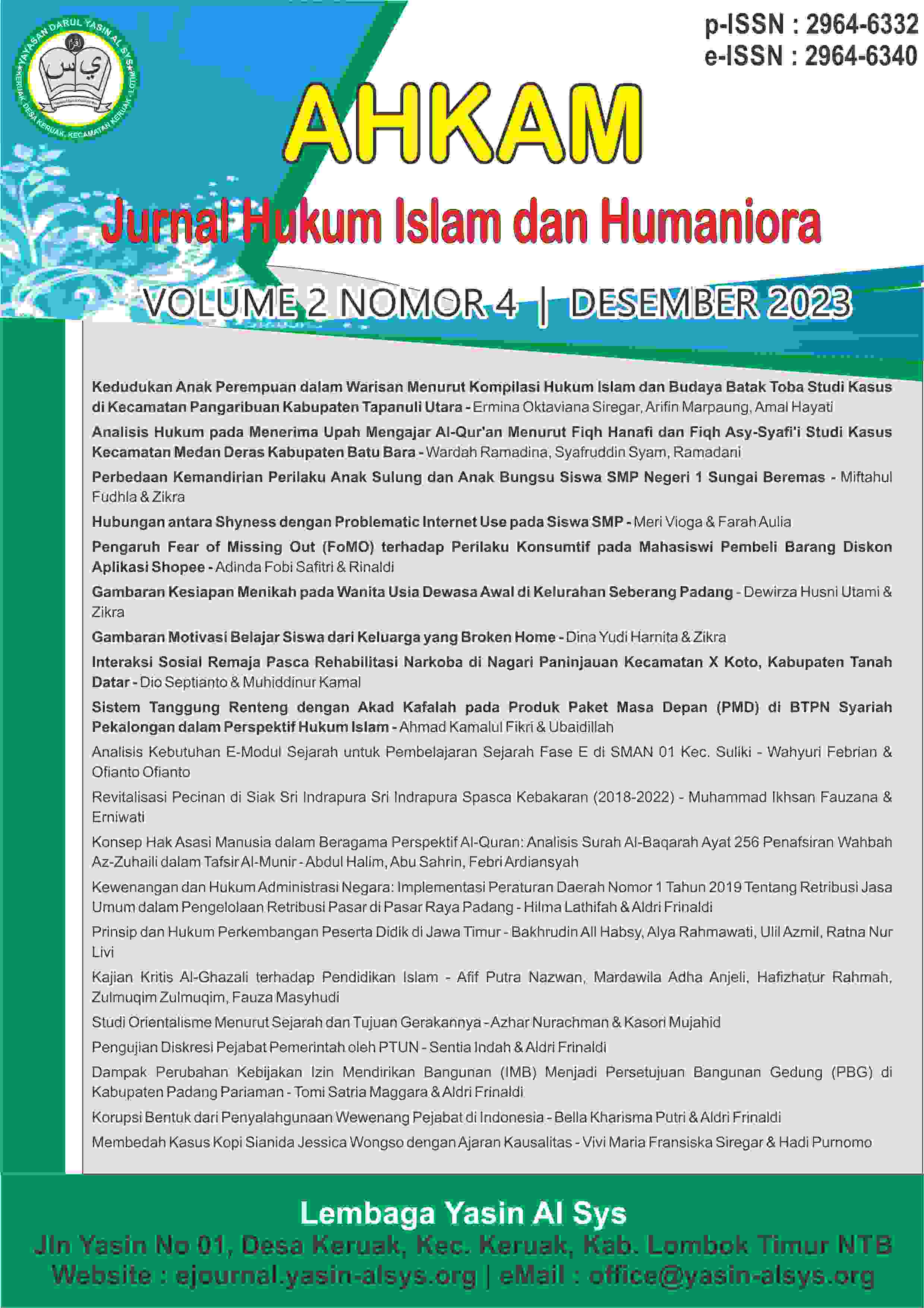
Hubungan antara Shyness dengan Problematic Internet Use pada Siswa SMP
Main Article Content
Abstract
Problematic internet use is one of the phenomena that occurs related to internet use in junior high school students. The internet becomes an alternative for shyness individuals to satisfy and express their feelings, social and emotional needs, which are not expressed directly or offline. When internet use is uncontrolled and excessive, it will make individuals problematic. This study aims to determine the relationship between shyness and problematic internet use. The subjects of this study were junior high school students who used the internet excessively, consisting of 126 students, 38 male students (30.2%) and 88 female students (69.8%). This study used quantitative methods. The data obtained were analyzed using Pearson product moment correlation technique. The results showed that there is a significant relationship between shyness and problematic internet use with a correlation coefficient value of 0.744 and a significance value of 0.000. This value proves that there is a positive relationship between shyness and problematic internet use in junior high school students, the higher the level of shyness, the higher the level of problematic internet use experienced.




Citation Metrics:




Downloads
Citation Metrics & Similar Scopus Articles
-
Irawati R. (2027)Enhancing accounting students’ writing performance through problem-based learning: Evidence from a vocational higher education contextMultidisciplinary Science Journal, 9(1)
-
Trisnowati E. (2027)Science, Technology, Engineering, and Mathematics (STEM) and Research Skill Development (RSD) in Science Education in Higher Education: A Delphi-Based ModelAsean Journal of Educational Research and Technology, 6(2), 253-268
-
Rymarzak M. (2027)IMPORTANCE OF STAKEHOLDERS AND KEY PERFORMANCE INDICATORS IN CAMPUS MANAGEMENTInternational Journal of Strategic Property Management, 30(3), 273-285
Article Details

Authors retain copyright and grant the journal right of first publication with the work simultaneously licensed under a Creative Commons Attribution-NonCommercial-ShareAlike 4.0 International License that allows others to share the work with an acknowledgement of the work's authorship and initial publication in this journal.
References
Ahmad, S., Nasreen, L., & Aiman, M. (2020). Shyness and psychological well-being as predictors of problematic internet use among students in Pakistan TT - La timidez y el bienestar psicológico como predictores del uso problemático de Internet entre estudiantes en Pakistán TT - Timidez e bem-estar. Psicol. Conoc. Soc, 10(3), 5–18.
Bardi, C. A., & Brady, M. F. (2010). Why shy people use instant messaging: Loneliness and other motives. Computers in Human Behavior, 26(6), 1722–1726. https://doi.org/10.1016/j.chb.2010.06.021
Beard, K. W., & Wolf, E. M. (2001). Modification in the proposed diagnostic criteria for internet addiction. Cyberpsychology & Behavior, 4(3), 377–383. https://doi.org/10.3390/life12060861
Caplan, S. E. (2010). Theory and measurement of generalized problematic internet use: A two-step approach. Computers in Human Behavior, 26(5), 1089–1097. https://doi.org/10.1016/j.chb.2010.03.012
Carducci, B. J., & Conkright, K. C. (2020). Shyness. III, 417–421.
Chak, K., & Leung, L. (2004). Shyness and locus of control as predictors of internet addiction and internet use. 7(5), 559–570.
Chikita, J., Murdiana, S., & Ridfah, A. (2019). Shyness Ditinjau Dari Five Guidance Needs Pada Remaja Sma Di Makassar. Jurnal Psikologi Poseidon, 1, 39–51. https://doi.org/10.30649/jpp.v2i1.29
Cholifah. (2018). Perilaku penggunaan internet siswa SMP di Jabodetabek. Jurnal ISIP: Jurnal Ilmu Sosial Dan Ilmu Politik, 15(1), 1–14. https://doi.org/10.36451/j.isip.v15i1.9
Douglas, A. C., Mills, J. E., Niang, M., Stepchenkova, S., Byun, S., & Ruffini, C. (2008). Internet addiction: Meta-synthesis of qualitative research for the decade 1996-2006. Computers in Human Behavior, 24, 3027–3044.
Fauziawati, W. (2015). Upaya mereduksi kebiasaan bermain game online melalui teknik diskusi kelompok. PSIKOPEDAGOGIA Jurnal Bimbingan Dan Konseling, 4(2), 115. https://doi.org/10.12928/psikopedagogia.v4i2.4483
Fernandes, B., Maia, B. R., & Pontes, H. M. (2019). Internet addiction or problematic internet use ? Which term should be used ? Psicologia USP, 30, 1–8.
Garvin. (2019). Hubungan antara kesepian dengan problematic internet use pada remaja. Psikostudia: Jurnal Psikologi, 8(1), 15–19.
Gunawan, R., Aulia, S., Supeno, H., Wijanarko, A., Uwiringiyimana, J. P., & Mahayana, D. (2021). Adiksi media sosial dan gadget bagi pengguna internet di Indonesia. Techno-Socio Ekonomika, 14(1), 1–14. https://doi.org/10.32897/techno.2021.14.1.544
Henderson, L., & Zimbardo, P. (1998). Shyness. In Encyclopedia of Mental Health. http://shyness.com/wp-content/uploads/1998/encyclopedia.html
Hidayati, D. S. (2016). Shyness dan loneliness. Seminar Asean 2nd Psychology and Humanity, 102–107.
Moreno, M. A., Jelenchick, L. A., & Christakis, D. A. (2013). Problematic internet use among older adolescents: A conceptual framework. Computers in Human Behavior, 29(4), 1879–1887. https://doi.org/10.1016/j.chb.2013.01.053
Odaci, H., & Çelik, Ç. B. (2013). Who are problematic internet users? An investigation of the correlations between problematic internet use and shyness, loneliness, narcissism, aggression and self-perception. Computers in Human Behavior, 29(6), 2382–2387. https://doi.org/10.1016/j.chb.2013.05.026
Ozturk, E., & Ozmen, S. K. (2011). An Investigation of the problematic internet Use of teacher candidates based on personality types, shyness and demographic factors. Kuram Ve Uygulamada Egitim Bilimleri, 11(4), 1799–1808.
Reinaldo, & Sokang, Y. A. (2016). Mahasiswa dan internet : dua sisi mata uang ? problematic internet use pada mahasiswa. Jurnal Psikologi, 43(2), 107–120.
Ridfah, A., & Murdiana, S. (2018). Properti psikometrik alat ukur shyness. Jurnal Psikologi Talenta, 4(1), 21–29. https://doi.org/http://dx.doi.org/10.26858/talenta.v4i1.6809
Ridfah, A., Prathama, A. G., & Utomo, A. B. (2014). Intervensi cognitive behavior therapy untuk menurunkan derajat shyness pada mahasiswa tahun kedua Fakultas X Universitas Y di Kota Makassar. Jurnal Psikologi, 27(2), 1–16.
Riyanto, S., & Hatmawan, A. A. (2020). Metode riset penelitian kuantitatif penelitian di bidang manajemen, teknik, pendidikan dan eksperimen. CV Budi Utama.
Santrock, J. W. (2013). Adolescence (5th ed.). McGraw-Hill Education.
Sherlyanita, A. K., & Rakhmawati, N. A. (2016). Pengaruh dan pola aktivitas penggunaan internet serta media sosial pada siswa SMPN 52 Surabaya. Journal of Information Systems Engineering and Business Intelligence, 2(1), 17. https://doi.org/10.20473/jisebi.2.1.17-22
Sugiyono. (2008). Metode penelitian kuantitatif, kualitatif dan R&D. ALFABETA.
Suler, J. (2004). The online disinhibition effect. Cyberpsychology & Behavior, 7(3), 321–327.
Ting, C. H., & Essau, C. (2021). Addictive behaviours among university students in Malaysia during COVID-19 pandemic. Addictive Behaviors Reports, 14, 1–7. https://doi.org/10.1016/j.abrep.2021.100375
Wahyudiyono, W. (2019). Implikasi pengggunaan internet terhadap partisipasi sosial di Jawa Timur. Jurnal Komunika : Jurnal Komunikasi, Media Dan Informatika, 8(2), 63. https://doi.org/10.31504/komunika.v8i2.2487
Wang, P., Yan, Y., Zhang, R., Wang, J., Zhan, X., & Tian, Y. (2020). The effect of shyness on adolescent network problem behavior: the role of gender and loneliness. Frontier in Psychology, 11(803). https://doi.org/https://doi.org/10.3389%2Ffpsyg.2020.00803
Article Sidebar
 Page Numbers:
716-726
Page Numbers:
716-726
 Digital Object ID:













 Viewed: 590 times
 Downloaded: 517 times

LYAS Publisher cordially invites qualified professionals to serve as Editors or Reviewers. Your expertise will make an important contribution to maintaining and strengthening the academic quality of our publications. Interested applicants are kindly requested to complete the application form at the following link: Editors & Reviewers


Please feel free to contact us if you need any further information about the submission process or if you have any additional questions.

 Authors:
 Copyright :
Authors retain copyright and grant the journal right of first publication.
Explore Our Journals
Find the journal that best fits your research. If this journal does not match your manuscript’s scope, explore our portfolio below to select a more suitable publication venue.