
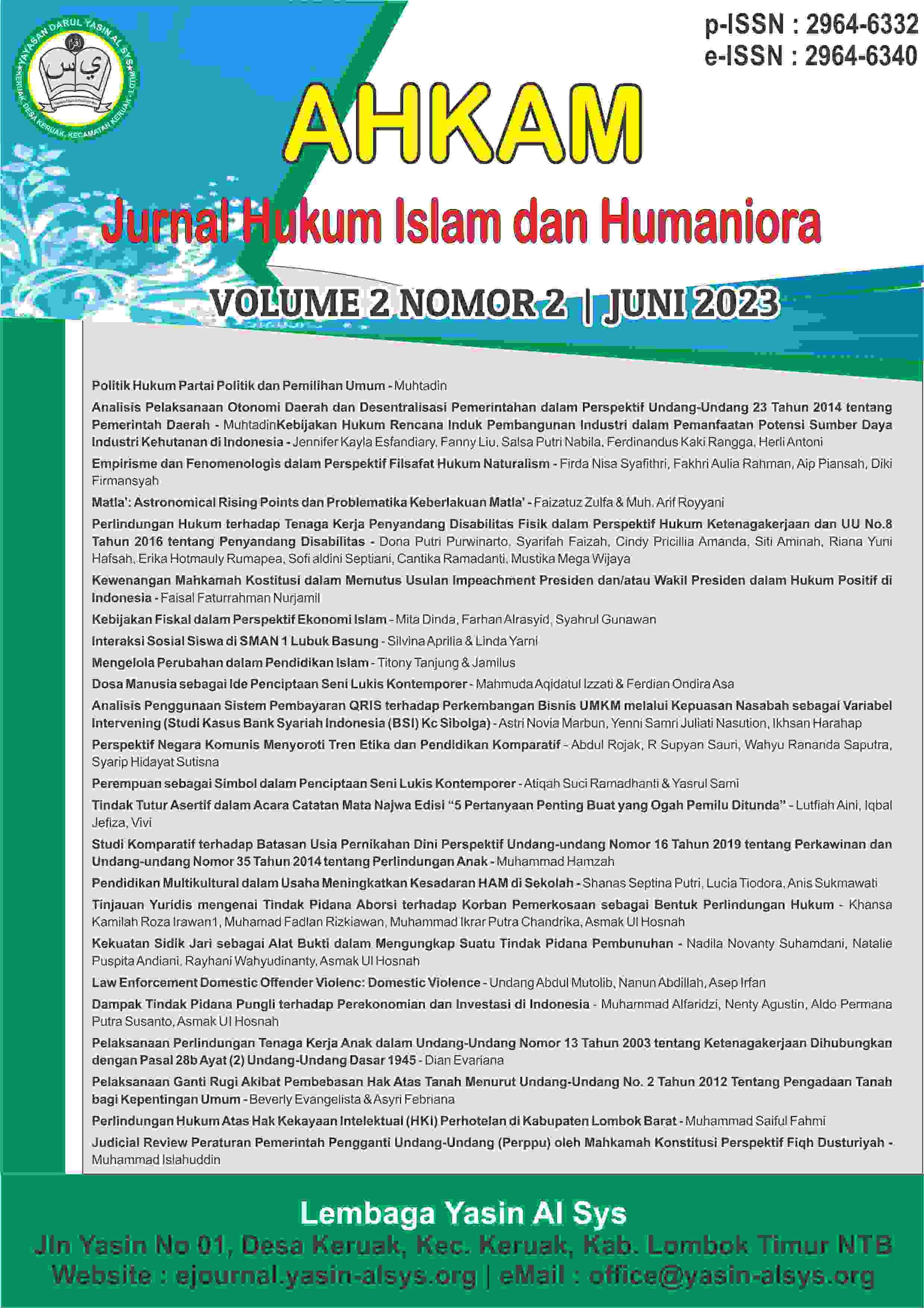
Perspektif Negara Komunis Menyoroti Tren Etika dan Pendidikan Komparatif
Main Article Content
Abstract
In this article, I have tried to highlight some aspects of the two perspectives. The first is the perspective of the researcher who recalls his past as a student in a communist country, interpreting his life experiences given his impact on his education and teaching profession. The second perspective is that of the researcher who looks to the future, initially lacking in resources but willing to connect with global research in his area of interest, educational ethics. International studies that support and inspire our research in the domain of educational ethics include philosophical works, the study of moral psychology, and resources from sociology and organizational psychology as well as from pedagogy. Regarding expected trends in comparative and international education, I have grouped them into three categories: (1) Trends related to research themes in comparative education: many of the main themes of education have been filtered or will be filtered through a comparative lens (educational history, philosophy- educational physics, curriculum and didactics, sociology of education, politics and economics of education and educational psychology); (2) Methodological trends in quantitative and qualitative methodologies together will support the research process in comparative education; and (3) Trends regarding the impact of research in comparative pedagogy: Global Models of will Inspire Local Initiatives without Copiable Beings.




Citation Metrics:




Downloads
Citation Metrics & Similar Scopus Articles
-
Naldi H. (2026)Resilience-based leadership ecosystem in Islamic boarding schools: Evidence from an Indonesian pesantrenSocial Sciences and Humanities Open, 14
-
Rosmini (2026)Toward a Moderate Islamic Parenting Model: Qur'anic Care, Positive Discipline from the Perspective of Islamic Family Law in Pesantren of South SulawesiEl Usrah, 9(2), 742-765
-
Mariyono D. (2026)Forming multicultural entrepreneurs attitudes (MEA): insights from Islamic boarding schoolBottom Line, 39(4), 553-575
Article Details

Authors retain copyright and grant the journal right of first publication with the work simultaneously licensed under a Creative Commons Attribution-NonCommercial-ShareAlike 4.0 International License that allows others to share the work with an acknowledgement of the work's authorship and initial publication in this journal.
References
Alexander, R. (2009). Menuju pedagogi komparatif. Dalam R.Cowen &A. M. Kazamias (Eds.), International handbook of comparative education (Vol. 22, hlm. 923—942). Dordrecht: Musim semi.
Campbell, E. (2003). The ethical teacher. Maidenhead, UK: Open University Press.
Ciurescu, C. (2009). Doctoral thesis “Dinamica sistemelor de ıˆnva˘t¸a˘maˆnt ıˆn Uniunea europeana˘” (“The dynamics of educational systems in the European Union”). University of Bucharest.
Code of Ethics of the Education Profession. (1975). NEA The National Education Association. Retrieved from http://www.nea.org/assets/docs/2013-NEA-Handbook-Code-of-Ethics.pdf Gordon, W., & Sork, T. (2001). Ethical issues and codes of ethics: Views of adult education practitioners in Canada and the United States. Adult Education Quarterly, 51, 202—218.
Holmes, B. (1985). Trends in comparative education. Prospects, 15(3), 325—346.
Larsen, M. A. (2010). New thinking in comparative education. In M. A. Larsen (Ed.), New thinking in comparative education: Honouring Robert Cowen (Vol. 8, pp. 1—14). Rotterdam: Sense Publishers.
Meirieu, P. (2006). L’e´ducation et le roˆle des enseignants a` l’horizon 2020. Paris: UNESCO. Retrieved from http://icp.ge.ch/gelibredu/pourlesmeninges/meirieu_unesco_2020.pdf/ view?searchterm=None Reboul, O. (1992). Les valeurs de l’e´ducation. Paris: Presses Universitaires de France.
Scriven, M. (2003). Evaluation in the new millenium: The transdisciplinary vision. In S. I. Donaldson & M. Scriven (Eds.), Evaluating social programs and problems: Visions for the new millennium (pp. 19—40). London: Lawrence Erlbaum Associates.
Article Sidebar
 Page Numbers:
373-381
Page Numbers:
373-381
 Digital Object ID:













 Viewed: 346 times
 Downloaded: 398 times

LYAS Publisher cordially invites qualified professionals to serve as Editors or Reviewers. Your expertise will make an important contribution to maintaining and strengthening the academic quality of our publications. Interested applicants are kindly requested to complete the application form at the following link: Editors & Reviewers


Please feel free to contact us if you need any further information about the submission process or if you have any additional questions.

 Authors:
 Copyright :
Authors retain copyright and grant the journal right of first publication.
Explore Our Journals
Find the journal that best fits your research. If this journal does not match your manuscript’s scope, explore our portfolio below to select a more suitable publication venue.