
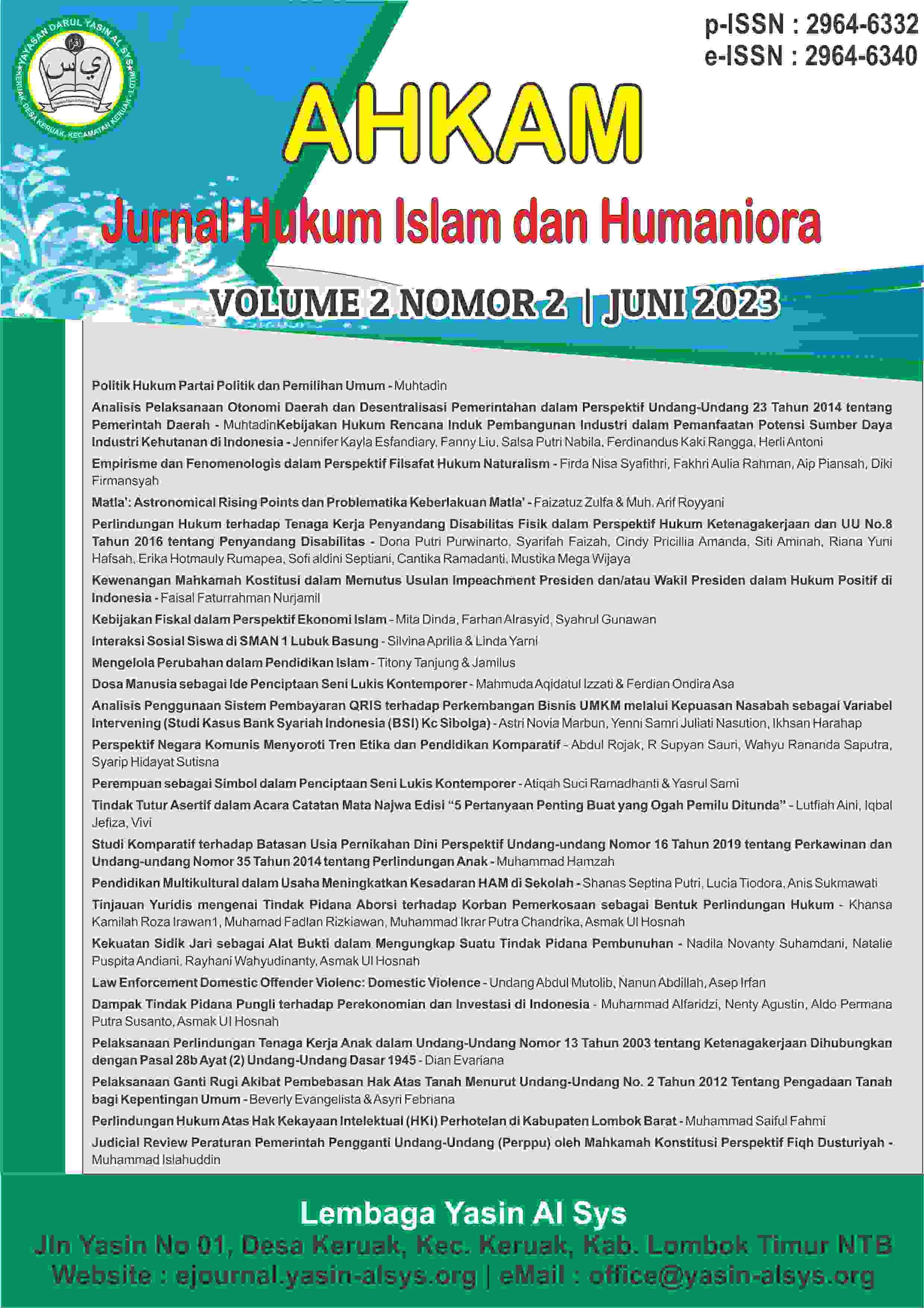
Kebijakan Fiskal dalam Perspektif Ekonomi Islam
Main Article Content
Abstract
Fiscall policy' is a policy madel by thel government withl the aiml of regulatingl income and expenditure within the country in order to maintain stability and encourage economic growth.In islamic economics,fiscal policy is intended as one of the tools to create a goal according to sharia. The intended purpose of sharia is :maintaining the welfare and also ownership.According to islam,there are principles that must be adhered to in implementing fiscal policy according to sharia or according to islam.Among these principle of muamalah,namely where every muslim will be freed in therms of carrying out an activity or business activity that has been recommended in Islam.




Citation Metrics:




Downloads
Citation Metrics & Similar Scopus Articles
-
Muqoyyidin A.W. (2026)Inclusive multicultural Islamic education and educational reform in Nurcholish Madjid’s thought a bibliometric and systematic reviewDiscover Global Society, 4(1)
-
Ferdinan (2026)Eco Islamic education and its contribution to sustainable development goals in Muhammadiyah boarding schools of South SulawesiDiscover Sustainability, 7(1)
-
Zeki A.M. (2027)Research on Islamic Studies in the ICT Field: A Bibliometric Review in the Scopus DatabaseCommunications in Computer and Information Science, 3093 CCIS, 278-292
Article Details

Authors retain copyright and grant the journal right of first publication with the work simultaneously licensed under a Creative Commons Attribution-NonCommercial-ShareAlike 4.0 International License that allows others to share the work with an acknowledgement of the work's authorship and initial publication in this journal.
References
Aini, Ihda. (2019). Kebijakan Fiskal dalam Ekonomi Islam." Al-Qisthu: Jurnal Kajian Ilmu-ilmu Hukum 17, no. 2
Aini, I. (2019). Kebijakan Fiskal dalam Ekonomi Islam. Al-Qisthu: Jurnal Kajian Ilmu Ilmu Hukum, 17(2), 43–50. https://doi.org/10.32694/010760
Fathurrahman, A. (2012). Kebijakan Fiskal Indonesia Dalam Perspektif Ekonomi Islam : Studi Kasus Dalam Mengentaskan Kemiskinan. Jurnal Ekonomi Dan Studi Pembangunan, 13(1), 72–82.
Hindarjo, Anton. (2018). Analisa Zakat Dan Instrumen Sejenis Terhadap Sistem Fiskal Islam.” Jurnal Asy-Syukriyyah 19, no. 2
Jajuli, Sulaeman. (2019). Kebijakan Fiskal dalam Perspektif islam (Baitul Maal sebagai Basis Pertama Dalam Pendapatan Islam ) ."Ad-Deenar : Jurnal Ekonomi dan Bisnis Islam
Kunaifi, A. (2017). Telaah Kritis Kebijakan Fiskal Perspektif Kaidah Fiqh. November 2014, 1–21.
Kusniawati. (2011). Zakat Sebagai Kebijakan Fiskal dalam Ekonomi Islam. In UIN Alauddin Makassar.
Latifah, E. (2021). Penerapan Zakat, Infak, Sedekah Dan Wakaf Sebagai Strategi Kebijakan Fiskal Pada Sharia Microfinance Institutions Application Of Zakat, Infak, Sedekah As Afiscal Policy Strategy In Sharia Microfinance Institutions Eny. I-JIEF Indonesian Journal of Islamic Economics and Finance, 1(1)
Lusiana, A. (2016). Konsep Ekonomi Pada Masa Rasulullah Nabi Muhammad SAW. 5(July), 1–23.
Priyono, S. (2013). Zakat Sebagai Instrumen Dalam Kebijakan Fiskal. Al-Maslahah : Jurnal Hukum Dan Pranata Sosial Islam, 1(2), 125–142.
Rahmawati, L. (2018). Kebijakan Fiskal dalam Islam. Al-Qanun, 11(2), 36–461.
Setiawan, Denil. (2019). Analisis Zakat Sebagai Instrument Kebijakan Fiskal.” Al Amwal 1, no. 2
Snyder, H. (2019). Literature review as a research methodology: An overview and guidelines. Journal of Business Research, 104(July),333–339. https://doi.org/10.1016/j.jbusres.2019.07.039
Turmudi, I. (2019). Kajian Kebijakan Fiskal dan Kebijakan Moneter dalam Islam. An-Nawa, 1(2), 74–90
Yusoff, Mohammed B. “Fiscal Policy in an Islamic Economy and the Role of Zakat.” IIUM Journal of Economics and Management 14, no. 2 (2006): 117–45
Article Sidebar
 Page Numbers:
327-334
Page Numbers:
327-334
 Digital Object ID:













 Viewed: 818 times
 Downloaded: 895 times

LYAS Publisher cordially invites qualified professionals to serve as Editors or Reviewers. Your expertise will make an important contribution to maintaining and strengthening the academic quality of our publications. Interested applicants are kindly requested to complete the application form at the following link: Editors & Reviewers


Please feel free to contact us if you need any further information about the submission process or if you have any additional questions.

 Authors:
 Copyright :
Authors retain copyright and grant the journal right of first publication.
Explore Our Journals
Find the journal that best fits your research. If this journal does not match your manuscript’s scope, explore our portfolio below to select a more suitable publication venue.