
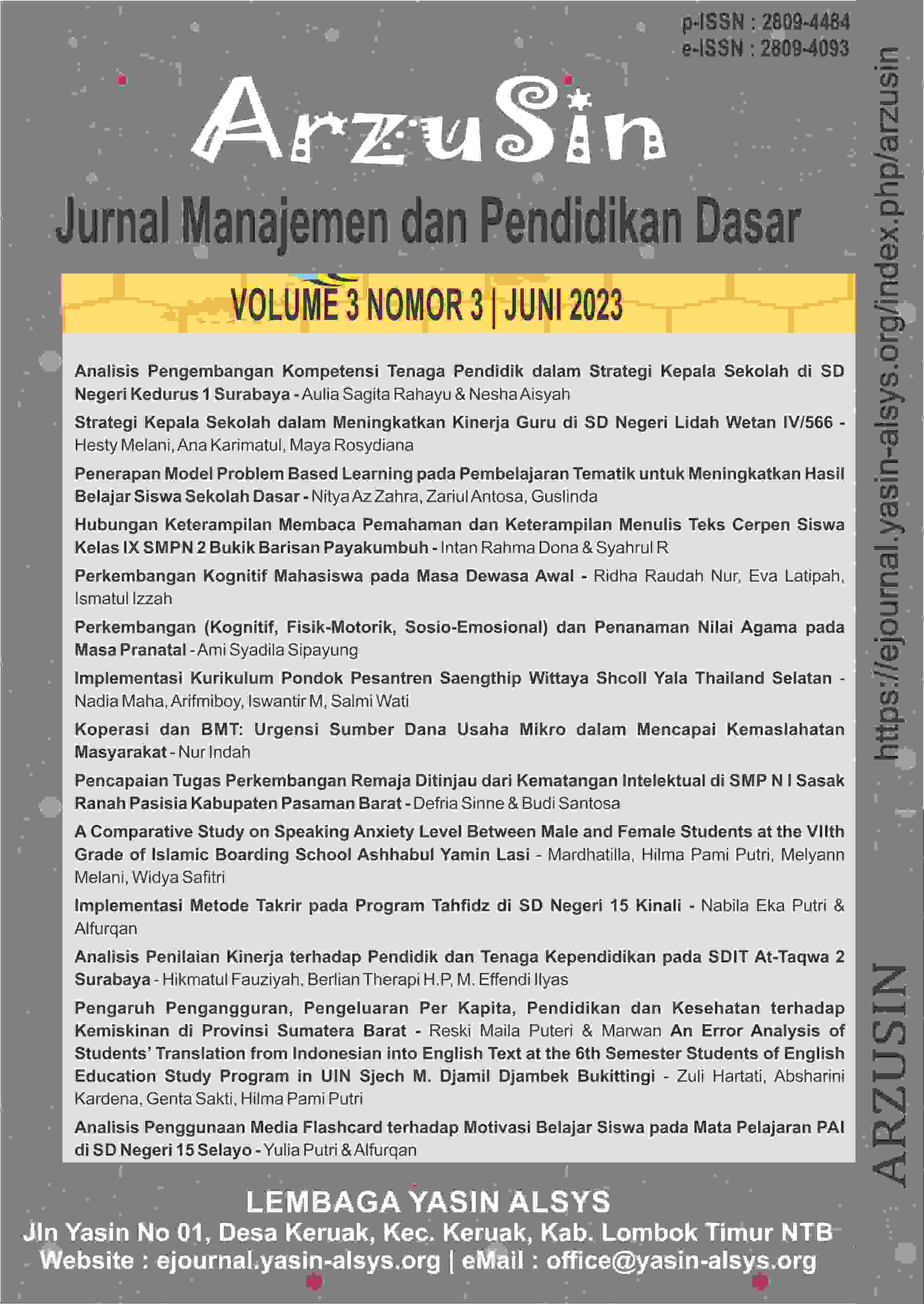
Perkembangan Kognitif Mahasiswa pada Masa Dewasa Awal
Main Article Content
Abstract
The purpose of writing this article is to analyze the cognitive development of students in early adulthood. This type of research is literature study. Qualitative research is inductive using a flexible research design, data collection techniques in the form of documentation, data validity testing using triangulai, and data analysis techniques using content analysis. The results of this study indicate that there are many changes in the cognitive development of students in early adulthood, due to experiences that are supported by the cerebral cortex, especially the forebrain. Cognitive progress and brain growth of students in early adulthood are most fundamentally triggered by various major events experienced by students in life and while studying in college, which initially students' way of thinking is based on Piaget's theory, namely formal operational and experiencing a shift to post-formal which is relative and reflective. Perry is multi-minded, more relative thinking, and full relativism. Gisela is pragmatic thinking and cognitive complexity. Schaie phase achieves achievement and responsibility.




Citation Metrics:




Downloads
Citation Metrics & Similar Scopus Articles
-
Rezvani V. (2027)Analysis of "Agentive Suffixes" in Russian and Persian Nouns from a Cognitive Morphological PerspectiveLanguage Related Research, 17(4), 203-230
-
Azhand A. (2027)Teaching Persian derivational affixes to non-Persian speakers from a Cognitive Morphology Approach: A case study of nominal suffixes (kar, gar, ban, baz, -ande)Language Related Research, 17(4), 469-497
-
Trisnowati E. (2027)Science, Technology, Engineering, and Mathematics (STEM) and Research Skill Development (RSD) in Science Education in Higher Education: A Delphi-Based ModelAsean Journal of Educational Research and Technology, 6(2), 253-268
Article Details

Authors retain copyright and grant the journal right of first publication with the work simultaneously licensed under a Creative Commons Attribution-NonCommercial-ShareAlike 4.0 International License that allows others to share the work with an acknowledgement of the work's authorship and initial publication in this journal.
Article Sidebar
 Page Numbers:
211-219
Page Numbers:
211-219
 Digital Object ID:













 Viewed: 8.085 times
 Downloaded: 8.144 times

LYAS Publisher cordially invites qualified professionals to serve as Editors or Reviewers. Your expertise will make an important contribution to maintaining and strengthening the academic quality of our publications. Interested applicants are kindly requested to complete the application form at the following link: Editors & Reviewers


Please feel free to contact us if you need any further information about the submission process or if you have any additional questions.

 Authors:
 Copyright :
Authors retain copyright and grant the journal right of first publication.
Explore Our Journals
Find the journal that best fits your research. If this journal does not match your manuscript’s scope, explore our portfolio below to select a more suitable publication venue.