

Asian Journal of Science, Technology, Engineering, and Art (AJSTEA)
Latest Issue: Vol. 4 No. 2 (April 2026). This issue features peer-reviewed contributions that advance multidisciplinary scholarship across science, technology, engineering, and art, and provide evidence-informed responses to contemporary scientific, technological, and societal challenges.
Open Access Peer Reviewed Science, Technology, Engineering, and Art
Indexed
Copernicus Harvard University Boston University Dimensions Scilit Crossref Garuda Google Scholar BASE
To date, AJSTEA has published articles by authors affiliated with institutions in fourteen (14) countries: Indonesia, Nigeria, Pakistan, Nepal, India, Laos, the Philippines, Vietnam, Cameroon, the United States, Iraq, El Salvador, Mexico, and Guatemala.










AJSTEA (Asian Journal of Science, Technology, Engineering, and Art) is an open-access, double-blind peer-reviewed journal that disseminates research and critical scholarship advancing Science, Technology, Engineering, and Art, including integrative studies connecting two or more of these domains. The journal publishes original research, theoretical analyses, and critical reviews, welcoming contributions from academics, researchers, graduate students, and policymakers in international contexts.
Aims
Asian Journal of Science, Technology, Engineering, and Art (AJSTEA) aims to publish high-quality, peer-reviewed scholarship that advances scientific understanding, technological innovation, engineering design, and artistic inquiry and practice. The journal prioritizes methodological transparency, defensible claims, and contributions that strengthen knowledge production and problem-solving in Asian and global contexts.
• Rigorous Scientific Research: advance scientific inquiry through transparent methods, appropriate analysis, and reproducible reporting where applicable.
• Technology Development and Evaluation: promote implementation, performance assessment, and responsible innovation.
• Engineering Design and Systems Thinking: strengthen validated models, prototyping, optimization, and responses to real-world constraints.
• Art-Based Scholarship: support analytically defensible creative practice, design research, and critique linked to broader knowledge claims.
• Interdisciplinary STEA Integration: encourage art-technology, science-engineering, design-computing, and related integrations with explicit logic.
Manuscripts should clearly identify the primary domain or domains, present verifiable methods or analytic procedures, and articulate contributions and implications for research, practice, industry, or policy.
Scope
AJSTEA considers manuscripts spanning Science, Technology, Engineering, and Art, including single-domain studies with broader relevance and integrative work bridging two or more domains. Submissions may address local-to-global challenges and should present clear methods, evidence, and disciplinary contributions.
• Science: natural and applied sciences, environmental studies, life and physical sciences, and data-driven scientific inquiry.
• Technology: computing, information systems, AI applications, digital transformation, and technology-enabled solutions with evaluation evidence.
• Engineering: systems, design and prototyping, optimization, instrumentation, manufacturing, and implementation studies in real contexts.
• Art and Design: visual and performing arts, creative industries, design research, practice-based inquiry, and critical or theoretical perspectives.
• STEA Intersections: human-centered computing, creative technologies, digital arts, design engineering, and science-to-art translation with explicit integration.
Authors are encouraged to state the domain contributions, clarify interdisciplinary integration where applicable, and provide sufficient detail for verification, replication, or responsible reuse of methods, data, software, models, or creative outputs.
Current Issue
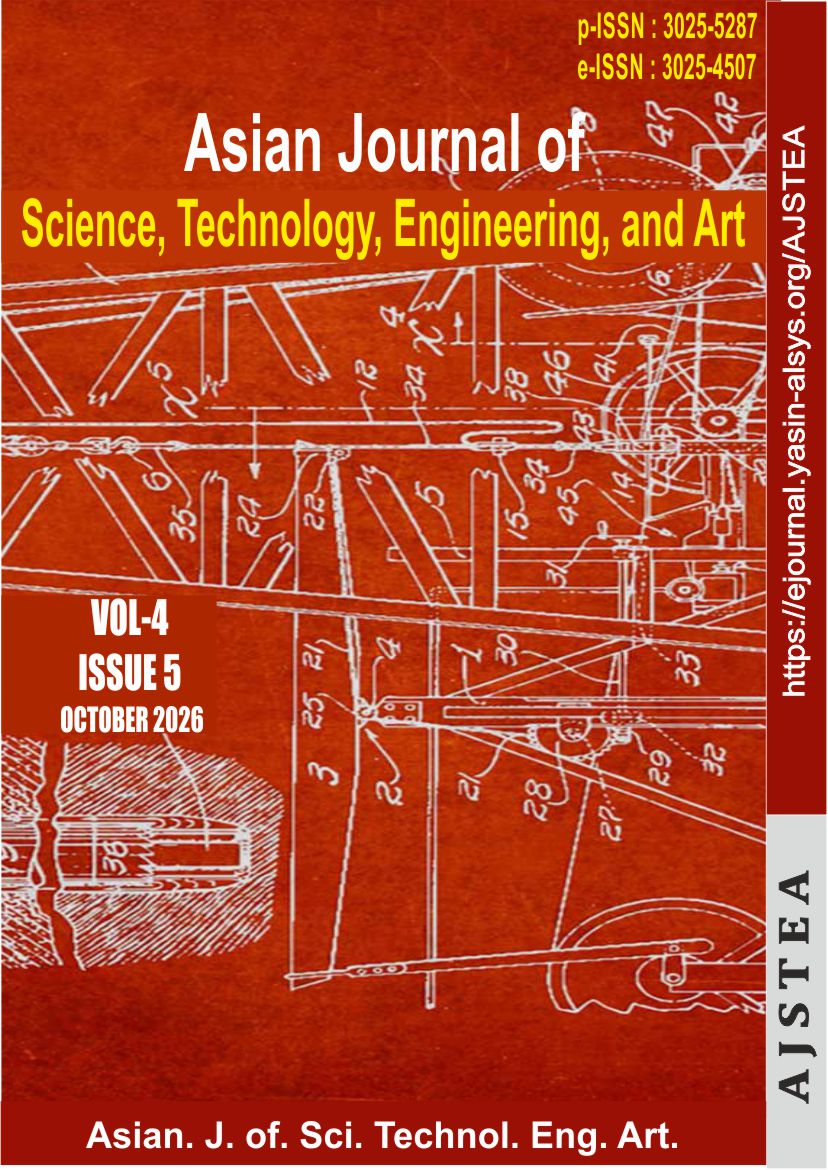
Vol 4 No 5 (2026): Asian Journal of Science, Technology, Engineering, and Art
- Total Articles: -
- Unique Authors: 0
- Unique Affiliations: 0
- Unique Countries: 0
Published: 2026-10-31